
The Complete Reptile Buying Guide: Real Costs, What to Buy & What to Check
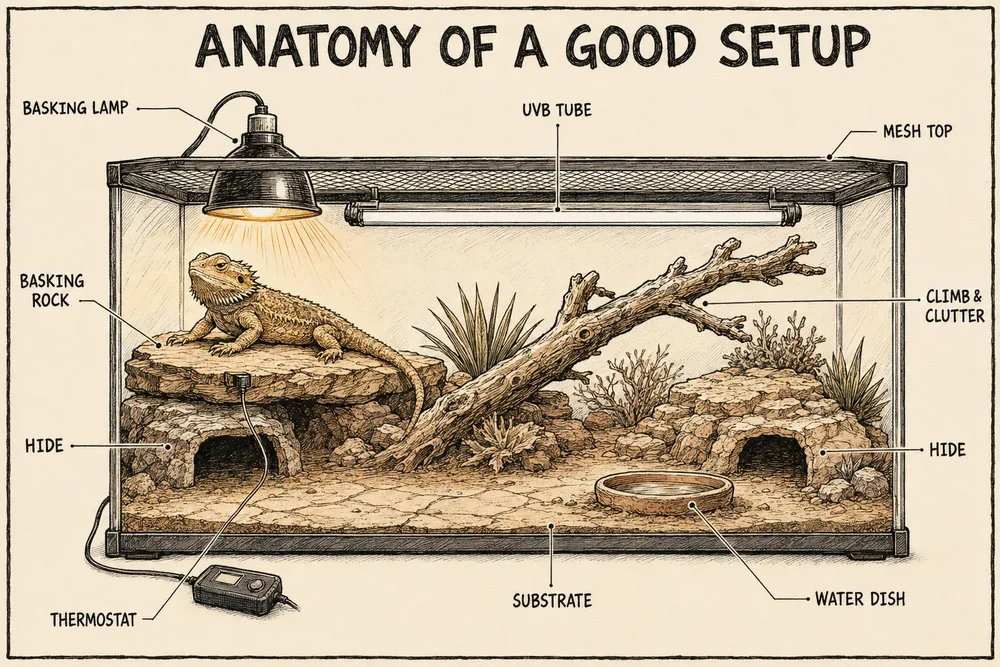
Bringing home your first reptile is exciting — and the single best thing you can do for the animal is buy the setup before you buy the reptile. This is the honest, end-to-end guide: what it really costs, exactly what to buy, where to buy it, and how to spot a healthy animal at the store.
The 30-second version: The animal is usually the cheapest part ($20–200). Budget $150–600+ for the setup depending on species (advanced ones more), and $10–45/month to run it. Buy captive-bred from someone who can answer care questions, check the animal is bright-eyed and well-fleshed before you commit, and build the enclosure — at adult size, with the right heat and UVB — before it comes home.
1. First — is a reptile right for you?
Reptiles are wonderful, quiet, fascinating pets. But before the fun part:
- They’re a long commitment. Leopard geckos live 10–20 years, bearded dragons 8–15+, ball pythons 20–30+, and a tortoise can outlive you. This is a years-to-decades relationship.
- They tolerate handling — they don’t crave it. Reptiles aren’t cuddly pets; most are happiest observed, with calm, occasional handling. Good to know now.
- The setup is the pet. Getting the heat, UVB, humidity and space right is the hobby. A reptile on the wrong setup declines slowly and quietly.
As the evidence-based care resource ReptiFiles cautions:
“just because a reptile is labeled as “good for beginners” doesn’t mean that it’s cheap or a good idea to give to a child as a birthday present. Reptiles are exotic pets, and that means they have very specific needs in order to thrive (or even stay alive, for that matter) in captivity.“
Not sure which species fits you? Start with what’s the best beginner reptile?, then compare any two side by side.
2. What it really costs
Here’s the honest part most shops skip. Costs are driven by the setup type, not the animal. These are rough US-dollar ranges for a single-animal beginner setup — prices vary a lot by country, brand, and whether you buy new or second-hand.
| Setup type | Example species | Starter setup | Monthly running |
|---|---|---|---|
| Beginner snake | Corn snake · ball python · kingsnake · hognose | ~$200–500 | ~$10–20 |
| Ground gecko | Leopard gecko · African fat-tail | ~$200–400 | ~$20–35 |
| Arboreal gecko | Crested · gargoyle | ~$150–400 | ~$15–30 |
| Desert basking lizard | Bearded dragon · uromastyx | ~$300–600 | ~$25–45 |
| Advanced / large | Blue tongue skink · tortoise · chameleon · ackie monitor · tegu | ~$500–1,000+ | ~$25–60 |
The animal itself: usually the cheapest line — most beginner reptiles are $20–200 (a corn snake or leopard gecko is often $30–60; a designer morph, tortoise or monitor more).
The costs people forget:
- Buy for the adult, not the baby. A bearded dragon, tegu, monitor or tortoise needs a big adult enclosure — buying a small one first just means buying twice.
- Lighting is the hidden cost. Strong UVB and a proper basking lamp are where desert lizards get expensive — and UVB bulbs must be replaced roughly yearly (~$30–60/year) even though they still glow.
- Electricity. Heat lamps run for hours a day; factor it in, especially for hot-basking species.
- A vet fund. An exotics vet visit is the big unpredictable cost. Set a little aside — “I can’t afford the vet” is not a position you want to be in with a sick animal.
Snakes are the cheapest reptiles to feed (a frozen/thawed rodent every week or two), while insect-eaters like geckos and dragons cost more month to month for live feeders and supplements.
3. What you actually need — the shopping list
Buy this before the animal. Learn the jargon as you go with the reptile glossary.
Every reptile needs:
- A correctly-sized, secure enclosure (front-opening is easiest) — sized for the adult
- A basking lamp + thermostat, and a thermal gradient (warm end + cool end)
- The right UVB for the species (see do reptiles need UVB & a heat lamp? and the UVB-by-species guide)
- A digital thermometer + hygrometer (guessing temps/humidity is how animals get hurt)
- At least two hides (warm and cool) and a water dish
- Species-appropriate substrate
Beginner snakes: a 4×2×2 ft secure enclosure, overhead heat on a thermostat, tight hides at both ends, and frozen/thawed rodents (never leave live prey unattended). Corn snakes are escape artists — check the lid.
Ground & arboreal geckos: a leopard gecko wants a horizontal desert setup with a humid hide; a crested gecko wants a tall planted enclosure, no hot lamp (keep under ~82°F), and can eat a complete powdered diet.
Desert basking lizards (beardie, uromastyx): the biggest, hottest, brightest setup — a large enclosure, a powerful basking lamp, strong linear T5 UVB, and (for a beardie) daily salad. Use the setup checker against the fact-checked targets.
For any UVB/heat species, set up and dial in the temperatures with a thermostat and thermometer before the animal arrives — not after.
4. Where to buy
In rough order of best to riskiest:
- A reputable breeder — best health, best information, captive-bred, and they’ll answer your questions honestly.
- A reptile expo — many breeders in one place; inspect the animal and ask about its history in person.
- A specialist reptile shop — good ones keep animals well and know their care.
- A rescue — a kind, rewarding option; just go in knowing the animal’s history may be unclear.
Rules whatever you choose:
- Ask: captive-bred or wild-caught? Choose captive-bred (CB) — wild-caught reptiles are stressed, often carry parasites, adapt poorly, and their collection harms wild populations. (Wild-caught vs captive-bred: why it matters, and how to tell.)
- Avoid impulse-buying from a big-box store where staff can’t answer basic care questions. The setup has to exist and be dialled in first.
- Never buy — or pick up — a wild-caught, unidentified snake. If you ever need a wild snake identified, that’s a job for an expert and your regional wildlife authority, from a safe distance.
5. How to spot a healthy reptile at the store
You can’t diagnose from the shop floor, but you can triage. Favour an animal that shows:
- Clear, bright eyes and a clean nose and mouth — no bubbles, mucus, or crusting
- A rounded, well-fleshed body and tail — not bony, sunken hips, or a thin “pencil” tail (a fat tail is a healthy gecko)
- Clean, intact skin — no retained shed on toes/tail, sores, or tiny moving dots (mites, often near the eyes and vent)
- Alertness — responsive and able to grip/right itself, not limp
- Clean housing without obviously sick enclosure-mates
Walk away (don’t “rescue” on impulse) if you see: a thin or wasting body, lethargy, open-mouth breathing or noise/mucus when breathing, a soft or rubbery jaw, stargazing (star-gazing/twisting the head up), sunken eyes, or mites. These need a vet, and buying a sick animal on impulse — without a quarantine setup ready — usually ends badly for you and the animal.
If you can, ask to see it eat. A strong feeding response is one of the best signs of a healthy reptile.
6. Bringing it home
- Quarantine first. Keep a new reptile in a simple, separate, easy-to-clean setup for several weeks (mites and infections can take time to show). It protects your whole collection.
- Leave it alone to settle. Minimal handling for the first week or two while it adjusts — a new reptile that hides and skips a meal or two is usually just settling in. See your reptile’s first two weeks.
- Watch, don’t panic. Learn what normal looks like for your species with the is this normal? tool, and keep an exotics vet’s number handy.
🦎 Do the boring part first — budget honestly, buy the setup at adult size, dial in the heat and UVB, choose a bright-eyed captive-bred animal — and the fun part takes care of itself. You’ve got this.
Go deeper: best beginner reptile · compare two species · do reptiles need UVB & heat? · browse all species · reptile glossary · reptile questions answered.
Sources & further reading
Cost ranges are compiled from current keeper price guides and should be treated as rough estimates that vary by region and retailer:
- Dragon’s Diet — budgeting for a bearded dragon and About Bearded Dragons — setup cost
- Terrarium Quest — leopard gecko cost and My Crested Gecko — cost breakdown
- ExoPetGuides — corn snake cost and Terrarium Quest — ball python cost
- ReptiFiles — Best Reptiles for Beginners — the quoted line on beginner reptiles not being cheap or low-need is reproduced verbatim.
Written and fact-checked by The Baskden Team against current husbandry sources. Honest general guidance, not veterinary advice — for a sick animal, see a reptile vet.
Common questions
How much does it cost to set up a pet reptile?
It depends far more on the setup type than the animal. A rough US-dollar guide: a beginner snake (corn snake, ball python) around $200–500; a ground gecko like a leopard gecko $200–400; an arboreal gecko like a crested gecko $150–400; a desert basking lizard like a bearded dragon $300–600 (the strong lighting is the pricey part); and advanced species (blue tongue skink, tortoise, chameleon, monitor, tegu) $500–1,000+ for a proper adult setup. The animal itself is usually the cheapest part ($20–200).
What's the ongoing monthly cost of a pet reptile?
Roughly $10–45 a month. Snakes are the cheapest to feed (a frozen/thawed rodent every 1–2 weeks, ~$10–20/month); insect-eaters like leopard geckos, crested geckos and bearded dragons cost more for live feeders and supplements (~$20–45). Don't forget yearly UVB bulb replacement (~$30–60), electricity for heat lamps, and a fund for an exotics vet.
Is the reptile or the setup more expensive?
The setup, almost always. Most beginner reptiles cost $20–200, but a correct enclosure with the right heating, UVB and space usually costs several times that — a bearded dragon's lighting alone can approach the price of the animal many times over. Budget for the whole habitat, at adult size, before you buy.
Where should I buy a pet reptile?
Buy captive-bred, from a reputable breeder, a reptile expo, or a specialist reptile shop (or adopt from a rescue) — and ask whether the animal is captive-bred (CB) or wild-caught (WC). Choose captive-bred: wild-caught reptiles are stressed, often carry parasites, and their collection harms wild populations. Avoid impulse-buying from a big-box store where staff can't answer care questions, and never buy or handle a wild-caught, unidentified snake.
How do I know if a reptile is healthy before I buy it?
Look for clear bright eyes, a clean nose and mouth (no bubbles or mucus), smooth skin with no retained shed, sores or tiny moving mites, a rounded well-fleshed body and tail, and an alert, responsive animal. Ask to see it eat. Walk away from an animal that's thin or sunken, lethargic, gaping or making noise when it breathes, has a rubbery jaw, stargazes, or is kept in dirty conditions — and never 'rescue' a sick shop animal on impulse without a quarantine setup ready.