
Reptile UVB Lighting: Ferguson Zones and the Right UVI for Your Species
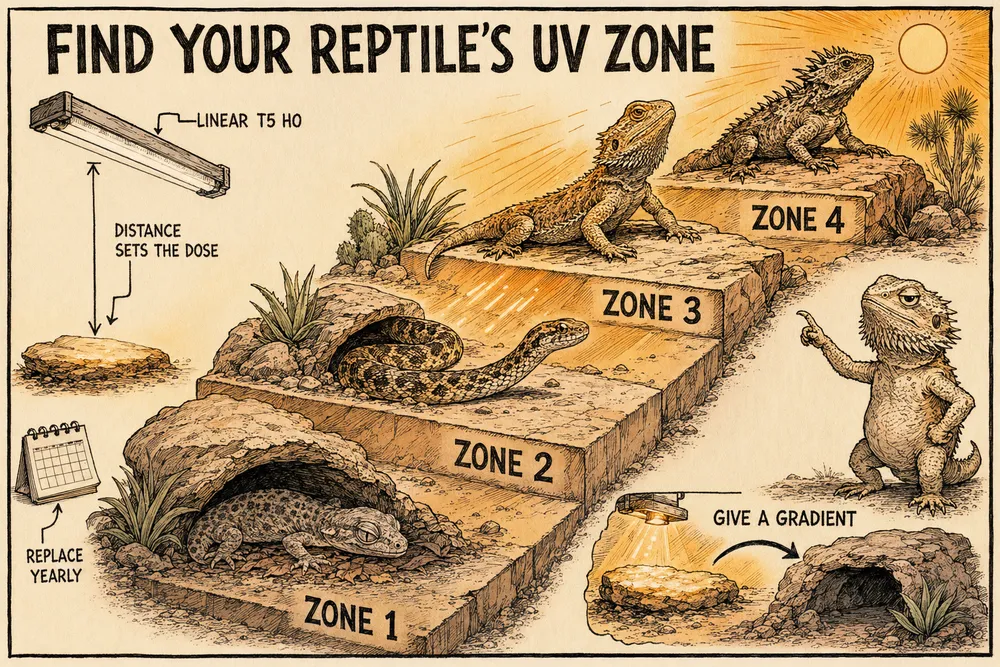
“Does my reptile need UVB?” is the beginner question. The deeper, more useful question is “how much?” — because a leopard gecko and a uromastyx both need UVB, but one wants a gentle glow and the other wants a desert sun. The tool that answers it is the Ferguson Zone system, and the number it gives you is the UV Index (UVI) at the basking spot. This is the companion to our does my reptile need UVB and a heat lamp? guide — the same principles, gone deep, with a fact-checked target for every species we cover.
☀️ The 30-second answer: UVB lets reptiles make vitamin D3 to use calcium — too little causes metabolic bone disease (MBD). How much a species needs is set by its Ferguson Zone (1–4) and measured as UVI at the basking spot: crepuscular geckos (Zone 1) want ~0.5–2.0; occasional-basking snakes (Zone 2) ~2.0–3.0; open-sun baskers like beardies, skinks, tortoises, chameleons, tegus and monitors (Zone 3) ~3.0–4.0; extreme desert baskers like uromastyx (Zone 4) ~4.5–6.0. Use a linear T5 HO bulb at the right distance, always provide a gradient down to shade, and replace it every 12 months (UVB fades before the light dies).
Why UVB matters
In the wild, sunlight’s UVB lets a reptile’s skin synthesise vitamin D3, which it needs to absorb and use calcium. Without enough UVB (and without heavy dietary D3 to compensate), a reptile slowly develops metabolic bone disease — soft, bendy, or fractured bones, a rubbery jaw, tremors, and weakness. MBD is one of the most common illnesses in captive reptiles, and it’s almost entirely preventable with correct lighting. The flip side is real too: too much UV can damage eyes and skin. As the peer-reviewed UV-Tool puts it plainly, “Excessive exposure to UV must, however, be avoided” — high doses, or the unnaturally short-wavelength UV thrown by some cheap lamps, can cause eye and skin damage.¹ So the goal isn’t “maximum UVB” — it’s the right amount for the species, with shade to escape into.
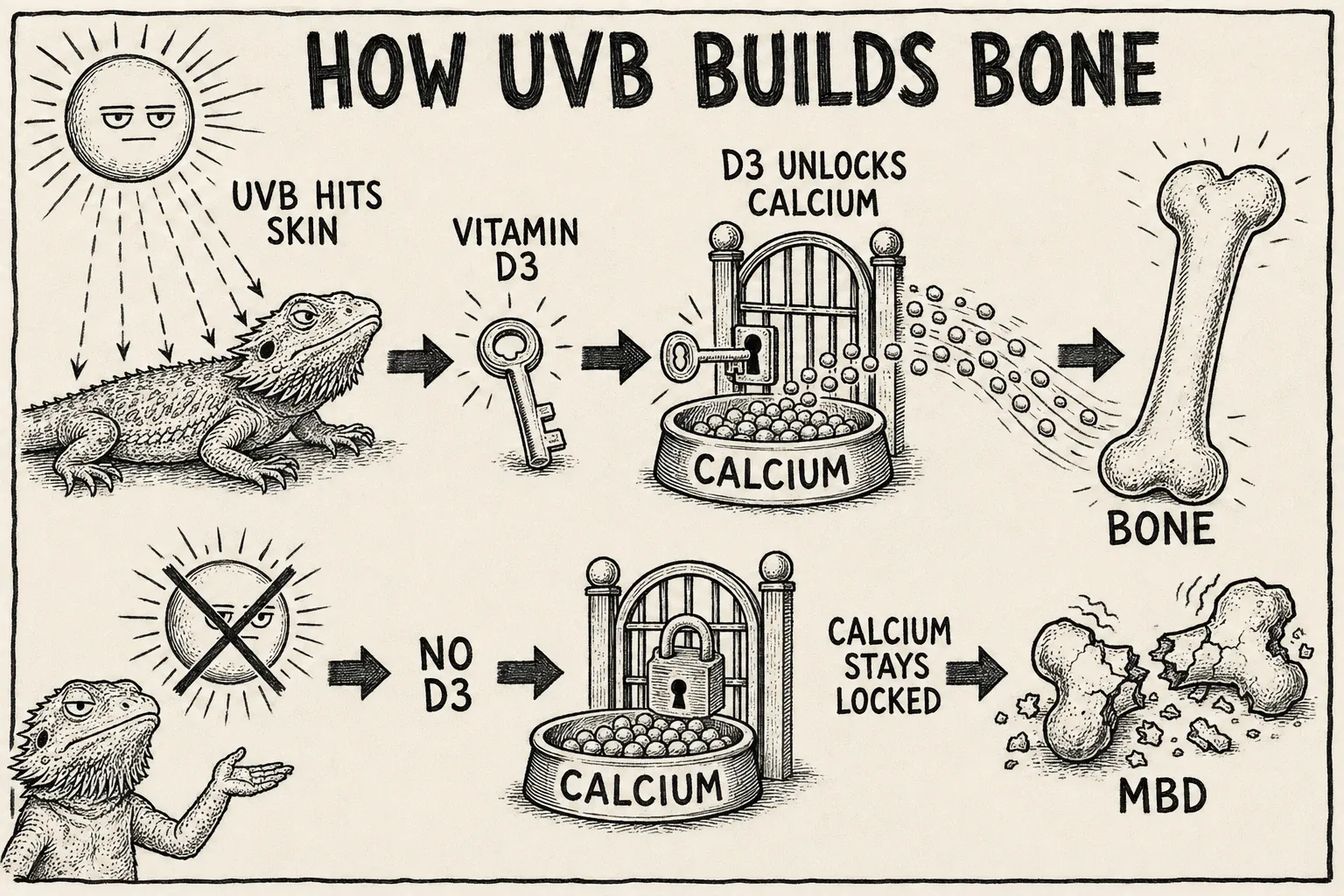
The whole chain in one picture: UVB → vitamin D3 (the key) → D3 unlocks calcium → strong bone. No UVB means no D3, the calcium stays locked away, and bones soften into metabolic bone disease (MBD).
The four Ferguson Zones
Dr Gary Ferguson studied how much UV different reptiles actually expose themselves to in the wild; the Baines UV-Tool — compiled by the British and Irish Association of Zoos and Aquaria (BIAZA) — expanded this into a system covering hundreds of species. Frances Baines — the reptile-lighting researcher whose UV-Tool underpins this whole system — and her co-authors set captive lighting “by considering the range of UV experienced by each species in the wild” in their peer-reviewed paper, because *“an animal’s UV-B exposure is determined by its behaviour within its native microhabitat.”*¹ In other words, the right amount of UVB isn’t a universal number — it’s whatever that species would meet under its own patch of sky. Everything sorts into four zones, measured by UV Index (UVI) — the same UV scale used in weather forecasts, read at the basking spot with a UV meter:
| Zone | Type | Typical UVI range | Feel of it |
|---|---|---|---|
| 1 | Crepuscular / shade-dweller | ~0–0.7 (max ~1.4) | A little dappled light; active at dawn/dusk |
| 2 | Partial-sun / occasional basker | ~0.7–1.0 (max ~3.0) | Basks sometimes, otherwise in cover |
| 3 | Open or partial-sun basker | ~1.0–2.6 (max ~7.4) | A committed daytime basker |
| 4 | Extreme sun-lover | ~2.6–7.4+ | Out in the desert midday sun |
A crucial rule for the higher zones: provide a gradient. A Zone 3 or 4 reptile needs a hot, high-UV basking spot and shaded areas down at Zone 1 levels, so it can photoregulate — move in and out of the UV as it needs. A single blanket of intense UV with nowhere to escape can cause harm.
The right UVI for your species
Here’s the practical payoff — a fact-checked basking-spot UVI target for every species we cover, grouped by zone. These are the same numbers in each species’ care guide, so a click takes you to the full setup. Prefer to just pick your species and get the number? Use the free UVB helper tool.
Low UVB — crepuscular geckos (Ferguson Zone 1)
| Species | Basking UVI target | Notes |
|---|---|---|
| 🦎 Leopard gecko | 0.5–1.5 | 0.5–0.7 for pale/albino morphs |
| 🦎 African fat-tailed gecko | 1.0–2.0 | Nocturnal; low and gentle |
| 🦎 Crested gecko | 1.0–2.0 | Also gets D3 from a complete diet |
| 🦎 Gargoyle gecko | 1.0–2.0 | As the crestie |
Moderate UVB — beginner snakes (Ferguson Zone 2)
| Species | Basking UVI target | Notes |
|---|---|---|
| 🐍 Ball python | 2.0–3.0 | Recommended, not strictly required |
| 🐍 Corn snake | 2.0–3.0 | |
| 🐍 California kingsnake | 2.0–3.0 | Diurnal, benefits from it |
| 🐍 Milk snake | 2.0–3.0 | |
| 🐍 Western hognose | 2.0–3.0 | Fossorial; a low-Zone-2 species |
Strong UVB — open-sun baskers (Ferguson Zone 3)
| Species | Basking UVI target | Notes |
|---|---|---|
| 🦎 Bearded dragon | 4.0–4.5 | No more than 3.0 for silkback/scaleless |
| 🦎 Blue tongue skink | 3.0–4.0 | Forest types a touch lower than Australian |
| 🦎 Veiled chameleon | ~3.0 | Needs a real gradient + bright daylight |
| 🐢 Russian tortoise | 3.0–4.0 | Plus a bright 6500K daylight lamp |
| 🦎 Argentine tegu | 3.0–4.0 | Big enclosure — span the bulb well |
| 🦎 Ackie monitor | 3.0–4.0 | Pairs with its extreme basking heat |
Extreme UVB — desert sun-worshippers (Ferguson Zone 4)
| Species | Basking UVI target | Notes |
|---|---|---|
| 🦎 Uromastyx | 4.5–6.0 | The highest UVB of any species here |
(A note on precision: field-research zone boundaries and practical husbandry targets don’t always line up to the decimal — these are the recommended basking-spot UVI values from the Baines UV-Tool and reputable care references. Always give the animal shade to move into.)
Choosing, placing, and replacing the bulb
Getting the number right only helps if the setup delivers it:
- 💡 Use a linear T5 HO tube (or a matched UVB kit), not a coil/compact bulb. Linear tubes give even, reliable UVB across the enclosure; cheap coils give patchy output and have a history of eye problems. Reputable brands (e.g. Arcadia, Zoo Med T5 HO) matter here.
- 📏 Distance is everything. UVI drops off fast with distance, so the bulb’s height above the basking spot sets the actual UVI. Follow the manufacturer’s distance chart for your target UVI — and remember mesh cuts UVB (mount over mesh at a closer distance, or account for the loss).
- 🌗 Build a gradient. Especially for Zone 3–4 species, give a high-UV basking area and shaded, low-UV retreats. The animal should be able to choose its exposure.
- 🔬 A UV meter is the gold standard. A Solarmeter (6.5) lets you measure the actual UVI at the basking spot and place the bulb precisely — the only way to know rather than guess.
- 📅 Replace it every ~12 months. A UVB bulb’s UV output fades long before its visible light does — a tube that still looks bright can be producing almost no useful UVB. Mark the date; don’t wait for it to “burn out.”
- 🌒 Mind the light-sensitive morphs. Pale, albino, and silkback/scaleless animals should sit at the low end of their range with extra shade.
The signs you got it wrong
Because MBD develops slowly, watch for the early signs — and treat them as a vet trip, not a wait-and-see: a soft or rubbery jaw, bowing or bent limbs, tremors or twitching, weakness, or difficulty climbing/standing. If you see these, review the UVB (bulb type, distance, age) and diet/calcium immediately, and see a reptile vet.
💚 UVB is the single piece of husbandry most worth getting precisely right — not “a bulb in there somewhere,” but the correct UVI for your species, delivered by a good linear tube at the right distance, with shade to escape into, replaced once a year. Match the number to the animal and MBD becomes a problem you simply never have.
Go deeper: the UVB helper tool (your species’ zone & UVI target in one click) · does my reptile need UVB and a heat lamp? (the beginner hub) · is my reptile sick? · the setup checker · your species’ care guide for its full lighting setup.
Sources & further reading
This guide was written and fact-checked against these authorities. It’s kind, general husbandry guidance — not a diagnosis or a substitute for a reptile vet:
- ¹ Baines F, Chattell J, Dale J, Garrick D, Gill I, Goetz M, Skelton T, Swatman M (2016). “How much UV-B does my reptile need? The UV-Tool, a guide to the selection of UV lighting for reptiles and amphibians in captivity” — Journal of Zoo and Aquarium Research 4(1): 42–63. The peer-reviewed Ferguson-Zone framework (both quoted lines above are from this paper’s abstract and introduction).
- ReptiFiles — a keeper-facing application of the Ferguson-Zone framework across its per-species care guides, and a source of the per-species basking-UVI targets in the table above.
- Arcadia Reptile — reptile UVB lighting, Ferguson Zones, and bulb selection/placement.
- Association of Reptilian & Amphibian Veterinarians (ARAV) — reptile veterinary care and metabolic bone disease.
- Merck Veterinary Manual — reptiles — metabolic bone disease and vitamin D / calcium metabolism.
Written and fact-checked by The Baskden Team against veterinarian-authored sources — metabolic bone disease needs veterinary care, so if your reptile shows soft bones, a rubbery jaw, tremors, or weakness, correct the UVB and see a reptile/exotics vet.
Common questions
What is a Ferguson Zone?
A Ferguson Zone is a way of grouping reptiles by how much sun — and therefore how much UVB — they naturally expose themselves to. Based on Dr Gary Ferguson's field research and expanded by the Baines UV-Tool, reptiles fall into four zones, from Zone 1 (crepuscular and shade-dwelling species that get very little UV) up to Zone 4 (extreme sun-lovers that bask through the desert midday). Your species' zone tells you the target UV Index (UVI) to provide at its basking spot.
How much UVB does my reptile need?
It's measured as UV Index (UVI) at the basking spot, and it depends on the species. Crepuscular geckos (Zone 1) want just a little — roughly UVI 0.5–2.0. Occasional-basking snakes (Zone 2) want about 2.0–3.0. Open-sun baskers like bearded dragons, blue tongue skinks, tortoises, chameleons, tegus and monitors (Zone 3) want around 3.0–4.0. Extreme desert baskers like uromastyx (Zone 4) want the most, around 4.5–6.0. Whatever the target, the reptile also needs shade to move into, so you provide a gradient, not a single blast.
Do snakes and leopard geckos need UVB?
Modern husbandry says yes — low-level UVB benefits them, even though they're crepuscular and were long kept without it. Leopard geckos, crested geckos and most beginner snakes sit in the low zones (Ferguson Zone 1–2), so they need only gentle UVB — roughly UVI 0.5–1.5 for a leo and 2.0–3.0 for a colubrid snake — not the intense lighting a bearded dragon needs. Pale, albino, or 'silkback' morphs are extra light-sensitive and should be kept at the very low end.
What kind of UVB bulb should I use, and how often do I replace it?
Use a linear T5 HO fluorescent tube (or a suitable UVB kit) rather than a coil/compact bulb — linear tubes give even, reliable coverage across the enclosure. Mount it the correct distance above the basking spot for your species' UVI (mesh reduces UVB, so account for that), and provide shade so the animal can move out of the UV. Replace the UVB bulb roughly every 12 months: its UVB output fades long before the visible light goes out, so a bulb that still 'works' can be producing almost no useful UVB.
What happens if a reptile gets too little UVB?
Without enough UVB (or dietary D3), a reptile can't properly use the calcium in its food, which leads to metabolic bone disease (MBD) — soft or bent bones, a rubbery jaw, tremors, and weakness. It's one of the most common and preventable illnesses in captive reptiles. Too much UVB has its own risks (eye and skin damage), which is why the goal is the right UVI for the species with a gradient down to shade — not simply 'as much as possible'.