
Does My Reptile Need UVB and a Heat Lamp?
🔍 Fact check
“A heat lamp is enough — most reptiles don't really need UVB.” — Old care sheets and starter-kit advice
Verdict: False
A heat lamp provides warmth, not UVB — they are different things. UVB is a specific wavelength (roughly 290–320 nm) that lets a reptile make vitamin D3 and use calcium; without enough of it, UVB-dependent species like bearded dragons develop metabolic bone disease, one of the most common serious reptile illnesses. Sun-basking species need strong UVB and even shade-dwellers are now given a low level. Heat alone does not cover it.
The evidence:
- UVB, not a heat lamp, is what makes vitamin D3. The RSPCA: "UVB allows the lizard to make essential vitamin D3 in its skin, which is used to store and use essential calcium. UVB does not pass through glass" (RSPCA).
- Too little UVB causes metabolic bone disease. VCA: metabolic bone disease "is one of the more common diseases in pet bearded dragons... caused either by a direct nutritional deficiency of vitamin D3 or a lack of exposure to the UV-B light required for lizards to make vitamin D3 in their skin" (VCA Animal Hospitals).
- A heat bulb is not a UVB source. VCA: the bulb "should emit light in the UV-B range (290-320 nanometers)" and "must reach the pet in an unfiltered form, so there must be no glass or plastic between the pet and the light" — a plain heat lamp does neither (VCA Animal Hospitals).
- Baskers need strong, correctly-placed UVB — and bulbs fade. ReptiFiles gives bearded dragons a desert-strength basking UVI of 4.0–4.5 and warns "UVB bulbs must be replaced regularly... Just because it's still producing visible light does NOT mean that it's still producing UVB!" (ReptiFiles).
If there’s one place reptile keeping goes wrong, it’s here — heat and light. It’s also the most fixable, because once you understand why a reptile needs what it needs, the numbers make sense and the pet-store myths fall away. Reptiles are ectotherms: they run their entire body — digestion, movement, immune function, bone health — on heat and light they take from their environment. Get this right and most other problems never appear. Get it wrong and you get the two classic, preventable tragedies: metabolic bone disease and thermal burns. Here’s the honest, plain-English version.
☀️ The 30-second answer: every reptile needs a measured warm-to-cool gradient so it can choose its temperature — not one flat temperature. Most also need UVB: a bearded dragon must have strong UVB, and geckos and snakes now benefit from low-level UVB (the “they don’t need it” line is outdated). UVB → vitamin D3 → usable calcium → no metabolic bone disease. The big myths to drop: coil bulbs, heat rocks, heat-mat-only for baskers, and “bone dry, no UVB”. Measure with a thermometer and UV meter — never guess. Tick your numbers against the fact-checked targets with the setup checker.
📊 This is the defining reptile challenge. In our analysis of 388 real reptile-keeping questions, heat and UVB was its own major category — about 10% of all care questions — the topic that most sets reptiles apart from other pets.
Why heat matters (it’s not just comfort)
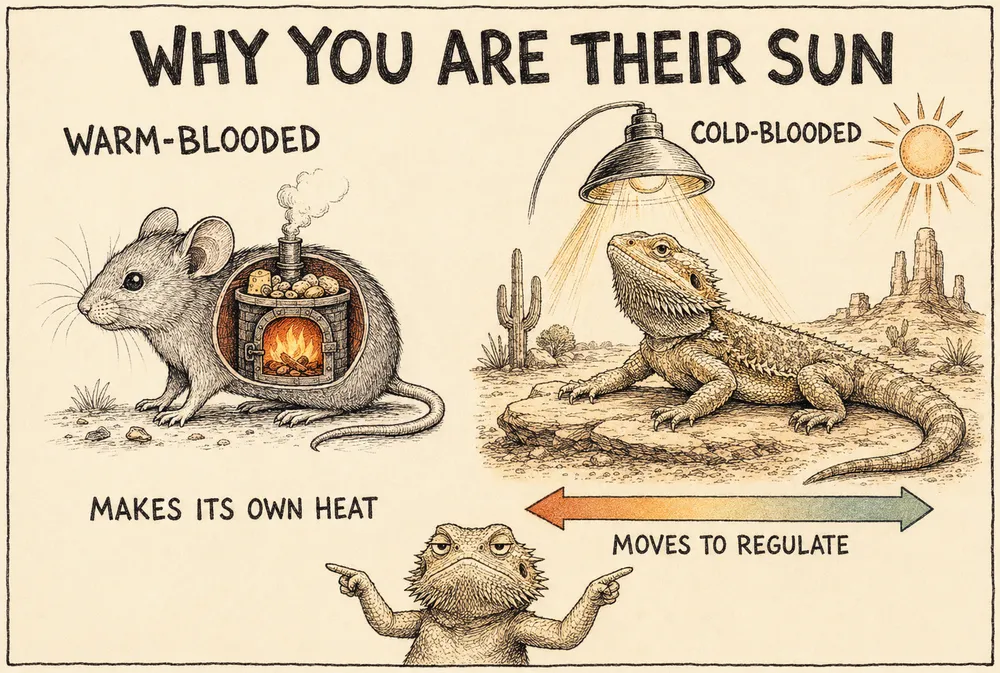
A reptile can’t generate its own body heat, so it moves between warm and cool zones to regulate itself — basking to warm up, retreating to cool down. That gradient does real work:
- 🌡️ Digestion. A reptile that’s too cold physically can’t digest a meal — which is why “too cold” is the number-one reason behind a reptile that won’t eat.
- 🛡️ Immune function. Chronically cool reptiles get sick more easily; respiratory infections in snakes are strongly linked to being kept too cool.
- ⚡ Everything else — activity, appetite, and general thriving all depend on correct warmth.
The key idea is the gradient: a genuine warm end and a cool end, so the animal chooses. One uniform temperature — too hot or too cold everywhere — is a common and serious mistake.
Why UVB matters (this is the one that prevents MBD)
UVB light lets a reptile’s skin make vitamin D3, which lets it absorb and use calcium. No usable calcium means the body strips it from the bones — and that’s metabolic bone disease: soft rubbery jaws, bent limbs, tremors, fractures. It is one of the most common reasons reptiles end up at the vet, and it is almost entirely preventable. The Merck Veterinary Manual’s reptile-nutrition guidance — peer-reviewed by board-certified exotic-animal vet João Brandão (DECZM, DACZM) — makes the key point: “UVB exposure, rather than dietary vitamin D, may be critically important in the production of active vitamin D in the skin of green iguanas and in the subsequent prevention of bone fractures.“¹ That study was in green iguanas, but the mechanism is shared across basking reptiles — which is why UVB, not just a calcium dusting, is what actually prevents MBD.
Here’s the modern, evidence-based position that the pet trade is slow to catch up with:
- Bearded dragons must have strong UVB. It’s non-negotiable — a desert basker without proper UVB will develop MBD.
- Leopard geckos, crested geckos and snakes now benefit from low-level UVB. They’re crepuscular or nocturnal, so they need far less than a beardie — but “none at all” is outdated advice. A gentle amount improves their long-term health.
- A coil/compact bulb is not enough for a species that needs real UVB. Use a linear T5 HO tube at the correct strength and distance.
- UVB bulbs expire. They stop emitting useful UVB long before they stop glowing — replace roughly every 12 months.
The numbers, species by species
This is where the sourced detail lives. Every figure below is fact-checked in that species’ care guide:
| Species | Basking / warm zone | UVB (UVI target) | The heat headline |
|---|---|---|---|
| 🦎 Bearded dragon | 108–113°F basking surface | 4.0–4.5 (strong; max 3.0 for silkbacks) | Strong overhead heat and strong UVB — both essential |
| 🦎 Leopard gecko | 94–97°F warm surface / 90–92°F warm hide | 0.5–1.5 (0.5–0.7 pale morphs) | Belly-height warmth from overhead heat — never a heat rock |
| 🦎 Crested gecko | Room temp 72–78°F; max ~82–85°F | 1.0–2.0 (low) | The exception: overheating kills — keeping it cool matters most |
| 🐍 Ball python | 86–90°F warm side | 2.0–3.0 (recommended) | Gentle warm end + full gradient; overhead heat in a real enclosure |
| 🐍 Corn snake | 90°F basking spot | 2.0–3.0 (recommended) | Warm-to-cool gradient on a thermostat |
Notice the crested gecko flips the whole logic: for that one, your job is keeping it cool enough, because sustained temperatures above the mid-80s°F cause fatal heat stress. Every species is different — match yours, don’t average them.
The myths that cause real harm
This is our “current husbandry, not folklore” section — the pet-store advice that keeps causing preventable illness, kindly corrected:
- ❌ “Reptiles don’t need UVB / a coil bulb is fine.” For a bearded dragon this causes MBD; for others it’s a missed benefit. Use the right linear T5 HO bulb for the species.
- ❌ “Heat rocks keep them cosy.” Heat rocks cause serious belly burns and are a classic vet emergency. Skip them entirely — reptiles take heat from above, like the sun.
- ❌ “A heat mat is all a lizard needs.” Not for a basking lizard: belly heat can’t replace an overhead basking zone. (Mats have a limited role for some snakes.)
- ❌ “A coloured night bulb keeps them warm safely.” Reptiles need darkness at night; a natural temperature drop is healthy. If your home is genuinely cold, use a non-light source (ceramic emitter or radiant panel) on a thermostat.
- ❌ “Keep it bone-dry with a blazing bulb.” Wrong on both counts for most species — humidity matters too, which is its own topic (see humidity & shedding).
Measure it — don’t guess
You cannot eyeball a temperature or a UV index. The tools are cheap next to a vet bill:
- A digital probe thermometer or infrared temp gun at the basking surface — the spot the animal actually sits, not the air, and not a stick-on dial that reads the glass.
- A thermostat controlling the heat source, so it can’t run away and cook or burn the animal.
- A UV index meter (a Solarmeter is the standard) — or, if you don’t have one, follow the published Ferguson-zone chart for your exact bulb and mounting height. Ferguson Zones rank species by how much sun they seek: shade-dwellers like leopard and crested geckos sit in Zone 1 (low), while bearded dragons are high-zone baskers.
Re-check whenever you change a bulb, the distance, or the enclosure. Run your whole setup through the setup checker to see what’s dialled in and what’s your next fix.
The red flags of getting it wrong
Bad heat and light show up on the animal. See a reptile/exotics vet for:
- 🦴 A soft or rubbery jaw, bent or weak limbs, tremors, or trouble moving — signs pointing to metabolic bone disease (a UVB/calcium failure).
- 🔥 Burns — blistered, discoloured, or damaged skin on the belly or side, often from a heat rock or an unguarded bulb.
- 🥵 Overheating (especially crested geckos) — gaping, lethargy, or collapse in heat is an emergency: cool the animal down and call a vet.
- 🥶 Chronic cold — persistent lethargy, not digesting, and not eating despite everything else looking right.
These are covered alongside the other warning signs in Is my reptile sick?
The honest part
We can’t set up your enclosure from afar, and getting lighting right takes a little reading — but it is learnable, and it’s the single highest-value thing you can do for your reptile. Build a measured warm-to-cool gradient, give the right UVB for the species, bin the heat rock and the coil bulb, and measure rather than guess. If MBD or a burn is already showing, that’s a vet visit, not a DIY fix.
Find the detail for your reptile
Every species has its own exact numbers and bulb recommendations:
| Your reptile | Care guide |
|---|---|
| 🦎 Bearded dragon | Bearded dragon care |
| 🦎 Leopard gecko | Leopard gecko care |
| 🦎 Crested gecko | Crested gecko care |
| 🐍 Ball python | Ball python care |
| 🐍 Corn snake | Corn snake care |
💚 Lighting is where good keeping is won. It feels technical at first, but it comes down to a simple idea: give your reptile a warm end and a cool end, the right UVB for its kind, and a way to measure both. Do that and you’ve prevented most of what sends reptiles to the vet.
Go deeper: the UVB helper (your species’ exact UVI target) · the Ferguson zones & UVI-by-species guide · the setup checker · humidity & shedding · Is my reptile sick? · more real questions in the Baskden Q&A.
Sources & further reading
This guide was written and fact-checked against these authorities. It’s kind, general husbandry guidance — not a diagnosis or a substitute for a reptile vet:
- ReptiFiles — evidence-based temperature and UVB targets (UVI figures, Ferguson zones) for each species.
- Arcadia Reptile — lighting science, Ferguson zones, and UV-meter guidance.
- Association of Reptilian & Amphibian Veterinarians (ARAV) — reptile veterinary care and a find-an-exotics-vet directory.
- ¹ Merck Veterinary Manual, “Nutrition in Reptiles” — by Joeke Nijboer, PhD & Anouk Fens, MSc; peer-reviewed by João Brandão, LMV, DECZM (Avian), DACZM (Colorado State University). The quoted line on UVB and bone-fracture prevention (page updated Oct 2025). See also the wider reptile section for MBD, thermal burns, and respiratory disease.
Written and fact-checked by The Baskden Team against veterinarian-authored sources — if your reptile shows signs of metabolic bone disease, a burn, or overheating, see a reptile/exotics vet promptly.
Common questions
Does my reptile need UVB?
It depends on the species, but the modern answer for most is yes. A bearded dragon absolutely must have strong UVB — going without is a leading cause of illness. Leopard geckos, crested geckos and snakes are now recommended to have low-level UVB even though they're not sun-baskers; the old 'they don't need it' advice is outdated. UVB lets a reptile make vitamin D3 and use calcium, which prevents metabolic bone disease. The amount differs hugely by species, so match the strength to yours.
Does my reptile need a heat lamp?
Almost all of them need a source of heat, because reptiles are cold-blooded and can't warm themselves — but the type and temperature vary. Basking species like bearded dragons need a hot overhead basking zone; snakes need a gentler warm end; and crested geckos are the exception, thriving at ordinary room temperature and actually at risk of overheating. What every species needs is a measured warm-to-cool gradient so the animal can choose its temperature — not one uniform temperature.
Are heat rocks and heat mats safe for reptiles?
Heat rocks are best avoided entirely — they cause serious belly burns and are a common vet emergency. Heat mats have their place for some snakes, but they are not enough on their own for a basking lizard, which needs heat from above (like the sun) to thermoregulate properly. In a correctly-sized enclosure, most reptiles are best heated by an overhead source on a thermostat, with the temperature measured at the basking surface.
What is metabolic bone disease in reptiles?
Metabolic bone disease (MBD) is a common, painful and largely preventable condition caused by a lack of usable calcium — usually from missing or inadequate UVB, poor supplementation, or both. The bones soften and deform: signs include a soft or rubbery jaw, bent or weak limbs, tremors, and difficulty moving. It's one of the most frequent reasons reptiles see a vet, and the tragedy is that correct UVB and calcium prevent nearly all of it.
How do I measure reptile temperature and UVB?
Measure temperature at the basking surface with a digital probe thermometer or an infrared temp gun — never a cheap stick-on dial, which reads the glass, not the animal's spot. For UVB, the gold standard is a Solarmeter UV index meter; if you don't have one, follow the Ferguson-zone chart for your exact bulb and mounting distance. The key principle is the same for both: measure, don't guess, and re-check when you change anything.