
Will Sand or Loose Substrate Give My Reptile Impaction?
🔍 Fact check
“Loose substrate like sand causes impaction, so reptiles must be kept on paper towel or tile.” — Cautionary pet-shop and forum advice
Verdict: Misleading
Impaction is almost always driven by husbandry — too-cool temperatures, dehydration, poor diet or illness — not by loose substrate on its own, so a healthy, warm, hydrated reptile on a suitable naturalistic substrate is at low risk. The important exception: a few products, especially calcium/'calci-sand', genuinely are dangerous and best avoided. So 'all loose substrate causes impaction' is misleading, but 'any substrate is fine' is wrong too.
The evidence:
- Calci-sand specifically is flagged as dangerous. The RSPCA names calcium-sand as a risk because reptiles ingest it and, when temperatures are too low for good digestion, it can clog the gut and cause a blockage (RSPCA).
- Impaction is a husbandry problem more than a substrate one. ReptiFiles states impaction is "almost always caused by bad husbandry" — when the environment is too cold or the animal is unwell, it cannot digest properly (ReptiFiles).
- The real causes are the drivers to fix first. ReptiFiles lists the causes of impaction as dehydration, low basking temperatures, poor heating, poor diet, overeating, insufficient UVB and illness — husbandry factors, not sand alone (ReptiFiles).
- Healthy, well-kept reptiles can use naturalistic substrate. The RSPCA notes healthy adult bearded dragons can be kept on reptile-safe sand or a sand/soil mix (never sharp builders' sand), and recommends a naturalistic or bioactive setup for permanent housing (RSPCA).
Almost every new reptile keeper hears the same warning, often at the till: “Whatever you do, don’t use loose substrate — sand causes impaction and it’ll kill your reptile.” It’s repeated so confidently, and so often, that it’s become a rule of the hobby. It’s also, for a healthy animal in correct husbandry, largely a myth — and one that’s led to a generation of reptiles kept on bare tile and paper towel, denied a basic behavioural need. Here’s the honest, evidence-based version.
🏜️ The 30-second answer: in a healthy reptile with correct husbandry (proper temps, UVB, and hydration), a suitable naturalistic loose substrate does not cause impaction. Impaction is almost always a symptom of an underlying problem — dehydration, a too-cool basking spot, low UVB/vitamin D, or poor diet — not the substrate. A compromised animal can impact on anything (even paper towel). Reptiles also have a real behavioural need to dig. The honest caveats: a few substrates are risky (dusty calci-sand, large chunks, swelling coco), and a sick or new animal belongs on paper towel while you monitor it.
The myth — and the evidence against it
The folklore goes: reptile eats sand → sand clumps in the gut → blockage → death, so all loose substrate is “not worth the risk.” It sounds intuitive. But it doesn’t hold up. As the evidence-based care resource ReptiFiles puts it:
“Impaction is a symptom of an underlying issue, rather than the root cause.”
The evidence backs that up:
- Impaction is a symptom, not a root cause. A healthy reptile with correct temperatures, adequate UVB/vitamin D, and good hydration passes small amounts of ingested substrate without trouble. It’s only when husbandry is off — or the animal is already unwell — that the gut can’t move things along and a blockage forms.
- A compromised animal impacts on anything. Dehydrated, too-cold, or sick reptiles have been impacted on paper towel, on their own shed, and on insect shells (chitin). Blaming the substrate misses the real problem — and removing it just masks the cause.
- The numbers don’t support the panic. In a 2017 review of 529 captive bearded dragons, most were housed on loose substrate, yet very few were impacted — the opposite of what the “sand kills” rule predicts.
- Wild reptiles live on it. Analysis of wild central bearded dragon habitat came back as roughly 96% fine sand. These animals evolved on loose substrate; they’re adapted to interact with it, dig in it, and even deliberately eat a little of it (a natural behaviour called geophagy, to supplement minerals).
What actually causes impaction
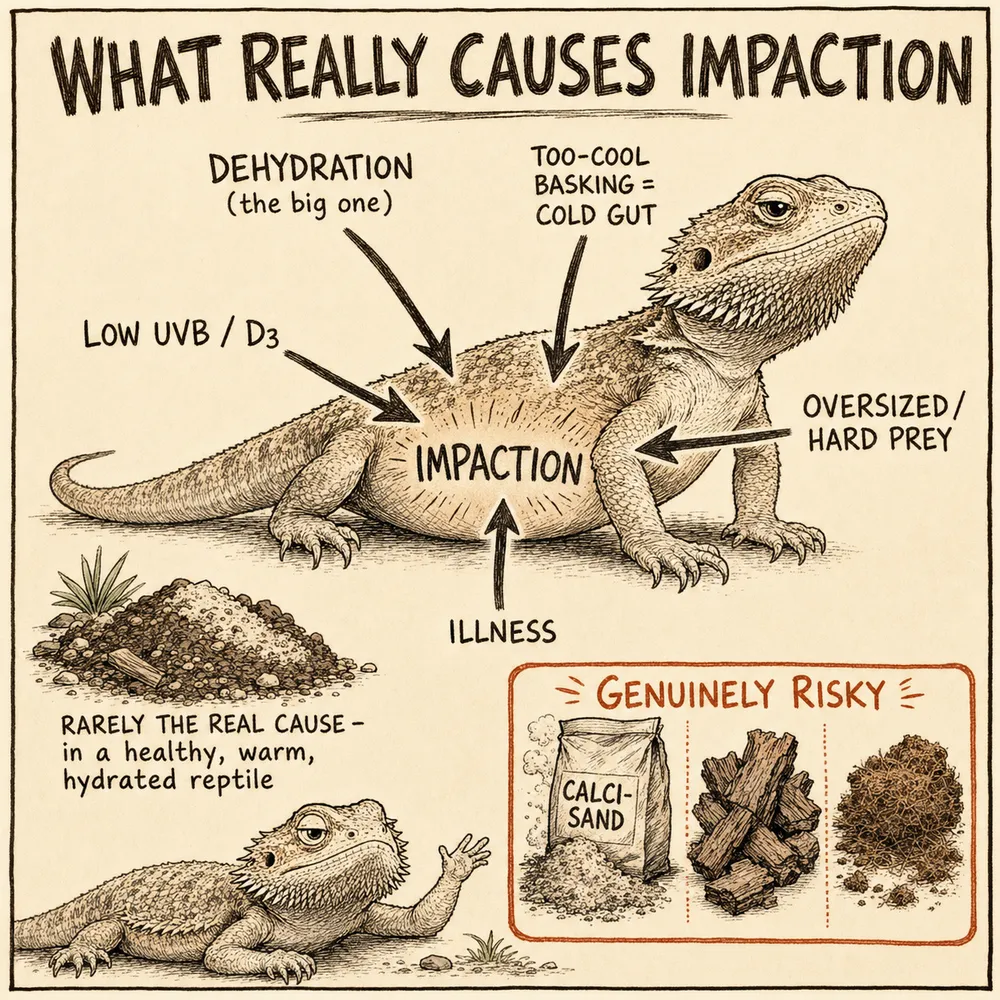
If not the substrate, then what? Almost always, one of these:
- 💧 Dehydration — the big one. This is hugely underestimated, especially for “desert” species. Keepers keep bearded dragons at 10–15% humidity and skip the water bowl believing “desert reptiles don’t need water” — but wild central-Australian humidity actually runs 55–65% at dawn and dusk and up to 75–80% at night in the microclimates they use. A dehydrated reptile has a dehydrated, hard-working colon that pulls extra water from waste, forming a dry, stuck mass — and it can’t lubricate and pass substrate either.
- 🌡️ A too-cool basking spot. If the reptile can’t reach its preferred body temperature, digestion and peristalsis (the gut’s muscle contractions that move food along) slow down. A cold gut is a stalled gut.
- ☀️ Not enough UVB / vitamin D. Vitamin D deficiency is linked to reduced intestinal motility — another way an under-lit reptile’s gut slows to the point that things get stuck.
- 🍽️ Poor diet. Oversized prey, hard-to-digest items, or a chronically bad diet all raise the risk.
- 🪱 Parasites and illness, which compromise the gut directly.
Notice what these have in common: fix the husbandry and you fix the actual risk. Rip out the substrate and you’ve changed nothing about the cold basking spot or the dehydration that was the real cause.
Reptiles need to dig
There’s a welfare cost to the myth, too. Digging and burrowing are natural, needed behaviours — reptiles dig to thermoregulate, to reach humid microclimates, and to feel secure. A bare tile or paper-towel floor removes that entire part of their behavioural repertoire. (Tellingly, many keepers who refuse loose substrate will happily add a loose lay box when they want a female to lay eggs — quietly admitting the animal needs to dig.) A proper naturalistic substrate isn’t just “safe enough”; done right, it’s better husbandry.
The substrates that ARE risky (the honest caveats)
“Loose substrate is fine” is not the same as “anything goes.” A few genuinely deserve caution — this is where the fear is misdirected but not baseless:
- 🚫 Dusty artificial “calci-sand.” Sold as safe-because-edible, it’s dusty, clumps when wet, and is a poor choice. Use natural sand/soil mixes instead.
- 🚫 Large indigestible chunks — walnut-shell bedding, big bark or wood chips — which can genuinely lodge in the gut.
- 🚫 Substrates that swell — dry, compressed coconut fibre and similar can expand if eaten dry; hydrate them properly and they’re far less of a concern.
- 🚫 Loose substrate for an already-sick or brand-new animal. During quarantine or while treating an unwell (or actually impacted) reptile, switch to paper towel so you can remove every variable and watch droppings closely.
Match the substrate to the species, too — a humidity-loving species and an arid one want different mixes (your species’ care guide has the specifics).
How to use loose substrate well
For a healthy reptile in good husbandry, a naturalistic substrate is a plus, not a gamble:
- Get the husbandry right first — correct basking temperature, proper UVB, and real hydration (the actual anti-impaction measures).
- Choose a suitable naturalistic mix for your species (a topsoil/sand/clay blend for arid diggers; a moisture-holding tropical mix for humid species), at a good depth so they can actually burrow.
- Avoid the risky ones above.
- Feed thoughtfully — appropriately sized prey, and if you’re worried about big mouthfuls of substrate, feed in a way or place that limits it.
- Use paper towel where it belongs — quarantine, hospital, and recovery setups.
Tick your setup against the fact-checked targets with the setup checker, and if you ever see the signs of an actual impaction — a firm, swollen belly, straining, and no droppings — don’t wait it out: that’s a reptile vet visit.
💚 The kindest, most current answer is this: a healthy reptile kept properly will not be impacted by a good naturalistic substrate — and it will benefit from being able to dig. The “sand kills” rule isn’t malicious; it’s just old folklore that treats a symptom as the cause. Fix the temperatures, the UVB, and the hydration, choose a sensible substrate, and let your reptile do what it evolved to do.
Go deeper: does my reptile need UVB and heat? · why is my reptile’s shed stuck? · is my reptile sick? · the setup checker · your species’ care guide for its ideal substrate.
Sources & further reading
This guide was written and fact-checked against these authorities. It’s kind, general husbandry guidance — not a diagnosis or a substitute for a reptile vet:
- ReptiFiles — Does Loose Substrate Cause Impaction? — the evidence-based case: impaction as a symptom of husbandry, the real causes (dehydration, low temps, low vitamin D, diet), the behavioural need to dig, and the 2017 bearded dragon study; the quoted line is reproduced verbatim.
- Association of Reptilian & Amphibian Veterinarians (ARAV) — reptile veterinary care and a find-an-exotics-vet directory.
- Merck Veterinary Manual — reptiles — gastrointestinal obstruction, dehydration, and metabolic bone disease in reptiles.
Written and fact-checked by The Baskden Team against veterinarian-authored sources — if you suspect an actual impaction (a firm swollen belly, straining, no droppings), see a reptile/exotics vet rather than waiting.
Common questions
Does loose substrate cause impaction in reptiles?
In a healthy reptile kept with correct husbandry — proper temperatures, UVB, and hydration — a suitable naturalistic loose substrate does not cause impaction. Impaction is almost always a symptom of an underlying problem (dehydration, a too-cool basking spot, poor diet, or illness), not the substrate itself. A compromised animal can impact on almost anything, including paper towel or insect shells, while a healthy one passes small amounts of ingested substrate without trouble. That said, a few specific substrates genuinely are risky — see below.
What actually causes impaction in reptiles?
Husbandry, mostly. The main drivers are dehydration (especially in 'desert' species kept too dry, which many keepers underestimate), basking temperatures too low for the reptile to digest properly, insufficient UVB or vitamin D (which reduces gut motility), and poor diet such as oversized or hard-to-digest prey. Parasites and other illness contribute too. Impaction is the visible symptom; one of these is usually the real cause, which is why simply removing the substrate often doesn't fix the problem.
Which substrates are actually dangerous for reptiles?
The genuinely risky ones are dusty, artificial 'calci-sand' (marketed as edible — it clumps and is dusty), large indigestible chunks like walnut-shell bedding or big bark/wood chips, and dry compressed substrates that swell when wet (like un-soaked coconut fibre) if eaten dry. Those deserve the caution the myth wrongly aims at all loose substrate. A fine, naturalistic sand/soil mix used at the correct depth, with correct husbandry, is a different thing entirely.
Should I keep my reptile on paper towel to be safe?
For a healthy animal in good husbandry, paper towel isn't 'safer' — and it denies reptiles a real behavioural need to dig and burrow. Where paper towel genuinely belongs is temporary situations: quarantining a new arrival, or housing a sick, recovering, or already-impacted animal during treatment, when you want to remove every variable and monitor droppings. Think of paper towel as a hospital or quarantine setup, not a permanent 'safe' default.
Do reptiles need to dig in loose substrate?
Yes — digging and burrowing are natural behaviours for many reptiles, letting them thermoregulate, access humid microclimates, and feel secure. Denying loose substrate removes an entire part of their behavioural repertoire, which is a welfare cost in itself. Many reptiles even practise geophagy (deliberately eating small amounts of earth for minerals) in the wild, which is one reason a healthy animal is well adapted to a little incidental substrate.