
Is My Reptile Sick? How to Tell — and Exactly When to See a Vet
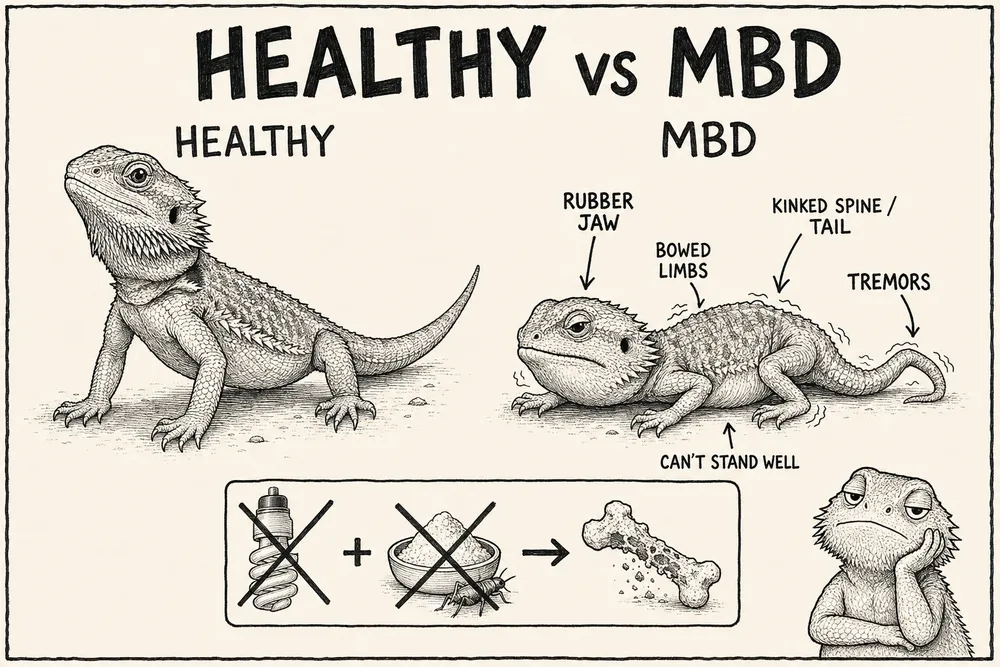
If you’re here because something about your reptile looks off, take a breath first. Reptiles are hardy when their setup is right, most problems are caught in time, and the fact that you’re paying close attention already makes you a good keeper. Reptiles are also just genuinely hard to read — quiet, still, and undemonstrative — so it’s easy to panic over something that’s completely normal, and just as easy to miss something that isn’t. This is the calm, cross-species version of the check.
🩺 The 30-second answer: a healthy reptile has bright eyes, clean unbroken skin, an alert response, good body condition, and a normal appetite. If yours looks off, check the husbandry first — temperature, UVB, and humidity fix most problems. But see a reptile vet promptly for any red flag: open-mouth breathing or mucus, tremors or “stargazing”, a rubbery jaw, a swollen belly with no droppings, sunken eyes with weakness, or a prolapse. Not sure? The free Is this normal? tool walks you through it — it never diagnoses, it helps you decide.
📊 You’re not alone in worrying. “Is my reptile sick?” is the second most-asked topic among keepers — about 14% of care questions in our analysis of 388 real reptile-keeping questions.
What a healthy reptile looks like
You can’t spot “wrong” until you know “right.” Across the common pet species, healthy looks like this:
- 👀 Eyes — full, bright, and clear (not sunken or cloudy, unless a snake is “in blue” before a shed).
- 🩹 Skin — clean and unbroken; colour normal for the species. (Colour-changing is normal; open sores, retained shed, or reddening are not.)
- ⚡ Response — alert; it reacts when you approach or at feeding time.
- 🍽️ Appetite — eating on its normal schedule (which for many adults is not every day).
- ⚖️ Body condition — right for the body type: a plump tail on a leopard gecko, a rounded-loaf shape on a snake, a full-but-not-dragging belly on a bearded dragon.
Hold your animal up against that list. If it matches, it’s very likely fine — even if it’s doing something that looks odd (more on that below). The body-condition checker helps with the weight part, which is one of the easiest things to misjudge.
Check these three things first
Here’s the pattern that surprises new keepers: most reptile “illness” is really a husbandry gap in disguise. As reptile-medicine specialist Stephen J. Divers, BVetMed, DACZM, DECZM puts it in the Merck Veterinary Manual, “Reptiles cannot process fluids and nutrients properly if environmental conditions are not optimal.“¹ Before assuming disease, check — and correct — the big three:
- Heat & UVB. Reptiles are cold-blooded: too cold and they can’t digest, move, or fight off illness. Each species needs a measured warm-to-cool gradient, and basking species (bearded dragons especially) need proper UVB. Check with a thermometer and, ideally, a UV meter — not a guess. (Full heat & UVB guide)
- Humidity. Too dry causes stuck sheds and dehydration; too damp-and-stale breeds respiratory infection. Ball pythons want it fairly high; bearded dragons much lower. Match your species. (Full humidity & shedding guide)
- Cleanliness & substrate. Dirty water, uneaten food, and the wrong substrate cause a lot of what looks like sudden illness.
Correcting these resolves a large share of problems on their own. If the animal is still off after the setup is right — or a red flag is present — it’s time for a vet. Tick your setup against the fact-checked targets with the setup checker.
The red flags: see a reptile vet now
Some signs are not husbandry you can fix at home and not wait-and-see. If you see any of these, contact a reptile/exotics vet promptly:
| 🔴 Red flag | Why it’s urgent |
|---|---|
| Open-mouth breathing, mucus or bubbles, clicking/whistling | Signs of a respiratory infection — common when kept too cool or damp-and-stale. |
| Tremors, wobbling, or “stargazing” (staring up, corkscrewing, can’t right itself) | Neurological or severe metabolic problem. |
| A soft, rubbery jaw or bent/weak limbs | Classic metabolic bone disease (a calcium/UVB failure) — common and preventable. |
| A firm, swollen belly with straining and no droppings | Possible impaction (a gut blockage). |
| Sunken eyes with weakness | Severe dehydration. |
| Tissue protruding from the vent (prolapse) | An emergency — keep it moist and go now. |
| Open wounds, sores, burns, or discharge | Infection risk; needs treatment. |
| Sudden collapse, limpness, or fast weight loss with refusing food | Serious — don’t wait it out. |
A vet call is never the wrong move. Many general vets don’t see reptiles, so find a reptile/exotics vet before you have an emergency and save the number.
The signs that are usually not an emergency
Just as important — a lot of “help, is my reptile dying?!” turns out to be completely normal:
- Hiding or burrowing for long stretches — most reptiles feel safest tucked away, and new arrivals hide for days or weeks.
- Not eating for a while — extremely common, especially fasting snakes and cooling-season lizards. (Why won’t my reptile eat?)
- Colour-changing — a bearded dragon’s dark “beard”, or a gecko darkening, is usually mood or temperature.
- Cloudy, blue-grey eyes and dull skin in a snake — that’s the normal pre-shed “in blue” phase.
- Basking hard after a meal — healthy; they’re warming up to digest.
- A dropped tail on a leopard or crested gecko — a natural escape response, not an injury you caused.
These become a concern only when they pair with a red flag. If that’s what you’re seeing, the Is this normal? tool sorts everyday-normal from worth-a-look.
The honest part
We can’t diagnose your reptile from afar — and neither can anyone else online, however confident they sound. What a good keeper can do is exactly what this page walks through: know what healthy looks like, correct the husbandry, recognise the red flags, and get a real vet involved when one appears. Diagnosis and treatment need a vet who can examine the animal and run tests.
Find the detail for your reptile
Once you’ve done the general check, go deep on yours — each guide has its own warning signs and a printable care sheet:
| Your reptile | Care guide |
|---|---|
| 🦎 Bearded dragon | Bearded dragon care |
| 🦎 Leopard gecko | Leopard gecko care |
| 🦎 Crested gecko | Crested gecko care |
| 🐍 Ball python | Ball python care |
| 🐍 Corn snake | Corn snake care |
💚 You don’t have to figure this out alone or feel silly for asking. Know what healthy looks like, correct the heat, UVB, and humidity, watch for the red flags, and reach out to a reptile vet or a kind keeper community. Most problems, caught early, are completely fixable.
Go deeper: the free Is this normal? tool · the body-condition checker · the setup checker · more real questions in the Baskden Q&A.
Sources & further reading
This guide was written and fact-checked against these authorities. It’s kind, general triage guidance — not a diagnosis or a substitute for a reptile vet:
- ReptiFiles — evidence-based husbandry (heat, UVB, humidity) that most reptile health problems trace back to.
- Association of Reptilian & Amphibian Veterinarians (ARAV) — reptile veterinary care and a find-an-exotics-vet directory.
- ¹ Merck Veterinary Manual, “Disorders and Diseases of Reptiles” — by Stephen J. Divers, BVetMed, DACZM, DECZM, FRCVS (University of Georgia). The quoted line on environment and nutrient processing; also MBD, respiratory infection, impaction, and other reptile illness.
Written and fact-checked by The Baskden Team against veterinarian-authored sources — if your reptile shows a red 🔴 flag above, see a reptile/exotics vet promptly.
Common questions
How do I know if my reptile is sick?
Compare it to healthy: bright, full eyes, clean unbroken skin, an alert response, good body condition for its type, and feeding on its normal schedule. A sick reptile usually shows the opposite — sunken eyes, dull or stuck skin, lethargy, hiding plus weight loss, or a change in how it breathes or holds itself. Most problems trace back to temperature, UVB, or humidity, so check those first, then watch for the red-flag signs that mean see a vet.
When does a reptile need to see a vet urgently?
See a reptile vet promptly for any of these: open-mouth breathing, mucus or bubbles around the mouth or nose, or clicking/whistling (respiratory); tremors, wobbling, or 'stargazing' and being unable to right itself; a soft, rubbery jaw or bent limbs (metabolic bone disease); a firm swollen belly with straining and no droppings; sunken eyes with weakness; any tissue protruding from the vent; or open wounds and sudden collapse. A gradually overweight but bright, active animal is not an emergency; a suddenly-off one is.
Can you tell me what is wrong with my reptile from a photo?
No — and honestly, nobody online can reliably diagnose a reptile from a photo, including us. What you can do is triage: compare the animal to the warning signs for its species, correct any husbandry problem (temperature, UVB, humidity, substrate), and if a genuine red flag is present, see a reptile vet. Diagnosis and treatment need a vet who can examine the animal and run tests.
My reptile stopped eating — is it dying?
Usually not. A fast is one of the most common and least alarming things a reptile does — snakes (ball pythons especially) can skip meals for weeks or months, and lizards and geckos eat less while settling in, shedding, or cooling for winter. Check the temperature first, because a cold reptile can't digest. It becomes concerning when not eating pairs with visible weight loss, lethargy, or a red-flag sign — that is when to see a vet.
Are most reptile illnesses actually husbandry problems?
Yes — the large majority of reptile 'illness' is a husbandry gap wearing a costume. Wrong temperature, missing or weak UVB, incorrect humidity, an unsafe substrate, or a poor diet cause most of what keepers panic about. That is good news: correcting the setup fixes many issues before they need a vet. But a handful of signs (respiratory infection, metabolic bone disease, impaction, prolapse) are genuine medical problems that husbandry alone won't fix.