
Should My Reptile Brumate? The Winter Slow-Down, Explained
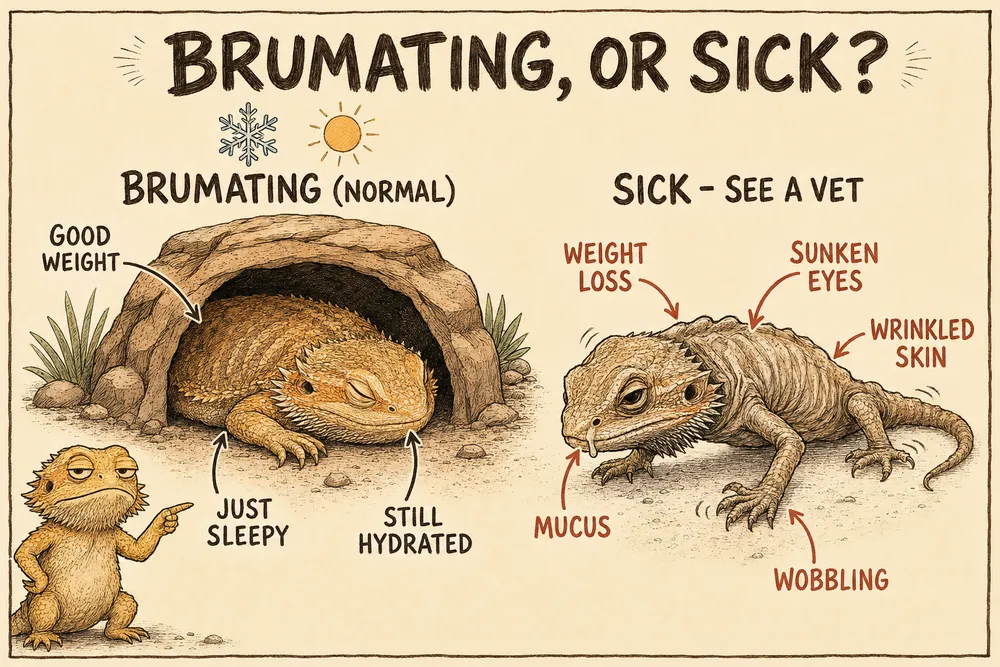
Every autumn, reptile keepers get the same fright: their bright, hungry animal suddenly goes quiet — sleeping all day, burrowing, turning down food, sometimes for weeks. Is it dying? Usually not. For many species, this is brumation, the reptile version of hibernation, and it’s a normal, healthy seasonal rhythm. But “usually not” isn’t “never,” so the real skill is telling a healthy winter slow-down apart from an animal that’s actually unwell.
❄️ The 30-second answer: brumation is a natural winter slow-down — sleeping more, hiding, eating little — that many temperate reptiles do (bearded dragons, Russian tortoises, Argentine tegus, temperate snakes). It’s normal for a healthy, good-weight adult. The golden rule: only a healthy, well-conditioned animal should brumate — never a sick, underweight, or very young one, and never a tropical species (crested gecko, ball python, veiled chameleon) that doesn’t naturally do it. If you see weight loss, sunken eyes, mucus, or weakness, that’s illness, not brumation → reptile vet.
What brumation actually is
Brumation is a state of dormancy triggered by shortening days and cooler temperatures. A brumating reptile’s metabolism drops right down: it sleeps far more, moves little, hides or burrows deep, and eats little or nothing — for anything from a couple of weeks to several months. It’s not the deep, continuous sleep of a hibernating mammal; the animal may still shift position, drink, or briefly bask on a warmer day, then settle back down.
It’s a survival adaptation. In the wild, there’s little food and dangerous cold in winter, so slowing the body to a crawl and waiting it out makes sense. Captive reptiles keep that instinct even in a warm house, cued by the changing daylight.
Which reptiles brumate — and which don’t
This is the first thing to sort out, because it changes everything. A winter shut-down is expected in a temperate species and suspicious in a tropical one.
| Commonly brumate (temperate) | Generally DON’T truly brumate (tropical/stable climate) |
|---|---|
| 🦎 Bearded dragon | 🦎 Crested gecko & gargoyle gecko |
| 🐢 Russian tortoise (properly hibernates) | 🐍 Ball python (may slow feeding, but not a true brumation) |
| 🦎 Argentine tegu (months-long brumation) | 🦎 Veiled chameleon |
| 🐍 Corn snake, kingsnake & other temperate snakes | 🦎 (Tropical species generally) |
It also varies by individual and setup — not every bearded dragon brumates every year, and a snake kept at steady temperatures with a constant photoperiod may skip it. The point isn’t a rigid list; it’s that a slow-down in a temperate species is likely natural, while the same behaviour in a tropical species deserves a closer look.
The golden rule: only a healthy animal brumates
This is the single most important thing on the page. Brumation must happen from a position of strength. A reptile going into a long fast and a suppressed immune state needs to be:
- A healthy, good body weight — not thin, not underweight, with good fat/condition to see it through.
- Otherwise well — eating normally beforehand, no symptoms, no recent illness.
- Not a hatchling or very young animal — juveniles are usually kept warm and growing, not brumated.
Never brumate a sick, underweight, or very young reptile. For tortoises especially, a vet check before hibernation is standard good practice — a hidden problem that’s survivable in an awake animal can become fatal during months of dormancy. As Dr. Ashley Navarrette, a clinical assistant professor at the Texas A&M College of Veterinary Medicine, notes, “Brumation can be dangerous but is often necessary for the reproductive and overall health of both wild and captive turtles/tortoises” — and her advice is to “consult with your exotic veterinarian prior to this process.“¹
Brumation vs illness — how to tell
Because brumation and illness can both look like “sleeping and not eating,” judge it on body condition and red flags, not on the sleeping alone:
| ✅ Looks like brumation | 🔴 Looks like illness — see a vet |
|---|---|
| A good-weight animal that simply sleeps and hides more | Weight loss, a thinning tail, or a showing spine/hip bones |
| Holds its weight steadily through the slow-down | Sunken eyes, wrinkled/dry skin (dehydration) |
| No other symptoms | Mucus, bubbles, or open-mouth breathing (respiratory) |
| A temperate, brumating species | Wobbling, tremors, or stargazing |
| Still drinks; may briefly bask on warm days | Discharge, a swollen belly with straining, or sudden weakness |
If any red flag is present — or if a tropical species, a juvenile, or a previously unwell animal “goes quiet” — treat it as possible illness and see a reptile vet. You can’t diagnose brumation by hope; a healthy brumating animal stays a healthy weight, just sleepy. Run what you’re seeing through the is-this-normal tool if you’re unsure.
How keepers handle a natural slow-down
Full, engineered cool-down cycles (dropping temperatures on a schedule) are mostly a breeder’s tool. For a pet keeper, the gentler and safer approach is usually to let a healthy animal follow a mild natural rhythm:
- Let it sleep. Don’t keep digging it out, waking it, or forcing interaction.
- Don’t force-feed. A brumating reptile that turns down food is fine; pushing food into a cold, slowed gut can cause problems.
- Keep fresh water available — brumating animals still hydrate, and dehydration is a real risk.
- Keep an eye on weight. Weigh weekly-ish; a little loss can be normal, but ongoing or sharp loss is a red flag.
- For snakes and some reptiles, make sure the animal has fully digested and passed its last meal before it cools down, so nothing sits rotting in a slowed gut. When in doubt, ask a vet about your species.
Coming out of it
As the days lengthen again, a brumating reptile gradually wakes up — becoming more active, basking more, and eventually asking for food again. Warm it back up to its normal temperatures, keep water available, and offer a small meal once it’s clearly alert and moving normally. If it comes out looking thin, weak, or unwell rather than simply hungry, that’s a vet trip, not a normal spring.
💚 Brumation is one of the great false alarms of reptile keeping — a healthy animal doing exactly what its biology tells it to, while its worried keeper imagines the worst. Learn whether your species brumates, judge it on body condition, not just sleepiness, and hold the golden rule firmly: a healthy, good-weight adult can brumate; a sick, thin, or young one needs a vet, not a long sleep.
Go deeper: Russian tortoise care · Argentine tegu care · bearded dragon care · is my reptile sick? · why won’t my reptile eat? · the is-this-normal tool.
Sources & further reading
This guide was written and fact-checked against these authorities. It’s kind, general triage guidance — not a diagnosis or a substitute for a reptile vet:
- ¹ Texas A&M College of Veterinary Medicine — “Turtle Brumation” (Pet Talk) — quoting Dr. Ashley Navarrette, clinical assistant professor. The quoted lines on brumation’s risks and consulting an exotic vet first.
- ReptiFiles — evidence-based husbandry and species-by-species brumation guidance.
- Association of Reptilian & Amphibian Veterinarians (ARAV) — reptile veterinary care and a find-an-exotics-vet directory (a pre-brumation check, especially for tortoises).
- Merck Veterinary Manual — reptiles — reptile physiology, dormancy, and the illnesses that mimic it.
Written and fact-checked by The Baskden Team against veterinarian-authored sources — never brumate a sick, underweight, or very young reptile, and if you can’t tell brumation from illness, see a reptile/exotics vet.
Common questions
What is brumation in reptiles?
Brumation is the reptile version of hibernation — a natural period of dormancy that many temperate species go through in autumn and winter as the days shorten and temperatures drop. A brumating reptile becomes sluggish, sleeps far more, hides or burrows, and eats little or nothing, sometimes for weeks or months. Unlike mammal hibernation it isn't a deep continuous sleep — the animal may still move, drink, and occasionally bask — but its metabolism slows right down.
Which reptiles brumate?
Mostly temperate species from climates with a real cold season: bearded dragons, Russian tortoises (which properly hibernate), Argentine tegus (which brumate for months), and many temperate snakes like corn snakes and kingsnakes. Tropical species generally do NOT truly brumate — crested and gargoyle geckos, ball pythons, and veiled chameleons come from warm, stable climates, so a prolonged winter shut-down in one of those is more likely to be an issue worth checking than a natural rhythm.
Is it normal for my reptile to stop eating in winter?
For a brumating species, yes — a healthy, good-weight adult reducing or stopping food as the days shorten and cool is normal and not a cause for panic. The key words are healthy and good-weight. Brumation should happen from a position of strength: the animal was eating well, at a good body condition, and looks well otherwise. Weight loss, sunken eyes, mucus, or weakness are NOT part of normal brumation and point to illness instead.
How do I know if my reptile is brumating or sick?
Body condition and red flags are the deciding factors. Brumation: a good-weight animal that's simply sleepy, still holds its weight, and has no other symptoms. Illness: real weight loss, sunken eyes, wrinkled skin (dehydration), mucus or open-mouth breathing, wobbling or tremors, discharge, or a swollen belly. If any red flag is present — or if a very young, underweight, or previously unwell animal 'goes quiet' — treat it as a possible illness and see a reptile vet, not as brumation.
Should I let my reptile brumate?
Only if it's a brumating species AND a healthy, good-weight adult — and ideally with a vet check first, especially for tortoises. Never brumate a sick, underweight, or very young animal, and never a tropical species that doesn't naturally do it. Many pet keepers simply let a healthy animal follow a mild natural slow-down (cooler, shorter days, water always available, no force-feeding) rather than engineering a deep cool-down. If you're unsure, a reptile vet can advise for your specific animal.