
Species · Arid basking lizard
Bearded Dragon
Pogona vitticeps
The friendly, hand-tame beginner lizard — the most popular pet reptile there is.
Difficulty: Beginner Printable care sheet →
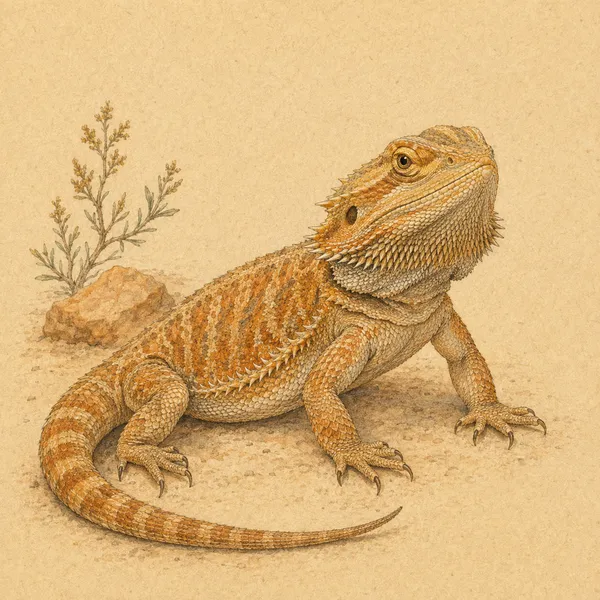
Beardies are the friendly golden retrievers of the reptile world — genuinely tame, curious, and happy to hang out with you. They are a wonderful first reptile once their setup is right. The catch is that “right” means real desert lighting and a proper thermal gradient, not the tiny starter kit the pet store sells. Get the sun-in-a-box part sorted and the rest is a joy.
Worried, or still setting up? Free tools
Or browse common Bearded Dragon questions →
Care at a glance
| Adult size | 16–24 in (40–60 cm) nose-to-tail |
|---|---|
| Lifespan | 8–15+ years — a decade-plus commitment |
| Enclosure | Adult minimum 4×2×2 ft (a 120-gallon footprint); 6×2×2 ft / 24 cu ft is the modern best-practice standard, and bigger is always better. Front-opening and well-ventilated. The 10–40-gallon “starter kit” tanks are far too small. |
| Basking / warm zone | Basking-surface temperature 108–113°F (42–45°C), from an overhead halogen/heat cluster of at least two flood bulbs on a thermostat/dimmer — measured with a temp gun at the basking rock, not a stick-on dial. |
| Cool side | Cool-side surface 77–85°F (25–29°C); overall air gradient ~72–99°F (22–37°C). |
| Night | Night 55–75°F (12–24°C) — a drop to ~50°F is fine and even healthy. Lights fully off at night; no coloured “night” bulbs. |
| UVB & lighting | Strong UVB is non-negotiable for a beardie. Use a linear T5 HO bulb (e.g. Arcadia 12% Desert or 14% Dragon) spanning roughly ½–⅔ of the enclosure, giving a UVI of 4.0–4.5 at the basking spot (and no more than 3.0 for pale/translucent or scaleless “silkback” morphs). Replace the bulb every 12 months. |
| Humidity | Ambient humidity 30–60%, measured on the cool end. The “keep it bone-dry” rule is a myth — central Australia isn’t bone dry, and too-low humidity causes its own problems. |
| Substrate | A naturalistic, burrowable soil/sand mix packed 4–6″ deep is ideal — and, done right, it does NOT cause impaction. Impaction usually traces to husbandry (too-cool temps → poor digestion), not to loose substrate itself. Avoid dusty artificial “calci-sand”, and skip loose substrate for unwell dragons. |
| Diet | Omnivore whose ratio flips with age: babies eat mostly insects (as much as they’ll take, daily) plus greens; adults flip to mostly greens daily with head-sized insects only ~2×/week. Insects no larger than the space between the eyes. Fruit is a rare treat, not a staple. |
| Supplements | Dust insects and salad with calcium; add a multivitamin ~1–2×/week (more for babies). Don’t over-supplement — a light dusting, “like salting your food”, not a blizzard. |
🦎 Did you know? — Bearded Dragon fun facts
Little true delights about the bearded dragon — each one checked against a named source, no pet-shop myths.
- A bearded dragon’s "beard" is an expandable spiky throat pouch that inflates and turns jet-black during mating and aggression displays. Animal Diversity Web
- Bearded dragons "arm-wave," balancing on three legs and rotating one forelimb in a slow circle to signal submission and recognise their own kind. Animal Diversity Web
- A female bearded dragon can store sperm, laying several clutches of fertile eggs from a single mating. Animal Diversity Web
What it's like to live with a Bearded Dragon
Beardies are the reason so many people fall for reptiles. They are unusually sociable for a lizard — a well-kept dragon will bask in the morning, watch you cross the room, come to the glass at feeding time, and happily sit on an arm or shoulder. You will see real behaviour: head-bobbing, the occasional arm-wave, and a settled routine of basking, mooching for greens, and dozing. They are not cuddly the way a dog is, but they tolerate and even seem to enjoy gentle company more than almost any other reptile. The day-to-day is calm and rewarding once the lighting and heat are right — that part is the whole job.
Your first month together
The settling-in period, in order — so you know what's normal and when not to worry.
- Have the enclosure fully built and the temperatures dialled in with a thermostat and temp gun BEFORE the dragon comes home — not after.
- Expect a shy first few days: a new beardie may hide, glass-surf, or eat little while it works out that this is home. That is normal settling-in, not illness.
- Feed a baby generously — young dragons eat a lot of insects daily, plus salad they will mostly ignore at first. Appetite usually picks up within a week once it feels secure.
- Watch for that first good poop and a steady basking rhythm — those are your early "it's settling in well" signs.
- Start short, calm handling only after it is basking normally and eating well (usually after the first week) — a few minutes, low over a soft surface, building up slowly.
Through the year, and as they grow
Care shifts a lot as a beardie grows: babies are insect-hungry and eat daily, then the ratio flips so adults eat mostly greens with insects only a couple of times a week. In cooler, darker months some dragons brumate — sleeping more, basking less, and going off food for weeks. In a healthy adult on correct temperatures this can be normal, but a sudden slowdown in a baby, or alongside weight loss or other symptoms, is a vet visit, not brumation.
The pet store gets these wrong
Common myths, kindly corrected — no shame for having believed them.
- A 10–20-gallon tank is enough — false; an adult needs at least 4×2×2 ft.
- “Bearded dragons don’t need UVB / a coil bulb is fine” — false; they need strong linear T5 HO UVB.
- Keep the humidity as low as possible — false; 30–60% is correct.
- All loose substrate causes impaction — oversimplified; a proper naturalistic mix is fine, calci-sand and cold temps are the real problems.
- A coloured night bulb keeps them warm safely — skip it; they need darkness, and a drop to ~50–75°F is healthy.
Before you buy
- Space for a 4×2×2 ft (ideally larger) enclosure — this is a big footprint.
- The lighting is the real cost: a T5 HO UVB bulb + fixture and a ≥2-bulb halogen basking cluster, on controllers.
- A 10–15+ year commitment.
- An exotics/reptile vet within reach before you need one.
- An ongoing supply of feeder insects AND fresh greens.
💷 The bearded dragon itself is usually the cheapest part — see the real cost of keeping one (upfront + ongoing, no sales pitch).
See a reptile vet if…
We can't diagnose from afar — but these are the signs to stop watching and get a professional:
- Not basking or staying lethargic despite correct, verified temperatures.
- Weak, shaky, or bent limbs, tremors, or a soft/rubbery jaw (signs pointing to metabolic bone disease).
- A swollen, firm belly with no droppings, or straining (possible impaction).
- Sunken eyes, wrinkled skin, or a persistent dark “beard” with refusing food.
- Laboured or open-mouth breathing, mucus, or clicking (possible respiratory infection).
- Any tissue protruding from the vent (prolapse) — keep it moist and go now.
Heading in? Print the free Bearded Dragon vet-prep sheet — what to bring, what to tell the vet, and the questions to ask.
Never
- Never rely on a heat mat for a basking lizard — they take heat from above, not their belly.
- Never skip UVB, and never use a weak coil/compact bulb in place of a linear T5 HO.
- Never house two bearded dragons together — they’re territorial and will hurt each other.
- Never feed fireflies (toxic) or wild-caught insects (pesticides/parasites).
- Never feed insects larger than the space between the eyes.
Common bearded dragon questions
How hard are Bearded Dragons to keep — are they good for beginners?
Beginner. Beginner-friendly to keep happy — but not low-effort. The lighting, heat and space have to be done properly, and that surprises a lot of new keepers.
What do Bearded Dragons eat?
Omnivore whose ratio flips with age: babies eat mostly insects (as much as they’ll take, daily) plus greens; adults flip to mostly greens daily with head-sized insects only ~2×/week. Insects no larger than the space between the eyes. Fruit is a rare treat, not a staple.
How big an enclosure do Bearded Dragons need?
Adult minimum 4×2×2 ft (a 120-gallon footprint); 6×2×2 ft / 24 cu ft is the modern best-practice standard, and bigger is always better. Front-opening and well-ventilated. The 10–40-gallon “starter kit” tanks are far too small.
What basking temperature do Bearded Dragons need?
Basking-surface temperature 108–113°F (42–45°C), from an overhead halogen/heat cluster of at least two flood bulbs on a thermostat/dimmer — measured with a temp gun at the basking rock, not a stick-on dial.
What should the cool side be for Bearded Dragons?
Cool-side surface 77–85°F (25–29°C); overall air gradient ~72–99°F (22–37°C).
What night-time temperature do Bearded Dragons need?
Night 55–75°F (12–24°C) — a drop to ~50°F is fine and even healthy. Lights fully off at night; no coloured “night” bulbs.
What UVB and lighting do Bearded Dragons need?
Strong UVB is non-negotiable for a beardie. Use a linear T5 HO bulb (e.g. Arcadia 12% Desert or 14% Dragon) spanning roughly ½–⅔ of the enclosure, giving a UVI of 4.0–4.5 at the basking spot (and no more than 3.0 for pale/translucent or scaleless “silkback” morphs). Replace the bulb every 12 months.
What humidity do Bearded Dragons need?
Ambient humidity 30–60%, measured on the cool end. The “keep it bone-dry” rule is a myth — central Australia isn’t bone dry, and too-low humidity causes its own problems.
What substrate do Bearded Dragons need?
A naturalistic, burrowable soil/sand mix packed 4–6″ deep is ideal — and, done right, it does NOT cause impaction. Impaction usually traces to husbandry (too-cool temps → poor digestion), not to loose substrate itself. Avoid dusty artificial “calci-sand”, and skip loose substrate for unwell dragons.
What supplements do Bearded Dragons need?
Dust insects and salad with calcium; add a multivitamin ~1–2×/week (more for babies). Don’t over-supplement — a light dusting, “like salting your food”, not a blizzard.
How big do Bearded Dragons get?
16–24 in (40–60 cm) nose-to-tail
How long do Bearded Dragons live?
8–15+ years — a decade-plus commitment
What are the signs Bearded Dragons are sick or need a vet?
See a reptile or exotics vet if you notice: Not basking or staying lethargic despite correct, verified temperatures.; Weak, shaky, or bent limbs, tremors, or a soft/rubbery jaw (signs pointing to metabolic bone disease).; A swollen, firm belly with no droppings, or straining (possible impaction).; Sunken eyes, wrinkled skin, or a persistent dark “beard” with refusing food.; Laboured or open-mouth breathing, mucus, or clicking (possible respiratory infection).; Any tissue protruding from the vent (prolapse) — keep it moist and go now..
Your first two weeks · Taming & handling · Behaviours explained · Won't eat? · Stuck shed · When to see a vet

Get the free Bearded Dragon Starter Kit
A one-page setup criteria checklist and a first-30-days plan for your first beardie — the lighting, heat and space done properly, not the pet-store starter kit. Join the den and we’ll send it over.
Free reptile care cheat-sheet the moment you join. No spam — unsubscribe anytime. See how we handle your data in our privacy notice.Sources & further reading
This guide was written and fact-checked against these authorities. It's kind, general guidance — not a diagnosis or a substitute for an exotics vet:
- ReptiFiles — Bearded Dragon Care — Enclosure size, temperatures, UVB (UVI 4.0–4.5), humidity, diet, supplementation, substrate.
- Research basis cited by ReptiFiles — Basking temps from Dr. Jonathan Howard’s work & Badham (1971) — optimal core body temp ~97°F requires 108–113°F basking surface.
- Association of Reptilian & Amphibian Veterinarians (ARAV) — Find-an-exotics-vet; MBD, impaction, respiratory disease references.
- Merck Veterinary Manual — reptiles — Metabolic bone disease, impaction, respiratory infection.
Written and fact-checked by The Baskden Team against veterinarian-authored sources — if your reptile shows a red-flag sign above, see an exotics vet promptly.