
Species · Beginner snake
Brazilian Rainbow Boa
Epicrates cenchria
The snake with a built-in rainbow shimmer — a notch harder than a corn because it needs high humidity and cool, not hot.
Difficulty: Beginner–Intermediate Printable care sheet →
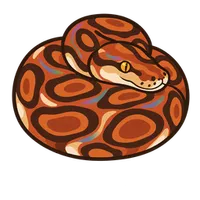
If there is a snake that looks like it was dipped in oil-slick and dropped in a rainforest, this is it — deep red-brown with black rings and an iridescent sheen that flashes green, purple and gold in the light. Under the shimmer it is a gentle, mostly nocturnal boa that stays a very keepable 5–6.5 ft. The whole job here is humid but never soggy, and warm but never hot: Brazilian rainbows are heat-sensitive and dehydrate easily, so your thermostat and your hygrometer are the two tools that matter most.
Worried, or still setting up? Free tools
Or browse common Brazilian Rainbow Boa questions →
Care at a glance
| Adult size | 5–6.5 ft (1.5–2 m); females tend to run slightly larger than males |
|---|---|
| Lifespan | Commonly 20+ years, and up to ~30 years with good care |
| Enclosure | Adult minimum roughly 6 ft L x 3 ft W x 3 ft H (about 4' x 2' x 2' is a common practical floor). A good rule of thumb is enclosure length = snake's full length and width = half its length. Bigger is better, and a front-opening PVC or glass vivarium holds humidity far better than a screen-top tank. |
| Basking / warm zone | Warm hotspot / basking zone 86–90°F (30–32°C). Do NOT let it climb higher — this species is heat-sensitive. |
| Cool side | Cool end / daytime ambient around 78–84°F (26–29°C), giving the snake a true gradient to choose from. |
| Night | Night drop to about 72–75°F (22–24°C) is fine and even welcome. |
| UVB & lighting | Low-need, not no-benefit. Brazilian rainbows live under dense forest cover and are largely nocturnal, so they can be kept healthily without UVB on a good varied rodent diet. Modern best practice still favors a low-output UVB source for overall wellness: a T5 HO Reptisun 5.0 or Arcadia Forest 6% giving a basking-zone UVI of about 2.0–3.0, on ~12 hours a day, replaced yearly. Never use a bright, hot basking bulb that pushes temps over 90°F. |
| Humidity | Roughly 70% by day, rising to 90–100% at night — the nightly humidity spike is essential, not optional. Neonates and snakes under ~1 year need a consistent 90–100%. Aim for humid air, not a swamp: the substrate should never be wet and stagnant. |
| Substrate | A deep (about 4 in / 10 cm) moisture-holding mix: cypress mulch, coconut coir, sphagnum moss, or a topsoil/coco-fiber blend (roughly 60/40). It should hold humidity while staying loose and breathable; spot-clean constantly and do a full change every few months to prevent mold and scale rot. |
| Diet | Appropriately sized frozen-thawed rodents (mice graduating to rats), roughly the width of the snake's body — target about 10% of body weight per meal. Juveniles every 7–14 days; adults every 10–14 days, stretching toward every 2–4 weeks for large adults. Frozen-thawed is safer than live. |
| Supplements | A varied, whole-prey rodent diet is nutritionally complete, so routine dusting is not required the way it is for insectivores. Always provide a large, sturdy water bowl the snake can soak in — clean, fresh water is the single most important daily "supplement" for this species. |
What it's like to live with a Brazilian Rainbow Boa
House one snake per enclosure. Rainbow boas are solitary; cohabitating snakes causes stress, food competition, and cannibalism risk, and makes monitoring feeding and health impossible. No tankmates of any kind.
Your first month together
The settling-in period, in order — so you know what's normal and when not to worry.
- Set the enclosure up and dial it in BEFORE the snake arrives — verify the gradient (86–90°F warm, ~78–84°F cool, 72–75°F night) with a probe thermostat and check humidity holds at 70% day / near 100% night for several days.
- Give at least two snug hides — one on the warm end, one on the cool end — plus a big water bowl it can fully soak in.
- Leave a new snake alone to settle for the first 1–2 weeks; only handle after it has eaten a couple of meals for you.
- Offer the first meal (frozen-thawed rodent) after settling; do not panic over one or two refusals during acclimation, but track it.
- Watch humidity and shed quality daily — retained skin or eye caps is your earliest sign the air is too dry.
- Handle gently and briefly (10–15 min) once settled; support the body, expect juveniles to be a bit nippy at first.
Through the year, and as they grow
Humidity naturally dips in dry winter-heated homes — expect to mist more or run a reptile humidifier/fogger at night to hold nighttime levels. Some keepers see a slight winter feeding slowdown and males may go off food during breeding season; a mild seasonal night-temp drop is normal, but never let daytime warmth spike above 90°F trying to compensate.
The pet store gets these wrong
Common myths, kindly corrected — no shame for having believed them.
- 'Rainbow boas need to be kept soaking wet.' No — they need humid AIR (70% day, near 100% night), not a waterlogged, stagnant substrate. Constant wet bedding causes scale rot. Humid, breathable, and clean is the goal.
- 'They're an easy first snake, just like a corn snake.' Close, but the humidity and heat-sensitivity make them a notch harder — a corn snake shrugs off dry air, a rainbow boa doesn't.
- 'Hotter is better for a tropical snake.' Dangerously wrong for this species. Brazilian rainbows are heat-sensitive and prolonged temps over 90°F (32°C) can be fatal — they need warm, not hot.
- 'Tropical snakes must have UVB or they'll get MBD.' They can be kept healthily without it on whole prey; low-level UVB is a modern wellness bonus, not a strict requirement.
- 'That rainbow shimmer means special lighting.' The iridescence is structural — microscopic ridges on the scales split light. It shows under any normal light; you don't buy it in a bulb.
Before you buy
- This is a 20–30 year commitment to an animal that will reach 5–6.5 ft — plan for the full lifespan and the adult-sized enclosure now.
- You must be able to hold high humidity year-round; dry-heated homes will fight you, so budget for a fogger/humidifier and a good hygrometer.
- It is heat-sensitive: you need a reliable probe thermostat, not a guess-and-hope heat source, and the discipline to keep it under 90°F.
- Buy captive-bred from a reputable breeder — captive-bred rainbows are healthier, better started, and calmer than wild-caught.
- They're beautiful and docile but mostly nocturnal, so it's more of a display-and-occasional-handle snake than a constant cuddler.
💷 The brazilian rainbow boa itself is usually the cheapest part — see the real cost of keeping one (upfront + ongoing, no sales pitch).
See a reptile vet if…
We can't diagnose from afar — but these are the signs to stop watching and get a professional:
- Open-mouth breathing, wheezing, popping/clicking sounds, or mucus/bubbles around the mouth or nostrils — possible respiratory infection, see an exotics vet promptly.
- Discolored, blistered, or foul-smelling belly scales — possible scale rot from substrate that's too wet; fix husbandry and see a vet.
- Swollen or bleeding gums, pus or 'cottage-cheese' matter in the mouth, or a snake that keeps refusing food — possible mouth rot (infectious stomatitis).
- Tiny moving black or red specks on the snake or in the water, constant soaking, or restless rubbing — possible mites/parasites.
- Repeatedly retained shed, especially stuck eye caps or tail tip — usually a humidity problem, but persistent cases need a vet before circulation is lost.
- Prolonged appetite loss with weight loss, regurgitation, lethargy, or any neurologic signs (stargazing, corkscrewing) — get an exotics vet involved; do not wait it out.
Heading in? Print the free Brazilian Rainbow Boa vet-prep sheet — what to bring, what to tell the vet, and the questions to ask.
Never
- Never let temperatures climb above ~90°F (32°C) for any sustained period — this species can die from overheating.
- Never keep the substrate soaking wet or stagnant; humid air is the goal, wet bedding causes scale rot.
- Never house two rainbow boas together — solitary only, or you risk stress, missed illness, and cannibalism.
- Never rely on an unregulated heat source (no thermostat) or on a screen-top tank you can't keep humid.
- Never feed prey larger than the widest part of the snake, and avoid live rodents that can bite and injure your snake.
Common brazilian rainbow boa questions
How hard are Brazilian Rainbow Boas to keep — are they good for beginners?
Beginner–Intermediate. A calm, manageable-sized boa with one real catch: it lives and dies by humidity, and it is genuinely heat-sensitive. Get the moisture and the thermal gradient right and it is a forgiving, long-lived snake. That single moisture/heat balance is why we nudge it just past pure-beginner.
What do Brazilian Rainbow Boas eat?
Appropriately sized frozen-thawed rodents (mice graduating to rats), roughly the width of the snake's body — target about 10% of body weight per meal. Juveniles every 7–14 days; adults every 10–14 days, stretching toward every 2–4 weeks for large adults. Frozen-thawed is safer than live.
How big an enclosure do Brazilian Rainbow Boas need?
Adult minimum roughly 6 ft L x 3 ft W x 3 ft H (about 4' x 2' x 2' is a common practical floor). A good rule of thumb is enclosure length = snake's full length and width = half its length. Bigger is better, and a front-opening PVC or glass vivarium holds humidity far better than a screen-top tank.
What basking temperature do Brazilian Rainbow Boas need?
Warm hotspot / basking zone 86–90°F (30–32°C). Do NOT let it climb higher — this species is heat-sensitive.
What should the cool side be for Brazilian Rainbow Boas?
Cool end / daytime ambient around 78–84°F (26–29°C), giving the snake a true gradient to choose from.
What night-time temperature do Brazilian Rainbow Boas need?
Night drop to about 72–75°F (22–24°C) is fine and even welcome.
What UVB and lighting do Brazilian Rainbow Boas need?
Low-need, not no-benefit. Brazilian rainbows live under dense forest cover and are largely nocturnal, so they can be kept healthily without UVB on a good varied rodent diet. Modern best practice still favors a low-output UVB source for overall wellness: a T5 HO Reptisun 5.0 or Arcadia Forest 6% giving a basking-zone UVI of about 2.0–3.0, on ~12 hours a day, replaced yearly. Never use a bright, hot basking bulb that pushes temps over 90°F.
What humidity do Brazilian Rainbow Boas need?
Roughly 70% by day, rising to 90–100% at night — the nightly humidity spike is essential, not optional. Neonates and snakes under ~1 year need a consistent 90–100%. Aim for humid air, not a swamp: the substrate should never be wet and stagnant.
What substrate do Brazilian Rainbow Boas need?
A deep (about 4 in / 10 cm) moisture-holding mix: cypress mulch, coconut coir, sphagnum moss, or a topsoil/coco-fiber blend (roughly 60/40). It should hold humidity while staying loose and breathable; spot-clean constantly and do a full change every few months to prevent mold and scale rot.
What supplements do Brazilian Rainbow Boas need?
A varied, whole-prey rodent diet is nutritionally complete, so routine dusting is not required the way it is for insectivores. Always provide a large, sturdy water bowl the snake can soak in — clean, fresh water is the single most important daily "supplement" for this species.
How big do Brazilian Rainbow Boas get?
5–6.5 ft (1.5–2 m); females tend to run slightly larger than males
How long do Brazilian Rainbow Boas live?
Commonly 20+ years, and up to ~30 years with good care
What are the signs Brazilian Rainbow Boas are sick or need a vet?
See a reptile or exotics vet if you notice: Open-mouth breathing, wheezing, popping/clicking sounds, or mucus/bubbles around the mouth or nostrils — possible respiratory infection, see an exotics vet promptly.; Discolored, blistered, or foul-smelling belly scales — possible scale rot from substrate that's too wet; fix husbandry and see a vet.; Swollen or bleeding gums, pus or 'cottage-cheese' matter in the mouth, or a snake that keeps refusing food — possible mouth rot (infectious stomatitis).; Tiny moving black or red specks on the snake or in the water, constant soaking, or restless rubbing — possible mites/parasites.; Repeatedly retained shed, especially stuck eye caps or tail tip — usually a humidity problem, but persistent cases need a vet before circulation is lost.; Prolonged appetite loss with weight loss, regurgitation, lethargy, or any neurologic signs (stargazing, corkscrewing) — get an exotics vet involved; do not wait it out..
Your first two weeks · Taming & handling · Behaviours explained · Won't eat? · Stuck shed · When to see a vet

Get the free Brazilian Rainbow Boa Starter Kit
A one-page setup criteria checklist and a first-30-days plan for your first brazilian rainbow boa — what to get, what makes each thing matter, and the honest bits the pet shop skips. Join the den and we’ll send it over.
Free reptile care cheat-sheet the moment you join. No spam — unsubscribe anytime. See how we handle your data in our privacy notice.Sources & further reading
This guide was written and fact-checked against these authorities. It's kind, general guidance — not a diagnosis or a substitute for an exotics vet:
- ReptiFiles — Brazilian Rainbow Boa Care Sheet — Modern best-practice care: enclosure ~6'x3'x3', basking 86–90°F, ambient 78–84°F, night 72–75°F, humidity 70% day / 90–100% night, UVB UVI 2.0–3.0, deep moist substrate, diet and portion sizing, ~30 yr lifespan.
- Swiftail Exotic Telemedicine — Brazilian Rainbow Boa Care Sheet (vet) — Vet source: basking 88–90°F, ambient 75–85°F, humidity 70–80%, moisture-holding substrate, rodent feeding every 7–14 days, and health red flags (respiratory/scale rot/mouth rot/parasites/retained shed).
- Reptiles Magazine — Rainbow Boa Care Sheet — Confirms adult size 5–6 ft, humidity 75–90% adults / 95–100% neonates, and the critical heat-sensitivity warning: never sustained temps over 90°F; 20+ year lifespan.
- Wikipedia — Rainbow boa (Epicrates cenchria) — Taxonomy: family Boidae, genus Epicrates; E. c. cenchria (Brazilian) is the largest subspecies.
Written and fact-checked by The Baskden Team against veterinarian-authored sources — if your reptile shows a red-flag sign above, see an exotics vet promptly.