
What Is My Reptile Doing? Common Reptile Behaviours, Decoded
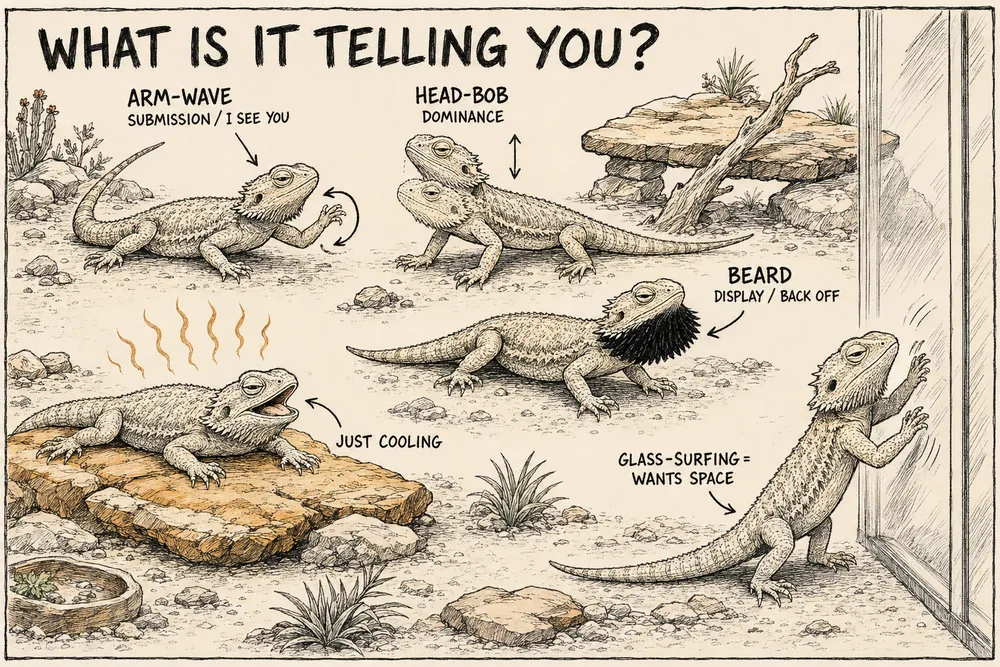
Reptiles are quiet, still, and undemonstrative — which means the moment yours does something, it’s natural to wonder “what on earth is that, and should I worry?” The good news, again and again, is: most of it is completely normal. Reptiles bask, soak, wave, bob, dig, ball up, and gape as part of ordinary life, and once you can read the body language, a lot of the daily worry simply evaporates. Here’s the field guide — the everyday quirks decoded, and the handful of behaviours that genuinely aren’t.
🤔 The 30-second answer: most “weird” reptile behaviour is normal — basking after a meal (digesting), sitting in the water bowl (hydrating/cooling/pre-shed), a beardie’s arm-waving (submission) and head-bobbing (dominance), a leo’s tail-wiggle before a pounce (hunting), a ball python balling up (security), gaping while basking (releasing heat), and cloudy blue eyes before a shed. It becomes worth a closer look only in specific forms: “stargazing” (staring up, corkscrewing), open-mouth breathing with mucus/clicking, constant frantic glass-surfing, or tremors and a rubbery jaw. Not sure which you’re seeing? The free Is this normal? tool sorts it.
Most of what looks odd is really a cold-blooded animal managing its temperature. As the Merck Veterinary Manual explains:
“Most reptiles are ectotherms (cold-blooded): they maintain their body temperature by absorbing heat from the environment, so their body temperature changes with environmental temperature.”
That’s why so much reptile behaviour — basking, moving between warm and cool, hiding, soaking — is constant, normal thermoregulation rather than a warning sign.
The everyday behaviours — usually completely normal
Hold your animal’s behaviour up against this list. If it’s here, it’s almost certainly fine:
| What you’re seeing | What it means | Look closer if… |
|---|---|---|
| 🔥 Basking or lying out after a meal | Raising body heat to digest — healthy | (Snake) just don’t handle it for ~48 h after eating |
| 🫓 Pressing its belly flat / soaking up heat | Thermoregulating; relaxed and warming | — |
| 👋 Arm-waving (bearded dragon) | A submissive “I see you” | — |
| ⬆️ Head-bobbing (bearded dragon) | Dominance display (harder from males) | Frantic bobbing + dark beard = territorial stress |
| ⚫ Dark “beard” / darkening colour | Heat absorption, display, or mild stress | Constant and paired with lethargy or not eating |
| 🌀 Tail-wiggle/rattle before pouncing (leo) | Hunting excitement — adorable, normal | — |
| ⛏️ Digging / burrowing | Thermoregulation, security, or nesting | Frantic digging in an unmated female (may be gravid) |
| 🕳️ Hiding for long stretches | Feeling safe; new arrivals hide for weeks | Hiding + weight loss or a red-flag sign |
| 👅 Tongue-flicking (snakes) | Smelling and mapping the world | — |
| ⚾ Balling up (ball python) | Its signature defensive security curl | — |
| 🔵 Cloudy blue eyes, dull skin (snake) | Normal pre-shed “in blue” phase | Won’t clear, or shed is retained afterwards |
| 🥱 Yawning / a quick jaw stretch | Realigning the jaw, often after a meal | Repeated open mouth + wheezing (respiratory) |
| 😴 Sleeping more / slowing in winter | Seasonal brumation in temperate species | With weight loss or looking unwell |
That’s the bulk of “help, is this normal?!” right there — all of it healthy.
“Why is my reptile in the water bowl?”
This one comes up constantly, so it’s worth its own note. Soaking is often completely normal: reptiles sit in their water to hydrate, to cool down when they’re warm, or to loosen their skin before a shed. A corn snake having a pre-shed soak, or a gecko cooling off, is nothing to worry about.
But soaking is also one of the classic “check something” behaviours, because reptiles will park in the water bowl when they’re uncomfortable. Frequent or constant soaking is worth investigating:
- 🌡️ Too hot — the animal is cooling off because the warm side is running too high. Check your basking temperature.
- 🏜️ Too dry — it’s seeking moisture because the humidity is too low for its species (see humidity & shedding).
- 🐛 Mites — reptiles soak to drown these parasites. Look for tiny black, red, or white moving dots on the animal or floating in the bowl; if you see them, it’s a vet trip.
An occasional soak is fine. A reptile that lives in its water bowl is telling you to check the temps, the humidity, and for mites.
The behaviours that ARE worth acting on
Now the important part — the handful of behaviours that look like the others but genuinely aren’t normal. These mean contact a reptile/exotics vet (they’re covered in full in Is my reptile sick?):
- 🔴 “Stargazing.” Not a snake calmly periscoping to look around — this is staring straight up, corkscrewing or twisting the head and neck, and being unable to right itself. It points to a neurological problem (notably in some spider-gene ball pythons).
- 🔴 Open-mouth breathing. The nuance from the FAQ matters: a beardie gaping on its basking spot is fine, but a reptile holding its mouth open to breathe away from the heat — especially with mucus, bubbles, or a clicking/whistling sound — is showing signs of a respiratory infection.
- 🔴 Constant, frantic glass-surfing. An occasional wall-climb is curiosity; relentlessly scratching and swimming at the glass usually means a husbandry problem — an enclosure that’s too small, too hot, stressful, or showing the animal its own reflection. Fix the setup rather than ignoring it.
- 🔴 Tremors, wobbling, twitching, or a soft rubbery jaw. These point to metabolic bone disease or a neurological issue — not a behavioural quirk.
The pattern: how to tell normal from worrying
The rule that ties it all together is the same one the whole site runs on: a normal behaviour becomes a concern when it pairs with a red flag or a husbandry problem. Basking is fine; basking while refusing food for weeks and losing weight is worth a look. Soaking is fine; soaking constantly with mites is not. Gaping to thermoregulate is fine; gaping to breathe with mucus is not.
When you’re not sure which side of the line you’re on, run what you’re seeing through the free Is this normal? tool — pick your species and the behaviour, and it’ll tell you what’s usually fine, what to watch for, and when to see a vet. It never diagnoses; it helps you decide.
The honest part
We can’t watch your particular reptile, and a short description can’t always separate a normal quirk from an early warning sign. What a good keeper can do is exactly this: learn the everyday behaviours so they stop being scary, know the specific forms that are red flags, and treat any behaviour-plus-red-flag combination as a reason to check husbandry or call a vet. When in doubt, an exotics/reptile vet is never the wrong call.
Find the detail for your reptile
Body language and its quirks differ by species — go deep on yours:
| Your reptile | Care guide |
|---|---|
| 🦎 Bearded dragon | Bearded dragon care |
| 🦎 Leopard gecko | Leopard gecko care |
| 🦎 Crested gecko | Crested gecko care |
| 🐍 Ball python | Ball python care |
| 🐍 Corn snake | Corn snake care |
💚 A reptile doing something odd is usually just… being a reptile. Once you can read basking, soaking, waving, bobbing, and balling up for what they are, most of the daily worry disappears — leaving you free to enjoy the personality, and sharp for the rare signs that actually matter.
Go deeper: the free Is this normal? tool · Is my reptile sick? · is my reptile scared of me? · more real questions in the Baskden Q&A.
Sources & further reading
This guide was written and fact-checked against these authorities. It’s kind, general guidance — not a diagnosis or a substitute for a reptile vet:
- ReptiFiles — evidence-based species behaviour, thermoregulation, and husbandry.
- Association of Reptilian & Amphibian Veterinarians (ARAV) — reptile veterinary care and a find-an-exotics-vet directory.
- Merck Veterinary Manual — Description and Physical Characteristics of Reptiles — the quoted line on reptiles being ectotherms is reproduced verbatim; also the neurological, respiratory, and metabolic conditions behind the red-flag behaviours above.
Written and fact-checked by The Baskden Team against veterinarian-authored sources — most reptile behaviour is normal, but if yours shows a red 🔴 flag above, see a reptile/exotics vet promptly.
Common questions
Why is my reptile basking or lying out after eating?
That’s normal and healthy — it’s raising its body temperature to digest the meal. Reptiles are cold-blooded, so after eating they seek their warm spot to power digestion, and coming out to bask or lying stretched in the warm hide is exactly what they should do. The one thing to avoid is handling a snake for about 48 hours after a meal, which risks it regurgitating.
Why is my reptile sitting in its water bowl?
Often it’s normal — reptiles soak to hydrate, to cool off, or to loosen their skin before a shed. But frequent or constant soaking can also mean the enclosure is too hot or too dry, or that the animal has mites, so it’s worth a check: confirm the temperatures and humidity are right for the species, and look for tiny moving dots on the animal or drowned in the water. An occasional soak is fine; a reptile that lives in its water bowl is asking you to check something.
Is it normal for my bearded dragon to wave its arm or bob its head?
Yes — both are normal bearded dragon communication. Slow arm-waving is usually a submissive ‘I see you’; head-bobbing is a dominance display, faster and harder from males, especially in breeding season. Neither is a medical sign — it’s healthy body language, and part of what makes beardies such characters.
Why does my reptile open its mouth — is gaping bad?
It depends entirely on the context. A bearded dragon gaping open-mouthed while basking is normal thermoregulation — it’s releasing excess heat, like a dog panting — and a quick yawn or jaw-stretch (often after a meal) is normal too. What is NOT normal is open-mouth *breathing* away from the heat, especially with mucus, bubbles, or a clicking/whistling sound: that points to a respiratory infection and needs a reptile vet. Context is everything.
What reptile behaviours should actually worry me?
A short list stands apart from the everyday quirks: ‘stargazing’ (staring straight up, corkscrewing the head, unable to right itself) points to a neurological problem; open-mouth breathing with mucus or clicking suggests a respiratory infection; constant, frantic glass-surfing usually signals a husbandry problem; and tremors, wobbling, or a soft rubbery jaw point to metabolic bone disease. Unlike hiding, basking, or arm-waving, these need a vet — the trick is telling the normal version from the red-flag one.