
Species · Semi-aquatic lizard
Caiman Lizard
Dracaena guianensis
A dragon-like, snail-crushing semi-aquatic lizard — spectacular but a specialist that needs a huge heated pool and a knowledgeable keeper.
Difficulty: Advanced Printable care sheet →
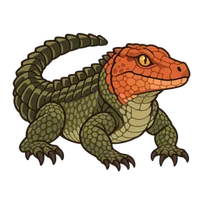
The caiman lizard looks like someone shrank a crocodilian and gave it emerald-green armor and a snail habit. It is one of the most striking lizards in the trade, a genuinely semi-aquatic South American teiid that swims, dives, and crushes freshwater snails and clams with molar-like back teeth. It is also a big commitment: a large, always-warm, always-humid pool that fouls quickly, next to a hot basking branch and proper UVB. Get the water and the space right and it is spectacular. Get them wrong and it goes downhill fast.
Worried, or still setting up? Free tools
Or browse common Caiman Lizard questions →
Care at a glance
| Adult size | Large. Females commonly reach about 4 ft (1.2 m) total length; males can grow up to roughly 5 ft (1.5 m) and 8-12 lb, though much of that length is tail. Plan for a genuinely big animal. |
|---|---|
| Lifespan | Commonly cited at 10+ years in captivity by keeper sources; verified longevity data is thin — the AnAge database lists a maximum recorded captive age of about 9.3 years. Treat ~10+ years as a realistic planning horizon and don't assume more. |
| Enclosure | Think room-sized, not tank-sized. Modern best-practice minimum for one adult is about 8 ft L x 4 ft W x 6 ft H; some older care sheets list 6 x 3 x 4 ft as the floor, but bigger is genuinely better for a swimming, climbing animal. The single most important feature is a large WATER area: a pool taking up roughly one-third to one-half of the floor, at least 12 in deep for adults (20 in is even better) so the lizard can fully submerge and swim, held at about 78 F (range 75-85 F) with a submersible aquarium heater. Water fouls FAST with this messy shellfish-eater: run a large, high-quality external/aquarium filter AND still do full water changes at least weekly, often 2-3x weekly, scrubbing the basin before refilling. On the LAND side, provide sturdy climbing branches under the basking lamp, since wild caiman lizards perch on limbs over water and dive in to escape. |
| Basking / warm zone | Hot basking spot on the land/branch side. Aim for an air basking zone around 100-105 F; keepers who measure the actual basking SURFACE with an IR temp gun target roughly 120-130 F on the perch under the lamp. Verify with a thermometer/IR gun, never guesswork. |
| Cool side | Cool end / ambient roughly 70-80 F, with the warm side sitting 80-90 F, giving a clear thermal gradient across the enclosure. |
| Night | A mild night drop is fine, but do not let temperatures fall below about 75 F. |
| UVB & lighting | Yes, real UVB is required for calcium metabolism and to prevent metabolic bone disease. Use a high-output linear T5 HO tube such as an Arcadia Desert 12% or Zoo Med ReptiSun T5 HO 10.0 (46 in), mounted over the basking branch and replaced on the manufacturer's schedule. Pair it with bright 6500K daytime lighting and run an 11-13 hour photoperiod (shorter in winter, longer in summer). |
| Humidity | High: target 70-80%, and do not let it sit below 60%. The large heated pool does a lot of the work; supplement with misting or a fogger/humidifier and good ventilation to avoid stagnant, mold-prone air. |
| Substrate | On the land side, a moisture-holding mix such as cypress mulch blended with organic topsoil (and a little sand) works well, kept several inches deep (about 6 in) and fully replaced roughly every 3-4 months. Avoid dusty or dry substrates that fight the humidity you are trying to hold. |
| Diet | A shellfish specialist. In the wild they crush freshwater snails, clams, crayfish and crabs with molar-like rear teeth, plus some fish, amphibians and invertebrates. In captivity feed canned/whole snails (a staple), crayfish/crawfish, shrimp, whole fish, plus superworms, dubia roaches, hornworms and earthworms, with occasional egg or small rodent and small amounts of non-citrus fruit. Prey should be no larger than the lizard's skull. Feed juveniles daily; adults about 2-3x per week. |
| Supplements | Lightly dust feeder items (except whole prey like rodents/fish) with a quality calcium-plus-vitamin-D3 supplement such as Repashy Calcium Plus LoD; some keepers add a multivitamin weekly and calcium a couple of times weekly. UVB does much of the D3 work, so avoid stacking heavy D3 dosing on top of strong UVB. |
What it's like to live with a Caiman Lizard
Keep one per enclosure unless you have breeding intentions, huge space and experience. These are large, food-motivated animals; two adults in a shared space risk competition, stress and injury, and the enclosure demands alone make cohabitation hard to do well.
Your first month together
The settling-in period, in order — so you know what's normal and when not to worry.
- Quarantine new imports and get a fecal/parasite check with an exotics vet before anything else - internal parasites are common in this species.
- Build and dial in the full setup BEFORE the lizard arrives: verify basking surface temp, cool end, water temp (~78 F) and humidity (70-80%) with real thermometers/IR gun for several days.
- Get the pool right first - filter running, heater set, water clean - because water quality is where most caiman lizard problems start.
- Feed on a target/tongs and expect a slow settle-in; a stressed new import may refuse food for a while.
- Handle minimally at first; let it learn the routine and start associating you with feeding rather than threat.
Through the year, and as they grow
Wild caiman lizards live in warm, humid flooded forests year-round, so keep conditions stable. A modest seasonal shift in photoperiod (about 11 hours in winter, 13 in summer) mirrors their range and is fine; watch that winter room heating does not quietly drop humidity or ambient temps below target.
The pet store gets these wrong
Common myths, kindly corrected — no shame for having believed them.
- "It's basically a fancy tegu you keep like a tegu." No - it's a semi-aquatic snail specialist. The huge heated pool and shellfish diet are the whole point, not optional extras.
- "A big water bowl is enough water." Not even close. Adults need a pool deep enough (12-20 in) to fully submerge and swim, or they can't behave, thermoregulate or stay healthy.
- "They're too pretty to be hard - good beginner show lizard." The looks are exactly why they get bought by unprepared keepers. The care load (space, water changes, humidity, UVB, specialist diet) is advanced.
- "Wild-caught green lizard, so it must be endangered to keep." Most in the trade today are farmed/captive-produced hatchlings; the species is CITES-listed and was historically hunted for hides, but modern pets are generally farmed imports rather than freshly wild-caught.
- "A filter means you don't have to change the water much." A filter helps, but this messy shellfish-eater still needs frequent full water changes - often several times a week.
Before you buy
- Space: this is an 8 x 4 x 6 ft (minimum) commitment with a large in-enclosure pool - most homes need a purpose-built enclosure, not a store terrarium.
- Water labor: expect to filter AND still change/scrub a large pool multiple times a week for the animal's whole life.
- Specialist diet: you need a reliable supply of snails/shellfish, not just crickets - budget and source for it before buying.
- Cost: heating, T5 HO UVB, filtration, a big enclosure and shellfish feeders add up, plus exotics-vet bills.
- Vet access: confirm a reptile-experienced exotics vet near you first; new imports often carry parasites.
- It's a decade-plus, large-animal commitment - be honest about whether that fits your life.
💷 The caiman lizard itself is usually the cheapest part — see the real cost of keeping one (upfront + ongoing, no sales pitch).
See a reptile vet if…
We can't diagnose from afar — but these are the signs to stop watching and get a professional:
- Not eating, lethargy, or noticeable weight loss for more than a week or two - see an exotics vet.
- Swollen or soft jaw/limbs, tremors, or reluctance to move (possible metabolic bone disease from poor UVB/calcium).
- Wheezing, open-mouth breathing, bubbles or mucus around the nose/mouth (possible respiratory infection).
- Retained shed, especially around toes, tail or eyes, or cloudy/swollen eyes.
- Runny stool, worms in feces, or a new import that seems unwell (parasites are common - get a fecal check).
- Any wound, skin infection, or scale rot from dirty water - clean water problems show up on the skin fast.
Heading in? Print the free Caiman Lizard vet-prep sheet — what to bring, what to tell the vet, and the questions to ask.
Never
- Never house it dry or with only a water bowl - no proper deep, heated pool is a welfare failure for a semi-aquatic species.
- Never let the water sit dirty - foul water quickly causes skin, eye and respiratory infections.
- Never skip UVB or rely on D3 supplements alone - metabolic bone disease follows.
- Never guess temperatures - always verify basking, cool side and water temps with real thermometers/an IR gun.
- Never grab it by the tail or free-handle a stressed new import - use targets/tongs and let it settle.
- Never treat it as a beginner or impulse lizard because it looks striking.
Common caiman lizard questions
How hard are Caiman Lizards to keep — are they good for beginners?
Advanced. This is a large, semi-aquatic, snail-crushing specialist that needs a room-sized, heated, filtered pool AND a warm basking land side, plus high humidity and strong UVB. The water fouls fast, the diet is unusual (shellfish and snails), and adults can top 4-5 feet. It is not a first lizard, or a fifth. Come in with real experience, real space, and a real exotics-vet plan.
What do Caiman Lizards eat?
A shellfish specialist. In the wild they crush freshwater snails, clams, crayfish and crabs with molar-like rear teeth, plus some fish, amphibians and invertebrates. In captivity feed canned/whole snails (a staple), crayfish/crawfish, shrimp, whole fish, plus superworms, dubia roaches, hornworms and earthworms, with occasional egg or small rodent and small amounts of non-citrus fruit. Prey should be no larger than the lizard's skull. Feed juveniles daily; adults about 2-3x per week.
How big an enclosure do Caiman Lizards need?
Think room-sized, not tank-sized. Modern best-practice minimum for one adult is about 8 ft L x 4 ft W x 6 ft H; some older care sheets list 6 x 3 x 4 ft as the floor, but bigger is genuinely better for a swimming, climbing animal. The single most important feature is a large WATER area: a pool taking up roughly one-third to one-half of the floor, at least 12 in deep for adults (20 in is even better) so the lizard can fully submerge and swim, held at about 78 F (range 75-85 F) with a submersible aquarium heater. Water fouls FAST with this messy shellfish-eater: run a large, high-quality external/aquarium filter AND still do full water changes at least weekly, often 2-3x weekly, scrubbing the basin before refilling. On the LAND side, provide sturdy climbing branches under the basking lamp, since wild caiman lizards perch on limbs over water and dive in to escape.
What basking temperature do Caiman Lizards need?
Hot basking spot on the land/branch side. Aim for an air basking zone around 100-105 F; keepers who measure the actual basking SURFACE with an IR temp gun target roughly 120-130 F on the perch under the lamp. Verify with a thermometer/IR gun, never guesswork.
What should the cool side be for Caiman Lizards?
Cool end / ambient roughly 70-80 F, with the warm side sitting 80-90 F, giving a clear thermal gradient across the enclosure.
What night-time temperature do Caiman Lizards need?
A mild night drop is fine, but do not let temperatures fall below about 75 F.
What UVB and lighting do Caiman Lizards need?
Yes, real UVB is required for calcium metabolism and to prevent metabolic bone disease. Use a high-output linear T5 HO tube such as an Arcadia Desert 12% or Zoo Med ReptiSun T5 HO 10.0 (46 in), mounted over the basking branch and replaced on the manufacturer's schedule. Pair it with bright 6500K daytime lighting and run an 11-13 hour photoperiod (shorter in winter, longer in summer).
What humidity do Caiman Lizards need?
High: target 70-80%, and do not let it sit below 60%. The large heated pool does a lot of the work; supplement with misting or a fogger/humidifier and good ventilation to avoid stagnant, mold-prone air.
What substrate do Caiman Lizards need?
On the land side, a moisture-holding mix such as cypress mulch blended with organic topsoil (and a little sand) works well, kept several inches deep (about 6 in) and fully replaced roughly every 3-4 months. Avoid dusty or dry substrates that fight the humidity you are trying to hold.
What supplements do Caiman Lizards need?
Lightly dust feeder items (except whole prey like rodents/fish) with a quality calcium-plus-vitamin-D3 supplement such as Repashy Calcium Plus LoD; some keepers add a multivitamin weekly and calcium a couple of times weekly. UVB does much of the D3 work, so avoid stacking heavy D3 dosing on top of strong UVB.
How big do Caiman Lizards get?
Large. Females commonly reach about 4 ft (1.2 m) total length; males can grow up to roughly 5 ft (1.5 m) and 8-12 lb, though much of that length is tail. Plan for a genuinely big animal.
How long do Caiman Lizards live?
Commonly cited at 10+ years in captivity by keeper sources; verified longevity data is thin — the AnAge database lists a maximum recorded captive age of about 9.3 years. Treat ~10+ years as a realistic planning horizon and don't assume more.
What are the signs Caiman Lizards are sick or need a vet?
See a reptile or exotics vet if you notice: Not eating, lethargy, or noticeable weight loss for more than a week or two - see an exotics vet.; Swollen or soft jaw/limbs, tremors, or reluctance to move (possible metabolic bone disease from poor UVB/calcium).; Wheezing, open-mouth breathing, bubbles or mucus around the nose/mouth (possible respiratory infection).; Retained shed, especially around toes, tail or eyes, or cloudy/swollen eyes.; Runny stool, worms in feces, or a new import that seems unwell (parasites are common - get a fecal check).; Any wound, skin infection, or scale rot from dirty water - clean water problems show up on the skin fast..
Your first two weeks · Taming & handling · Behaviours explained · Won't eat? · Stuck shed · When to see a vet

Get the free Caiman Lizard Starter Kit
A one-page setup criteria checklist and a first-30-days plan for your first caiman lizard — what to get, what makes each thing matter, and the honest bits the pet shop skips. Join the den and we’ll send it over.
Free reptile care cheat-sheet the moment you join. No spam — unsubscribe anytime. See how we handle your data in our privacy notice.Sources & further reading
This guide was written and fact-checked against these authorities. It's kind, general guidance — not a diagnosis or a substitute for an exotics vet:
- Reptiles Magazine - Caiman Lizard Care Sheet — Enclosure minimums, water depth (20 in), water temp 75-85 F, basking 100 F+, ambient 80-90 F, night not below 75 F, humidity 60-80%, adult size/weight, ~10 yr lifespan, diet and supplements.
- Reptile Direct - Caiman Lizard Care — 6x3x4 ft adult minimum, basking 100-105 F, cool side 80-90 F, night ~75 F, humidity 60-80%, adult length 4-5 ft, ~10 yr lifespan, substrate and supplement guidance.
- DubiaRoaches.com - Caiman Lizard Care Sheet — Modern 8x4x6 ft minimum, pool 1/2-1/3 floor and 12 in deep at ~78 F, basking surface 120-130 F, cool side 70-80 F, T5 HO UVB (Arcadia 12% / ReptiSun 10.0 46 in), humidity 70-80%, weekly water changes, diet and Repashy Calcium Plus LoD.
- Reptile Supply - How to Care for Your Caiman Lizard — 8x4x6 ft enclosure, pool depth/temp, basking 120-130 F, cool end down to 70 F, T5 HO UVB bulbs and photoperiod, humidity 70-80%, substrate depth/replacement, diet/supplements.
- Wikipedia - Northern caiman lizard (Dracaena guianensis) — Family Teiidae, native flooded-forest/swamp range, semi-aquatic behavior, snail/mollusk/crayfish diet and shell-crushing dentition, size, CITES Appendix II and farmed-import status.
- Reptiles Magazine - Caiman Lizard Care and Information — Water filtration best practice plus frequent (weekly to 2-3x weekly) water changes, water 75-85 F, farmed/captive-bred trade status, parasite and health concerns, advanced difficulty.
- A-Z Animals - Caiman Lizard — Lifespan (wild 8-12 yr, captivity 12-20 yr), size, semi-aquatic dive-to-escape behavior, basking on branches over water, apple-snail specialization.
Written and fact-checked by The Baskden Team against veterinarian-authored sources — if your reptile shows a red-flag sign above, see an exotics vet promptly.