
Species · Beginner snake
Carpet Python
Morelia spilota
A beautiful semi-arboreal python — often feisty as a youngster, but a rewarding intermediate keeper's snake.
Difficulty: Beginner–Intermediate Printable care sheet →
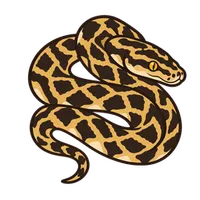
Carpet pythons are the bright, curious, semi-arboreal pythons of Australia and New Guinea — the snake a lot of keepers "graduate" to after a ball python. They're beautifully patterned, genuinely active (they climb, hunt, and explore), and tame down into confident, handleable animals. The catch is honest: this is a strong 5-to-8-foot snake that lives 20-plus years, so buy the enclosure and the decades before you buy the hatchling.
Worried, or still setting up? Free tools
Or browse common Carpet Python questions →
Care at a glance
| Adult size | Typically 5–8 ft (1.5–2.5 m). Coastal (M. s. mcdowelli) is the largest, regularly reaching 9 ft (2.7–3 m); Darwin (M. s. variegata) is the smallest at ~4–6 ft (1.2–1.8 m). Jungle and Irian Jaya sit around 5–7 ft. |
|---|---|
| Lifespan | 20–30+ years in captivity with correct husbandry — plan for a two-decade-plus commitment. |
| Enclosure | Adult minimum roughly 6.5 ft L x 3 ft W x 3 ft H (2 x 0.9 x 0.9 m); bigger and taller is always better. These are semi-arboreal — height for sturdy climbing branches matters as much as floor space. Smaller subspecies (Darwin) do fine in a 4 x 2 x 2 ft footprint as adults. |
| Basking / warm zone | Warm hotspot 88–95°F (31–35°C). ReptiFiles targets a warmer basking surface of 95–100°F (35–38°C) under a halogen; PetMD's vet sheet gives a warm end of 85–90°F. Aim for a genuine surface hotspot in the low-to-mid 90s and let the snake choose. |
| Cool side | 75–80°F (24–26°C) at the cool end — a true thermal gradient across the enclosure is the goal, not one uniform temperature. |
| Night | 72–78°F (22–25°C); a natural night drop is fine and healthy. Don't let it fall below 70°F (21°C). A small seasonal winter dip of 5–10°F is normal and can help mature adults. |
| UVB & lighting | Low-need but beneficial, not strictly essential. A T5 HO 5–6% bulb (Zoo Med Reptisun 5.0 / Arcadia Forest 6%) giving a basking-zone UVI of ~2.0–3.0 (Ferguson Zone 1–2) supports natural behavior and D3 synthesis. Provide UVB gradient shade. If you skip UVB, dust prey with D3 more consistently — modern best practice leans toward offering it. |
| Humidity | 40–60% ambient is the everyday target, with a humid hide (moist sphagnum moss) always available. Let it rise toward 60–70% during a shed. Chronically wet, stagnant air causes respiratory infection and scale rot — ventilate. |
| Substrate | 2–4 in of a moisture-holding, absorbent substrate: cypress mulch, coconut fiber, ReptiSoil/topsoil blends, or aspen for drier setups. Newspaper/paper towel works for quarantine or hatchlings. Avoid anything dusty or aromatic (cedar/pine). |
| Diet | Obligate carnivore fed whole frozen-thawed rodents sized to the snake's girth (mice up graduating to appropriately sized rats). Hatchlings/juveniles every 7–10 days; adults every 10–14 days, tapering to every 2–4 weeks for large adults. Feed roughly 10% of body weight per meal — carpets stay lean and active, and overfeeding is a real welfare risk. |
| Supplements | If not offering UVB, lightly dust prey with a calcium + D3 supplement occasionally, plus an occasional multivitamin. With good UVB and whole-prey feeding, supplementation needs are minimal. |
What it's like to live with a Carpet Python
House one carpet python per enclosure. Pythons are solitary and cohabitation risks stress, competition at feeding, and cannibalism (larger carpets will eat smaller snakes). No tankmates, no pairs "for company."
Your first month together
The settling-in period, in order — so you know what's normal and when not to worry.
- Set the enclosure up and run it EMPTY for a week — verify a stable hotspot in the low-90s°F and a 75–80°F cool end with two thermometers plus a thermostat on the heat source before the snake arrives.
- Give hides at BOTH the warm and cool ends plus a humid hide, so the snake never has to choose between feeling secure and feeling the right temperature.
- Leave a new hatchling alone for the first 1–2 weeks except spot-cleaning — let it settle and take a first meal before any handling.
- Offer the first meal in the evening; hatchlings can be shy feeders, so dim the room and give privacy. Don't handle for 48 hours after a meal.
- Once it's eating reliably, start short, calm handling sessions to build a confident adult — young carpets can be nippy and food-driven, and gentle routine fixes that.
Through the year, and as they grow
Carpets respond to seasons: a mild winter cool-down (nights toward the low 70s°F, a slightly shorter ~10-hour photoperiod) is natural and often precedes breeding behavior. Appetite may dip in winter — a healthy adult refusing a meal or two in the cool months is usually normal, not cause for alarm.
The pet store gets these wrong
Common myths, kindly corrected — no shame for having believed them.
- "Carpet pythons are aggressive." Hatchlings are defensive and food-motivated (those needle teeth are startling, not dangerous), but with routine handling nearly all grow into calm, confident adults.
- "Any big tank will do." They're semi-arboreal — vertical space and climbing branches matter, and a bare-floor tub sells the animal short.
- "Snakes don't need UVB." Carpets do fine without it, but low-level UVB is genuinely beneficial; the modern standard is to offer a gradient, not to insist it's pointless.
- "They only eat live prey." Frozen-thawed is safer (no bite injuries to the snake) and readily accepted by well-started carpets.
- "Two can share a big enclosure." No — they're solitary and larger carpets will cannibalize smaller snakes.
Before you buy
- This is a 5–8 ft, strong, long-lived snake — buy the 6+ ft adult enclosure and the 20+ year commitment up front, not 'when it grows.'
- Confirm the subspecies: a Coastal can hit 9 ft while a Darwin stays ~5 ft, which changes the enclosure you need.
- You'll need a reliable frozen-rodent supply and freezer space for years.
- Hatchlings are nippy and semi-arboreal escape artists — a secure, lockable enclosure is non-negotiable.
- Have a reptile-experienced exotics vet identified before you bring one home.
💷 The carpet python itself is usually the cheapest part — see the real cost of keeping one (upfront + ongoing, no sales pitch).
See a reptile vet if…
We can't diagnose from afar — but these are the signs to stop watching and get a professional:
- Open-mouth breathing, wheezing, mucus/bubbles around the nose or mouth, or gaping — possible respiratory infection; see an exotics vet promptly.
- Repeated regurgitation of meals — stop feeding and get veterinary advice (often a temperature or handling issue, sometimes parasites/infection).
- Cheesy or yellow material, redness, or swelling in the mouth — possible mouth rot (infectious stomatitis).
- Prolonged loss of appetite paired with weight loss or lethargy (a healthy carpet may fast seasonally, but decline + weight loss is a red flag).
- Retained shed, especially eye caps, or tiny moving dots (mites) — address husbandry and see a vet if it persists.
- Any wound, burn, unusual lump, or persistent behavior change.
Heading in? Print the free Carpet Python vet-prep sheet — what to bring, what to tell the vet, and the questions to ask.
Never
- Never house two carpet pythons together — solitary snakes, and larger ones eat smaller ones.
- Never use an unregulated heat mat or bulb without a thermostat — burns are one of the most common serious injuries.
- Never keep them in constantly soggy, poorly ventilated air — it causes respiratory infection and scale rot.
- Never use cedar or pine shavings — the aromatic oils are toxic to snakes.
- Never handle for 48 hours after a meal, and never free-roam an unsupervised python — they're strong climbers and escape artists.
Common carpet python questions
How hard are Carpet Pythons to keep — are they good for beginners?
Beginner–Intermediate. A hardy, forgiving first "big snake" — but emphasis on big. Care is simple once the enclosure is right; the real leap from a ball python is size, strength, and the alert, food-motivated attitude of a young carpet. Handleable and rewarding, just not a starter snake for someone wanting something small.
What do Carpet Pythons eat?
Obligate carnivore fed whole frozen-thawed rodents sized to the snake's girth (mice up graduating to appropriately sized rats). Hatchlings/juveniles every 7–10 days; adults every 10–14 days, tapering to every 2–4 weeks for large adults. Feed roughly 10% of body weight per meal — carpets stay lean and active, and overfeeding is a real welfare risk.
How big an enclosure do Carpet Pythons need?
Adult minimum roughly 6.5 ft L x 3 ft W x 3 ft H (2 x 0.9 x 0.9 m); bigger and taller is always better. These are semi-arboreal — height for sturdy climbing branches matters as much as floor space. Smaller subspecies (Darwin) do fine in a 4 x 2 x 2 ft footprint as adults.
What basking temperature do Carpet Pythons need?
Warm hotspot 88–95°F (31–35°C). ReptiFiles targets a warmer basking surface of 95–100°F (35–38°C) under a halogen; PetMD's vet sheet gives a warm end of 85–90°F. Aim for a genuine surface hotspot in the low-to-mid 90s and let the snake choose.
What should the cool side be for Carpet Pythons?
75–80°F (24–26°C) at the cool end — a true thermal gradient across the enclosure is the goal, not one uniform temperature.
What night-time temperature do Carpet Pythons need?
72–78°F (22–25°C); a natural night drop is fine and healthy. Don't let it fall below 70°F (21°C). A small seasonal winter dip of 5–10°F is normal and can help mature adults.
What UVB and lighting do Carpet Pythons need?
Low-need but beneficial, not strictly essential. A T5 HO 5–6% bulb (Zoo Med Reptisun 5.0 / Arcadia Forest 6%) giving a basking-zone UVI of ~2.0–3.0 (Ferguson Zone 1–2) supports natural behavior and D3 synthesis. Provide UVB gradient shade. If you skip UVB, dust prey with D3 more consistently — modern best practice leans toward offering it.
What humidity do Carpet Pythons need?
40–60% ambient is the everyday target, with a humid hide (moist sphagnum moss) always available. Let it rise toward 60–70% during a shed. Chronically wet, stagnant air causes respiratory infection and scale rot — ventilate.
What substrate do Carpet Pythons need?
2–4 in of a moisture-holding, absorbent substrate: cypress mulch, coconut fiber, ReptiSoil/topsoil blends, or aspen for drier setups. Newspaper/paper towel works for quarantine or hatchlings. Avoid anything dusty or aromatic (cedar/pine).
What supplements do Carpet Pythons need?
If not offering UVB, lightly dust prey with a calcium + D3 supplement occasionally, plus an occasional multivitamin. With good UVB and whole-prey feeding, supplementation needs are minimal.
How big do Carpet Pythons get?
Typically 5–8 ft (1.5–2.5 m). Coastal (M. s. mcdowelli) is the largest, regularly reaching 9 ft (2.7–3 m); Darwin (M. s. variegata) is the smallest at ~4–6 ft (1.2–1.8 m). Jungle and Irian Jaya sit around 5–7 ft.
How long do Carpet Pythons live?
20–30+ years in captivity with correct husbandry — plan for a two-decade-plus commitment.
What are the signs Carpet Pythons are sick or need a vet?
See a reptile or exotics vet if you notice: Open-mouth breathing, wheezing, mucus/bubbles around the nose or mouth, or gaping — possible respiratory infection; see an exotics vet promptly.; Repeated regurgitation of meals — stop feeding and get veterinary advice (often a temperature or handling issue, sometimes parasites/infection).; Cheesy or yellow material, redness, or swelling in the mouth — possible mouth rot (infectious stomatitis).; Prolonged loss of appetite paired with weight loss or lethargy (a healthy carpet may fast seasonally, but decline + weight loss is a red flag).; Retained shed, especially eye caps, or tiny moving dots (mites) — address husbandry and see a vet if it persists.; Any wound, burn, unusual lump, or persistent behavior change..
Your first two weeks · Taming & handling · Behaviours explained · Won't eat? · Stuck shed · When to see a vet

Get the free Carpet Python Starter Kit
A one-page setup criteria checklist and a first-30-days plan for your first carpet python — what to get, what makes each thing matter, and the honest bits the pet shop skips. Join the den and we’ll send it over.
Free reptile care cheat-sheet the moment you join. No spam — unsubscribe anytime. See how we handle your data in our privacy notice.Sources & further reading
This guide was written and fact-checked against these authorities. It's kind, general guidance — not a diagnosis or a substitute for an exotics vet:
- ReptiFiles — Carpet Python Care Sheet (Morelia spilota) — Primary keeper authority: enclosure 6.5'x3'x3', basking 95-100°F, cool 75-80°F, night 72-78°F, UVI 2.0-3.0 (T5 5-6%), humidity 40-60%, diet & feeding frequency, substrate, lifespan.
- PetMD — Pet Python Snake Care Sheet (vet-reviewed, Melissa Witherell, DVM) — Vet-reviewed corroboration: warm end 85-90°F, cool 75-80°F, night not below 70°F, humidity 40-60%, feeding frequency, and vet red flags (respiratory disease, regurgitation, mouth rot, anorexia).
- ReptileVault — Carpet Python Care Sheet — Corroborates basking ~90°F, cool 75-78°F, humidity 50-70%, UVI 1-2 (Ferguson Zone 2), substrate options, adult size 6-9 ft by subspecies.
- Wikipedia — Morelia spilota (taxonomy & subspecies) — Family Pythonidae; subspecies sizes — Coastal (mcdowelli) largest at 2.7-3.0 m, Darwin (variegata) smallest at 120-180 cm; native range.
Written and fact-checked by The Baskden Team against veterinarian-authored sources — if your reptile shows a red-flag sign above, see an exotics vet promptly.