
Species · Box turtle
Eastern Box Turtle
Terrapene carolina carolina
A terrestrial woodland turtle — NOT a tank turtle — that wants a big humid land space, a shallow soak, and decades of care.
Difficulty: Intermediate Printable care sheet →
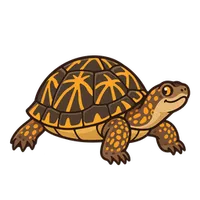
The Eastern box turtle is a woodland turtle that lives on land — not in a pond. It roams the forest floor, burrows into damp leaf litter, and hinges its shell shut like a little box when it feels threatened. That "land turtle" identity is the whole game: give it a big, humid, deeply planted floor with a shallow soak dish and it thrives; stick it in a dry aquarium and it slowly declines. If you can offer a spacious outdoor pen for part of the year, this is one of the most rewarding, personable, long-lived reptiles you can keep.
Worried, or still setting up? Free tools
Or browse common Eastern Box Turtle questions →
Care at a glance
| Adult size | Roughly 4.5–8 in / 11–20 cm shell (carapace) length; commonly around 4–6 in / 10–15 cm (ReptiFiles; Smithsonian National Zoo). |
|---|---|
| Lifespan | Decades — 40+ years is normal in good captive care, with wild individuals often 25–35 years and documented maximums well past 100. Plan for a lifelong, possibly-outlives-you commitment (ReptiFiles; Smithsonian National Zoo). |
| Enclosure | Think land floor space, not a fish tank. Indoor minimum is about 5.5 ft L x 3 ft W x 1.5 ft H (1.6 x 0.8 x 0.4 m), roughly 14 sq ft / 1.3 sq m of floor, and bigger is always better (ReptiFiles). A secure OUTDOOR pen is the gold standard — walls at least 2 ft (0.6 m) tall and sunk ~12 in (30 cm) into the soil to stop digging escapes (ReptiFiles). This is NOT an aquatic turtle: instead of a swim tank it needs a SHALLOW soak/water dish no deeper than the turtle's "knees," with an easy ramp in and out, cleaned daily because they drink and defecate in it (ReptiFiles; VCA). |
| Basking / warm zone | Basking spot 84-88°F / 29-31°C (ReptiFiles). Some sources list a warmer zone, but for this shade-dwelling woodland species keep it moderate — aim for the lower, well-ventilated end, and always pair it with a cooler, shaded, humid retreat it can escape into. |
| Cool side | Cool end about 70–75°F / 21–24°C (ReptiFiles; VCA). |
| Night | Nighttime can safely drop to about 50°F / 10°C for this temperate species (ReptiFiles); a gentle night drop is normal and healthy. VCA notes 65–70°F / 18–24°C is also fine indoors with no supplemental heat needed. |
| UVB & lighting | Yes — UVB is essential (it drives vitamin D3 and calcium absorption; without it you get metabolic bone disease). Use a linear T5 HO tube such as Arcadia 6% or Zoo Med ReptiSun 5.0, mounted over the basking area to hit a UV Index of about 3.0–4.0 (ReptiFiles). Mount distance: ~13–14 in / 33–36 cm below the lamp if there's mesh between bulb and turtle, or ~17–18 in / 43–46 cm with no mesh (ReptiFiles). Never filter UVB through glass or plastic, and replace the bulb per the maker's schedule (roughly every 6–12 months) (VCA). A turtle living outdoors in real sunlight needs no artificial UVB. |
| Humidity | High — target an average of 60–80%, and don't let daytime humidity fall below ~51% (ReptiFiles). Always provide a humid hide on the cool side lined with damp substrate, and mist/soak as needed. Chronic dryness causes shell and eye problems. |
| Substrate | Deep and MOIST so the turtle can burrow. Indoors, use at least 4 in / 10 cm of a water-holding mix — e.g. roughly 40% organic topsoil, 40% coir/Reptisoil, 20% play sand — topped with a leaf-litter layer of at least ~1 in / 2.5 cm (more is better). Outdoors, aim for ~12 in / 30 cm of soil for digging and brumation (ReptiFiles). Avoid bare setups on sand alone, gravel, wood shavings, corn cob, or walnut shell (VCA). |
| Diet | Omnivore, split roughly 50% animal matter / 50% plant matter for adults; juveniles are more carnivorous (~70–80% protein) and shift toward plants as they mature (ReptiFiles; VCA; Merck). Protein: earthworms, crickets, grasshoppers, mealworms, hard-boiled egg, and quality reptile/turtle pellets. Greens: dandelion, collard, mustard and turnip greens, kale, bok choy, watercress, plus squash, carrot, and bell pepper. Fruit is a small treat — under ~10% of the diet (berries, melon, apple, pear, fig). Feed juveniles daily, adults every other day. Skip iceberg lettuce, celery, dog/cat food, and wild-caught insects (VCA). |
| Supplements | Dust food with a calcium (no-D3) supplement, and use a D3 multivitamin lightly — VCA suggests calcium roughly 2–3x/week and a multivitamin about weekly; ReptiFiles uses an alternating ~50/50 calcium/multivitamin approach. Offer a cuttlebone for free-choice calcium and beak wear. Don't over-supplement fat-soluble vitamins, especially D3, if UVB is good (VCA). |
What it's like to live with a Eastern Box Turtle
Keep box turtles singly. Cohabiting is not recommended — they don't need company, and crowding causes stress, competition, bullying, and disease spread (ReptiFiles). Do not mix box turtles with other species or with wild-caught turtles (disease risk). They can be handled gently but are not "cuddly"; too much handling stresses them.
Your first month together
The settling-in period, in order — so you know what's normal and when not to worry.
- Confirm the LAW first: Eastern box turtles are protected native wildlife across their range — buy only a legal, captive-bred animal with paperwork, and NEVER take one from the wild.
- Build the big humid land enclosure BEFORE the turtle arrives — deep moist substrate, leaf litter, humid hide, a shallow soak dish, and a proper basking + UVB setup with a working thermal gradient.
- Verify temps and humidity with real thermometers/hygrometer and a UV Index meter (or correct bulb + distance) — don't guess.
- Find an exotics/reptile vet now and book a new-pet health check plus a fecal parasite screen (wild-origin turtles often carry parasites).
- Offer water in a shallow ramped dish daily and soak the turtle in shallow lukewarm water a few times a week while it settles.
- Feed a varied omnivore diet with calcium dusting, and expect a shy new turtle to hide and eat little for the first week or two — that's normal.
Through the year, and as they grow
Temperate Eastern box turtles are seasonal animals. In fall (roughly Oct/Nov) northern turtles enter brumation (a hibernation-like dormancy) and stay dormant until spring (~April), burrowing into deep soil/leaf-litter hibernacula; southern turtles may stay active year-round (Smithsonian). ReptiFiles notes hibernation facilities must be provided in winter. Only brumate a healthy, well-fed, vet-checked adult in appropriate cool conditions — sick or underweight turtles should be kept warm and active instead. Also shift photoperiod seasonally (about 14 h light in summer, 10 h in winter).
The pet store gets these wrong
Common myths, kindly corrected — no shame for having believed them.
- "It's a turtle, so it needs a swim tank." No. This is a terrestrial woodland turtle — it drowns risk in deep water. It needs a big humid LAND enclosure with only a shallow soak dish, not a pond.
- "Box turtle, box tortoise — same thing." It's a true turtle (family Emydidae), not a tortoise. That's why it needs high humidity and moist substrate rather than an arid setup.
- "A 20-gallon tank is fine." A small tank is where box turtles slowly fail. They need many square feet of floor space, ideally an outdoor pen — floor area matters far more than tank gallons.
- "Just grab one from the yard/woods." Wild collection is illegal across their range and harms already-declining populations. Box turtles have tiny home ranges and often die trying to return home when relocated — get a legal captive-bred animal instead.
- "They mostly eat lettuce/veg." They're true omnivores that need real animal protein (worms, insects) alongside greens; a fruit-and-lettuce diet causes deficiencies.
Before you buy
- It's likely ILLEGAL to take one from the wild — Eastern box turtles are protected native wildlife across their range; buy only legal, captive-bred stock.
- This is a decades-long commitment (40+ years) — it may outlive your current living situation, so plan for its whole life.
- It needs a large, humid land enclosure — an outdoor pen is ideal; a small dry aquarium will not work.
- Temperate box turtles brumate in winter — you'll need to manage a cool dormancy period or a proper indoor overwinter setup.
- Exotics vet care (initial check, parasite screen, and future visits) is part of the real cost — line up a reptile vet before you commit.
💷 The eastern box turtle itself is usually the cheapest part — see the real cost of keeping one (upfront + ongoing, no sales pitch).
See a reptile vet if…
We can't diagnose from afar — but these are the signs to stop watching and get a professional:
- Soft, bumpy, or deformed shell, a rubbery jaw, or trouble walking — possible metabolic bone disease from poor UVB/calcium; see an exotics vet.
- Puffy, swollen, or crusted/closed eyes, or a runny nose, gaping, or wheezing/bubbling — possible vitamin A deficiency or respiratory infection; get seen promptly.
- Refusing food for an extended period, sunken eyes, lethargy, or noticeable weight loss (outside of intended brumation) — see a vet.
- Cheesy white plaques in the mouth, drooling, or a swollen/abscessed ear (a lump behind the eye) — needs veterinary treatment.
- Blood in the water, straining, prolapse, or shell wounds/rot with soft or foul-smelling patches — urgent exotics-vet visit.
Heading in? Print the free Eastern Box Turtle vet-prep sheet — what to bring, what to tell the vet, and the questions to ask.
Never
- Never house it like an aquatic turtle in deep water — it can drown; use only a shallow, ramped soak dish.
- Never keep it in a small, dry aquarium — cramped, low-humidity setups cause chronic decline.
- Never skip UVB (or run it through glass/plastic) — that leads to fatal metabolic bone disease.
- Never take a box turtle from the wild — it's illegal across its range, harms wild populations, and relocated turtles often die trying to get home.
- Never feed a diet of just fruit and lettuce, dog/cat food, or wild-caught insects — cause deficiencies, imbalance, or pesticide poisoning.
- Never cohabit box turtles or mix them with other/wild turtles — stress, bullying, and disease transmission.
Common eastern box turtle questions
How hard are Eastern Box Turtles to keep — are they good for beginners?
Intermediate. Not hard to feed, but genuinely hard to house well. Box turtles need a big, humid, deep-substrate LAND enclosure (an outdoor pen is ideal), precise UVB, a proper thermal gradient, and — for temperate ones — a cool winter brumation period. They also live for decades, so this is a multi-decade commitment, not a starter pet. The single biggest failure point is trying to keep them in a small dry tank.
What do Eastern Box Turtles eat?
Omnivore, split roughly 50% animal matter / 50% plant matter for adults; juveniles are more carnivorous (~70–80% protein) and shift toward plants as they mature (ReptiFiles; VCA; Merck). Protein: earthworms, crickets, grasshoppers, mealworms, hard-boiled egg, and quality reptile/turtle pellets. Greens: dandelion, collard, mustard and turnip greens, kale, bok choy, watercress, plus squash, carrot, and bell pepper. Fruit is a small treat — under ~10% of the diet (berries, melon, apple, pear, fig). Feed juveniles daily, adults every other day. Skip iceberg lettuce, celery, dog/cat food, and wild-caught insects (VCA).
How big an enclosure do Eastern Box Turtles need?
Think land floor space, not a fish tank. Indoor minimum is about 5.5 ft L x 3 ft W x 1.5 ft H (1.6 x 0.8 x 0.4 m), roughly 14 sq ft / 1.3 sq m of floor, and bigger is always better (ReptiFiles). A secure OUTDOOR pen is the gold standard — walls at least 2 ft (0.6 m) tall and sunk ~12 in (30 cm) into the soil to stop digging escapes (ReptiFiles). This is NOT an aquatic turtle: instead of a swim tank it needs a SHALLOW soak/water dish no deeper than the turtle's "knees," with an easy ramp in and out, cleaned daily because they drink and defecate in it (ReptiFiles; VCA).
What basking temperature do Eastern Box Turtles need?
Basking spot 84-88°F / 29-31°C (ReptiFiles). Some sources list a warmer zone, but for this shade-dwelling woodland species keep it moderate — aim for the lower, well-ventilated end, and always pair it with a cooler, shaded, humid retreat it can escape into.
What should the cool side be for Eastern Box Turtles?
Cool end about 70–75°F / 21–24°C (ReptiFiles; VCA).
What night-time temperature do Eastern Box Turtles need?
Nighttime can safely drop to about 50°F / 10°C for this temperate species (ReptiFiles); a gentle night drop is normal and healthy. VCA notes 65–70°F / 18–24°C is also fine indoors with no supplemental heat needed.
What UVB and lighting do Eastern Box Turtles need?
Yes — UVB is essential (it drives vitamin D3 and calcium absorption; without it you get metabolic bone disease). Use a linear T5 HO tube such as Arcadia 6% or Zoo Med ReptiSun 5.0, mounted over the basking area to hit a UV Index of about 3.0–4.0 (ReptiFiles). Mount distance: ~13–14 in / 33–36 cm below the lamp if there's mesh between bulb and turtle, or ~17–18 in / 43–46 cm with no mesh (ReptiFiles). Never filter UVB through glass or plastic, and replace the bulb per the maker's schedule (roughly every 6–12 months) (VCA). A turtle living outdoors in real sunlight needs no artificial UVB.
What humidity do Eastern Box Turtles need?
High — target an average of 60–80%, and don't let daytime humidity fall below ~51% (ReptiFiles). Always provide a humid hide on the cool side lined with damp substrate, and mist/soak as needed. Chronic dryness causes shell and eye problems.
What substrate do Eastern Box Turtles need?
Deep and MOIST so the turtle can burrow. Indoors, use at least 4 in / 10 cm of a water-holding mix — e.g. roughly 40% organic topsoil, 40% coir/Reptisoil, 20% play sand — topped with a leaf-litter layer of at least ~1 in / 2.5 cm (more is better). Outdoors, aim for ~12 in / 30 cm of soil for digging and brumation (ReptiFiles). Avoid bare setups on sand alone, gravel, wood shavings, corn cob, or walnut shell (VCA).
What supplements do Eastern Box Turtles need?
Dust food with a calcium (no-D3) supplement, and use a D3 multivitamin lightly — VCA suggests calcium roughly 2–3x/week and a multivitamin about weekly; ReptiFiles uses an alternating ~50/50 calcium/multivitamin approach. Offer a cuttlebone for free-choice calcium and beak wear. Don't over-supplement fat-soluble vitamins, especially D3, if UVB is good (VCA).
How big do Eastern Box Turtles get?
Roughly 4.5–8 in / 11–20 cm shell (carapace) length; commonly around 4–6 in / 10–15 cm (ReptiFiles; Smithsonian National Zoo).
How long do Eastern Box Turtles live?
Decades — 40+ years is normal in good captive care, with wild individuals often 25–35 years and documented maximums well past 100. Plan for a lifelong, possibly-outlives-you commitment (ReptiFiles; Smithsonian National Zoo).
What are the signs Eastern Box Turtles are sick or need a vet?
See a reptile or exotics vet if you notice: Soft, bumpy, or deformed shell, a rubbery jaw, or trouble walking — possible metabolic bone disease from poor UVB/calcium; see an exotics vet.; Puffy, swollen, or crusted/closed eyes, or a runny nose, gaping, or wheezing/bubbling — possible vitamin A deficiency or respiratory infection; get seen promptly.; Refusing food for an extended period, sunken eyes, lethargy, or noticeable weight loss (outside of intended brumation) — see a vet.; Cheesy white plaques in the mouth, drooling, or a swollen/abscessed ear (a lump behind the eye) — needs veterinary treatment.; Blood in the water, straining, prolapse, or shell wounds/rot with soft or foul-smelling patches — urgent exotics-vet visit..
Your first two weeks · Taming & handling · Behaviours explained · Won't eat? · Stuck shed · When to see a vet

Get the free Eastern Box Turtle Starter Kit
A one-page setup criteria checklist and a first-30-days plan for your first eastern box turtle — what to get, what makes each thing matter, and the honest bits the pet shop skips. Join the den and we’ll send it over.
Free reptile care cheat-sheet the moment you join. No spam — unsubscribe anytime. See how we handle your data in our privacy notice.Sources & further reading
This guide was written and fact-checked against these authorities. It's kind, general guidance — not a diagnosis or a substitute for an exotics vet:
- ReptiFiles — Eastern Box Turtle Care Sheet — Specialist care source: enclosure size, temps, UVB bulb/UVI/distance, humidity, substrate depth/mix, soak-dish depth, 50/50 diet, supplements, brumation.
- VCA Animal Hospitals — Housing Box Turtles — Vet-authored: temperature ranges, UVB spectrum/distance/replacement, substrate do/don'ts, shallow ramped soak dish, MBD warning.
- VCA Animal Hospitals — Feeding Box Turtles — Vet-authored: 50/50 adult diet, juvenile carnivory, safe greens/protein/fruit, foods to avoid, calcium 2–3x/week + weekly multivitamin.
- Smithsonian's National Zoo — Eastern Box Turtle — Biology authority: family Emydidae, adult size, lifespan (25–35 wild, 100+ max), terrestrial woodland habitat, omnivore diet, brumation.
- Merck Veterinary Manual — Nutrition in Reptiles — Vet reference corroborating juvenile ~70–80% protein shifting to ~50/50 in adults, and calcium supplementation guidance.
Written and fact-checked by The Baskden Team against veterinarian-authored sources — if your reptile shows a red-flag sign above, see an exotics vet promptly.