
Species · Arboreal lizard
Frilled Dragon
Chlamydosaurus kingii
The umbrella-necked 'dinosaur' lizard — that flaring frill display is unforgettable, but it wants height and heat.
Difficulty: Intermediate Printable care sheet →
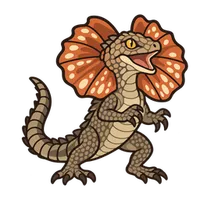
The frilled dragon is the one with the umbrella - that dramatic neck frill it flares open, mouth gaping, when it wants to look terrifying (it mostly just wants you to leave). Behind the theatrics it's a tall-treetop Aussie agama that basks blisteringly hot, drinks up strong UVB, and runs on two legs when startled. Give it height, real heat, and a proper thermal gradient and it's one of the most charismatic lizards you can keep - just go in knowing it's a look-don't-maul-me pet more than a lap pet.
Worried, or still setting up? Free tools
Or browse common Frilled Dragon questions →
Care at a glance
| Adult size | Around 85-90 cm (33-35 in) total length, most of that tail; males noticeably larger and heavier-built than females, reaching roughly 600 g+. New Guinea-locality animals stay smaller, often closer to 60-65 cm (~2 ft). |
|---|---|
| Lifespan | Commonly 10-15 years in captivity with good husbandry; females can run a little shorter due to reproductive stress. |
| Enclosure | Tall and arboreal. Treat 4 x 2 x 4 ft (L x D x H, ~120 x 60 x 120 cm) as a realistic adult minimum, and go taller/bigger where you can - many keepers aim for ~4 x 2.5 x 5-6 ft. Vertical space and climbing branches matter more than floor area for this species. Babies do better started in smaller enclosures so they can find prey and warmth. |
| Basking / warm zone | A genuinely hot basking surface of about 105–115°F (40–46°C) directly under the lamp. Aim for the middle of that band and verify with a probe/temp gun at the branch, not a guess. |
| Cool side | Warm-side ambient in the mid-to-high 80s°F (~29-32°C), grading down to a cool end around 75-80°F (24-27°C) so the animal can thermoregulate. |
| Night | A natural nighttime drop to about 70-78°F (21-26°C) is fine and healthy; try not to let it fall below ~68-70°F (20-21°C). |
| UVB & lighting | High UVB need. Use a high-output T5 HO tube (Arcadia 12% / Zoo Med 10.0 or similar) spanning roughly the warm two-thirds of the enclosure, positioned to give a basking-zone UV Index of about 3–5 (Ferguson Zone 2, the standard classification for this species). Distance depends on the fixture and whether there's mesh in between — measure with a Solarmeter if you can. Replace the tube on schedule (about every 12 months for quality T5 HO), not when it stops glowing. |
| Humidity | Moderate: aim for roughly 50-70% average, allowed to swing (drier by day, higher overnight/after misting). Provide good ventilation and let it dry out between mistings - chronically damp, stagnant air above ~75% is linked to respiratory infection. |
| Substrate | A moisture-holding, naturalistic mix works well for adults - cypress mulch, coconut fiber, or a soil/organic-topsoil blend - deep enough to hold humidity (and for females, a deeper lay-box area). Skip loose sand-only setups, cedar, and pine. Very young animals are often kept on paper towel to reduce impaction risk and make prey easy to find. |
| Diet | Primarily insectivorous. Base the diet on gut-loaded, varied feeder insects: crickets, dubia and other roaches, black soldier fly larvae (calciworms), locusts, plus occasional hornworms, silkworms and (sparingly) waxworms/superworms as treats. Many adults also nibble some greens/soft fruit, and occasional vertebrate prey (e.g. a pinky) is a rare extra, not a staple. Feed hatchlings/juveniles daily; adults roughly every 2-3 days / several times a week. |
| Supplements | Dust feeders with a phosphorus-free calcium (plain calcium most feedings; a calcium + D3 product where UVB coverage is uncertain, less often), plus a reptile multivitamin about once a week. Gut-load insects for 24-48h before feeding. Don't over-supplement - variety plus real UVB does most of the work. |
What it's like to live with a Frilled Dragon
Best kept singly. Never house two males together - they fight, sometimes to the death. Even male/female or female groups need a large, well-planted enclosure with multiple basking sites and constant monitoring for stress and bullying; most pet keepers should just keep one. They're a display/observation lizard, tolerant of gentle handling at best rather than a lap pet.
Your first month together
The settling-in period, in order — so you know what's normal and when not to worry.
- Build and dial in the enclosure BEFORE the dragon arrives: confirm a 105-120°F basking surface, a real gradient to a 75-80°F cool end, and UVI 4-6 at the branch with a meter.
- Expect a nervous, flighty animal at first - frilling, gaping, and running are fear responses. Keep handling minimal for the first couple of weeks and let it settle.
- Offer food daily and watch that it's actually eating, pooping, and using the basking spot; a new frilled that hides and refuses all food for many days warrants a closer look.
- Provide fresh water and mist to a moderate humidity, then let the enclosure dry out between mistings - watch for good sheds and clear eyes/nose.
- Weigh it and jot down a baseline; track weight and appetite so you notice problems early.
Through the year, and as they grow
In the wild, frilled dragons are far more active in the tropical wet season and quieter in the dry season - they don't truly hibernate/go torpid, but naturally reduce activity, feeding, and metabolic rate when food and water are scarce. In captivity you can mirror this with mild seasonal cycling (photoperiod ~12h, slightly cooler/drier "dry season") - useful for breeding, and it's normal for appetite to dip a bit in cooler months. Keep heat and UVB on year-round; a healthy adult slowing down is different from a sick one shutting down.
The pet store gets these wrong
Common myths, kindly corrected — no shame for having believed them.
- "They run on two legs because of the frill." The frill is a bluff/communication display, not a running aid. Frilleds genuinely run bipedally to flee or hunt, but they balance with head and tail - the frill stays folded when they sprint.
- "That Jurassic Park dinosaur was a frilled dragon." No - the Dilophosaurus frill/venom in the film was Hollywood invention. Real frilled dragons flare to look big and scary; they're harmless bluffers with no venom.
- "Frilling means it's happy or showing off." It's the opposite - an open frill, gaping mouth, hiss and tail-lash is a stressed, defensive animal saying back off. A calm frilled keeps the frill down.
- "A big lizard needs a big FLOOR." For an arboreal species like this, height and climbing branches matter more than floor space - a tall enclosure beats a long, low one.
- "They're easy display lizards / good for beginners." They're intermediate: the hot basking, strong UVB, tall enclosure and flighty temperament all leave little room for shortcuts.
Before you buy
- A tall, roughly 4 x 2 x 4 ft (or larger) enclosure - most standard reptile tanks are far too short.
- Real, verified heat: a basking surface of 105-120°F plus a genuine gradient, run on a good thermostat - not a single low-watt bulb.
- A high-output T5 HO UVB tube giving UVI 4-6 at the branch, and the budget to replace it about yearly.
- A steady supply of varied, gut-loaded feeder insects plus calcium/multivitamin supplements.
- Realistic expectations: this is a fast, often nervous look-but-don't-cuddle lizard, and an exotics-vet relationship for when things go wrong.
💷 The frilled dragon itself is usually the cheapest part — see the real cost of keeping one (upfront + ongoing, no sales pitch).
See a reptile vet if…
We can't diagnose from afar — but these are the signs to stop watching and get a professional:
- Soft, bendy, or bumpy jaw/limbs, tremors, or trouble climbing/standing - classic signs of metabolic bone disease from poor UVB or calcium; see an exotics vet.
- Open-mouth breathing, wheezing, mucus/bubbles at the nose or mouth, or lethargy - possible respiratory infection (often from cold or chronically-damp, stagnant air).
- Refusing all food for an extended period alongside weight loss, sunken eyes, or hiding constantly - especially in a new or previously-eating animal.
- Straining, or a female that seems gravid but can't pass eggs (egg-binding) - this is urgent.
- Stuck shed (especially around toes, tail tip, or eyes), swelling, wounds, discoloration, or bite injuries from an attempted cohabitation.
Heading in? Print the free Frilled Dragon vet-prep sheet — what to bring, what to tell the vet, and the questions to ask.
Never
- Never house two males together - they will fight, potentially to the death.
- Never rely on a UVB bulb past its rated life or skip a UV meter and just hope - MBD is the top preventable killer here.
- Never let the enclosure sit chronically wet and stuffy above ~75% humidity with poor airflow - that invites respiratory disease.
- Never use cedar or pine substrate, and avoid loose sand-only setups (toxic fumes / impaction risk).
- Never expect a frilled to be a calm handling pet by force - grabbing a frightened, frilling animal leads to stress, bites, and dropped/damaged tails.
Common frilled dragon questions
How hard are Frilled Dragons to keep — are they good for beginners?
Intermediate. Not a beginner lizard. The care itself isn't exotic - it's a hot, tall, humid, high-UVB setup - but frilleds are big, fast, often flighty, and unforgiving of thermostat, UVB, or humidity mistakes. Expect a large custom enclosure and a lizard that would rather flee-then-frill than be cuddled.
What do Frilled Dragons eat?
Primarily insectivorous. Base the diet on gut-loaded, varied feeder insects: crickets, dubia and other roaches, black soldier fly larvae (calciworms), locusts, plus occasional hornworms, silkworms and (sparingly) waxworms/superworms as treats. Many adults also nibble some greens/soft fruit, and occasional vertebrate prey (e.g. a pinky) is a rare extra, not a staple. Feed hatchlings/juveniles daily; adults roughly every 2-3 days / several times a week.
How big an enclosure do Frilled Dragons need?
Tall and arboreal. Treat 4 x 2 x 4 ft (L x D x H, ~120 x 60 x 120 cm) as a realistic adult minimum, and go taller/bigger where you can - many keepers aim for ~4 x 2.5 x 5-6 ft. Vertical space and climbing branches matter more than floor area for this species. Babies do better started in smaller enclosures so they can find prey and warmth.
What basking temperature do Frilled Dragons need?
A genuinely hot basking surface of about 105–115°F (40–46°C) directly under the lamp. Aim for the middle of that band and verify with a probe/temp gun at the branch, not a guess.
What should the cool side be for Frilled Dragons?
Warm-side ambient in the mid-to-high 80s°F (~29-32°C), grading down to a cool end around 75-80°F (24-27°C) so the animal can thermoregulate.
What night-time temperature do Frilled Dragons need?
A natural nighttime drop to about 70-78°F (21-26°C) is fine and healthy; try not to let it fall below ~68-70°F (20-21°C).
What UVB and lighting do Frilled Dragons need?
High UVB need. Use a high-output T5 HO tube (Arcadia 12% / Zoo Med 10.0 or similar) spanning roughly the warm two-thirds of the enclosure, positioned to give a basking-zone UV Index of about 3–5 (Ferguson Zone 2, the standard classification for this species). Distance depends on the fixture and whether there's mesh in between — measure with a Solarmeter if you can. Replace the tube on schedule (about every 12 months for quality T5 HO), not when it stops glowing.
What humidity do Frilled Dragons need?
Moderate: aim for roughly 50-70% average, allowed to swing (drier by day, higher overnight/after misting). Provide good ventilation and let it dry out between mistings - chronically damp, stagnant air above ~75% is linked to respiratory infection.
What substrate do Frilled Dragons need?
A moisture-holding, naturalistic mix works well for adults - cypress mulch, coconut fiber, or a soil/organic-topsoil blend - deep enough to hold humidity (and for females, a deeper lay-box area). Skip loose sand-only setups, cedar, and pine. Very young animals are often kept on paper towel to reduce impaction risk and make prey easy to find.
What supplements do Frilled Dragons need?
Dust feeders with a phosphorus-free calcium (plain calcium most feedings; a calcium + D3 product where UVB coverage is uncertain, less often), plus a reptile multivitamin about once a week. Gut-load insects for 24-48h before feeding. Don't over-supplement - variety plus real UVB does most of the work.
How big do Frilled Dragons get?
Around 85-90 cm (33-35 in) total length, most of that tail; males noticeably larger and heavier-built than females, reaching roughly 600 g+. New Guinea-locality animals stay smaller, often closer to 60-65 cm (~2 ft).
How long do Frilled Dragons live?
Commonly 10-15 years in captivity with good husbandry; females can run a little shorter due to reproductive stress.
What are the signs Frilled Dragons are sick or need a vet?
See a reptile or exotics vet if you notice: Soft, bendy, or bumpy jaw/limbs, tremors, or trouble climbing/standing - classic signs of metabolic bone disease from poor UVB or calcium; see an exotics vet.; Open-mouth breathing, wheezing, mucus/bubbles at the nose or mouth, or lethargy - possible respiratory infection (often from cold or chronically-damp, stagnant air).; Refusing all food for an extended period alongside weight loss, sunken eyes, or hiding constantly - especially in a new or previously-eating animal.; Straining, or a female that seems gravid but can't pass eggs (egg-binding) - this is urgent.; Stuck shed (especially around toes, tail tip, or eyes), swelling, wounds, discoloration, or bite injuries from an attempted cohabitation..
Your first two weeks · Taming & handling · Behaviours explained · Won't eat? · Stuck shed · When to see a vet

Get the free Frilled Dragon Starter Kit
A one-page setup criteria checklist and a first-30-days plan for your first frilled dragon — what to get, what makes each thing matter, and the honest bits the pet shop skips. Join the den and we’ll send it over.
Free reptile care cheat-sheet the moment you join. No spam — unsubscribe anytime. See how we handle your data in our privacy notice.Sources & further reading
This guide was written and fact-checked against these authorities. It's kind, general guidance — not a diagnosis or a substitute for an exotics vet:
- Wikipedia - Frilled lizard (Chlamydosaurus kingii) — Family Agamidae; ~90 cm total length, males larger, ~600 g+; frill = threat display/communication (not a running aid); bipedal running; northern Australia/southern New Guinea range; insectivore; reduces activity in dry season without true torpor.
- All Angles Creatures - Frilled Dragon Care Guide — Total length 24-36 in; lifespan 10-15 yrs; ~4 x 2 x 6 ft tall enclosure; basking ~100-110°F; warm 85-90°F, cool 75-80°F, night 70-75°F; T5 HO 10.0/12.0 UVB replaced yearly; 50-70% humidity; calcium/multivitamin schedule.
- Reptile Direct - Frilled Dragon Care — Up to ~36 in (New Guinea ~26 in); lifespan 10-15 yrs; min 36x24x48 in, ideal 48x30x60 in; basking up to 115°F, night as low as 75°F; humidity 50-70%; omnivorous insectivore; calcium+D3 every other feeding.
- Herpetological Society of Ireland - Frilled Dragon Care — Males ~3 ft (mostly tail), females smaller; up to 15 yrs; min 3 ft height x 2 ft floor; basking 95-100°F, background 78-85°F, night 72-75°F (never <70°F); humidity 55-65% (>75% linked to respiratory problems); never house two males together.
- Jabberwock Reptiles - Frilled Dragon Care — Basking ~115°F, ambient 85-90°F, night 75-80°F; adult min 36x18x36 in; humidity 60-80% (aim ~70%); coco-fiber/cypress/peat/sand substrate; varied gut-loaded feeders; baby/juvenile/adult feeding frequency.
- Reptile Centre - Frilled Dragon Care Sheet — Adult ~90 cm; ~15 yrs; ~4x2x3 ft enclosure; basking ~100°F, night ~80°F; 10% UV T5 tube over ~2/3 length, 10-12h photoperiod; mid-to-high humidity; insect base with alternating calcium+D3/multivitamin dusting.
Written and fact-checked by The Baskden Team against veterinarian-authored sources — if your reptile shows a red-flag sign above, see an exotics vet promptly.