
Species · Tortoise (chelonian)
Greek Tortoise
Testudo graeca
A hardy, dog-tame Mediterranean grazer — one of the best beginner tortoises, and a 50-year-plus commitment.
Difficulty: Intermediate Printable care sheet →
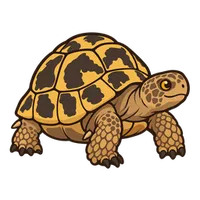
Greek tortoises are the classic Mediterranean "garden tortoise" — a small, sturdy, sun-loving grazer that potters around eating weeds and basking. They're one of the best-suited species for temperate keepers because they naturally hibernate and thrive in an outdoor pen for much of the year. The catch is the timeline: these are multi-decade animals that can outlive their owners, so this is a family-scale decision, not an impulse buy.
Worried, or still setting up? Free tools
Or browse common Greek Tortoise questions →
Care at a glance
| Adult size | Roughly 5–12 in (13–30 cm) shell length depending on subspecies; larger northeastern-Turkey (ibera) types reach the upper end and can weigh up to ~6 kg (13 lb). |
|---|---|
| Lifespan | 50+ years is normal with good care; verified individuals have exceeded 100 years. Plan for a genuine lifetime, multi-generational commitment. |
| Enclosure | Adults need a minimum of ~12 sq ft (about 6 x 3 ft / 1.8 x 0.9 m) of usable FLOOR space indoors, and bigger is always better. Ideally they live outdoors in a secure, predator-proof, escape-proof planted pen for the warm months — tortoises are diggers and surprising climbers, so bury the walls and check the top. |
| Basking / warm zone | Basking spot 95-105°F (35-40°C) directly under the heat lamp. |
| Cool side | Ambient / cool end 75-85°F (24-29°C), giving a proper warm-to-cool gradient across the enclosure. |
| Night | Heat can be turned off at night; a natural drop is healthy. Don't let it fall below ~50°F (10°C) indoors — if a night shelter dips lower, give supplementary heat to hold ~55-60°F (13-16°C). |
| UVB & lighting | High UVB requirement (Ferguson Zone 3 — open sun-basker, basking-zone UVI ~2.9-7.4). Use a strong linear T5 HO tube such as Arcadia T5 HO 12% or Zoo Med Reptisun 10.0, sized to cover much of the enclosure and mounted per the maker's chart (roughly 6-8 in for the Zoo Med / 17-18 in for the Arcadia above the shell). Replace UVB tubes every ~12 months even if they still glow. Natural unfiltered sunlight outdoors is ideal. |
| Humidity | An arid/semi-arid species: low ambient humidity is fine, but always provide a humid microclimate — a humid hide or damp substrate area kept around 65-70% so they can hydrate and burrow. Hatchlings are far more prone to dehydration and do best kept at 65-70% ambient with regular soaks. |
| Substrate | A deep, diggable, moderately water-holding mix — a ~50/50 blend of topsoil and play sand (or topsoil/coir with some sand) works well. At least 4 in (10 cm) deep so they can dig and thermoregulate; deeper is better. Avoid cedar and pine shavings (respiratory irritants). Spot-clean often and fully replace every few months. |
| Diet | Strict herbivore and grazer. Base the diet on low-calorie, high-fiber leafy weeds and greens: dandelion, clover, plantain, hawksbit, cat's ear, sow thistle, plus collard/turnip/mustard greens, kale, hibiscus leaves and flowers, and grazing grasses. Offer variety daily. Fruit is NOT appropriate for Mediterranean tortoises — their gut isn't built for sugary food, and it causes digestive upset. Avoid high-protein/animal foods and iceberg-type filler greens. |
| Supplements | Calcium is critical for shell and bone health. Dust food with a plain calcium (or a plant-focused supplement like Repashy SuperVeggie) on most feeds, and keep a cuttlebone available for free-choice gnawing. Keepers relying on strong UVB or real sunlight generally use little-to-no added D3; if UVB is weak or absent, a limited D3 source becomes important — get the balance right, because both deficiency and excess cause problems. |
What it's like to live with a Greek Tortoise
Best kept singly or in carefully managed groups with plenty of space and visual breaks. Males can be persistent, aggressive harassers of females and of each other (biting, ramming, relentless mating attempts), so never keep two males together and give any female enough room to escape. Do not mix Greek tortoises with other tortoise species or with any other reptile — different pathogens, diets, and needs.
Your first month together
The settling-in period, in order — so you know what's normal and when not to worry.
- Set up and stabilize the enclosure BEFORE the tortoise arrives: confirm a 95-105°F basking spot, a 75-85°F cool end, and a fresh, correctly-mounted T5 HO UVB tube.
- Weigh your tortoise on a kitchen scale and log it weekly — steady weight and growth are your best early-warning system.
- Soak in shallow warm water 2-3 times a week (more for hatchlings) so it drinks and stays hydrated.
- Feed a varied weed/leafy-green salad daily with calcium dusting; skip fruit entirely.
- Book a new-pet exam with an exotics/reptile vet, ideally including a fecal check for parasites, especially for wild-origin or newly imported animals.
- Give it quiet time to settle — expect shyness and reduced appetite at first while it adjusts.
Through the year, and as they grow
Healthy adult Greek tortoises naturally hibernate (brumate) over winter. The Tortoise Trust standard is a controlled cold hold at about 4-6°C (~40-43°F) for roughly 8-16 weeks (longer for larger animals), never letting temps approach 2.5°C or rise above ~10°C for long. Only hibernate a tortoise that is healthy and a good weight — do a full pre-hibernation check (eyes, nose, mouth for mouth-rot, weight) and never hibernate a sick, underweight, or recently acquired animal. In summer they should get maximum sunshine and outdoor grazing. Note: some North African populations (e.g. Tunisia/Libya) do NOT hibernate — origin matters, so confirm your animal's type before winter.
The pet store gets these wrong
Common myths, kindly corrected — no shame for having believed them.
- "They only need a little tabletop tortoise table." No — adults need ~12 sq ft of floor minimum, and they truly thrive with an outdoor pen. Cramped housing is a leading cause of stress and poor health.
- "Lettuce and fruit are fine." Iceberg lettuce is near-worthless filler and fruit actively harms Mediterranean tortoises. Their diet should be high-fiber weeds and leafy greens.
- "A little household bulb is enough light." Greek tortoises are high-UVB, Ferguson-Zone-3 sun-baskers; without strong UVB (or real sunlight) plus calcium they develop metabolic bone disease.
- "Hibernation is dangerous, so keep them warm all winter." Done properly (controlled ~5°C, healthy animal, correct checks) hibernation is natural and healthy; it's UNCONTROLLED cold or hibernating a sick animal that kills.
- "Two tortoises will be happier together." They're not social the way we imagine — two males will fight, and males relentlessly harass females. Solo or well-spaced, carefully sexed groups only.
Before you buy
- This is a 50-to-100-year commitment — realistically it may outlive you, so have a succession plan.
- You need real space and, ideally, a garden: a secure outdoor pen makes keeping one dramatically easier and healthier.
- Winter means either a proper controlled hibernation setup (a fridge or cold room with a thermometer) or year-round indoor heating for non-hibernating types.
- Budget for strong T5 HO UVB (replaced yearly), heat, a large enclosure, and access to an exotics vet.
- Buy captive-bred from a reputable source — wild-caught imports often arrive stressed, parasitized, and dehydrated, and wild collection harms native populations (Testudo graeca is a protected/CITES-listed species).
💷 The greek tortoise itself is usually the cheapest part — see the real cost of keeping one (upfront + ongoing, no sales pitch).
See a reptile vet if…
We can't diagnose from afar — but these are the signs to stop watching and get a professional:
- Soft, flexible, or increasingly lumpy/pyramided shell, bowed or weak limbs, or a tortoise that won't grow — classic signs of metabolic bone disease; see an exotics vet.
- Nasal discharge, bubbling, wheezing, open-mouth breathing, or a persistently gaping mouth — possible respiratory infection (a real emergency in tortoises).
- Runny or crusty eyes, or eyes swollen shut — get it checked.
- Not eating for an extended period, marked lethargy, or steady weight loss (watch your weight log) — non-specific but always worth a vet visit.
- Any wound, cheesy/white patches or ulcers in the mouth (mouth-rot), or a runny nose noticed before hibernation — do NOT hibernate; see a vet first.
- Straining, no droppings, or a swelling near the tail (possible constipation, egg-binding, or prolapse) — urgent.
Heading in? Print the free Greek Tortoise vet-prep sheet — what to bring, what to tell the vet, and the questions to ask.
Never
- Never feed fruit or high-protein/animal foods to a Mediterranean tortoise.
- Never keep two males together, and never let a single female be constantly harassed by a male.
- Never hibernate a sick, underweight, dehydrated, or newly acquired tortoise, and never let hibernation temps swing high or near freezing.
- Never rely on a plain heat/house bulb without proper UVB — it leads to metabolic bone disease.
- Never use cedar or pine shavings as substrate.
- Never house a Greek tortoise with other species, and never buy wild-caught if a captive-bred option exists.
Common greek tortoise questions
How hard are Greek Tortoises to keep — are they good for beginners?
Intermediate. Hardy and long-lived, but not a "starter" pet. The commitment is enormous (decades, easily outliving you), they need real floor space and strong outdoor-grade UVB, and getting the diet and hibernation right takes homework. A well-set-up Greek tortoise is low-drama; a poorly set-up one develops slow, preventable diseases you won't notice until they're advanced.
What do Greek Tortoises eat?
Strict herbivore and grazer. Base the diet on low-calorie, high-fiber leafy weeds and greens: dandelion, clover, plantain, hawksbit, cat's ear, sow thistle, plus collard/turnip/mustard greens, kale, hibiscus leaves and flowers, and grazing grasses. Offer variety daily. Fruit is NOT appropriate for Mediterranean tortoises — their gut isn't built for sugary food, and it causes digestive upset. Avoid high-protein/animal foods and iceberg-type filler greens.
How big an enclosure do Greek Tortoises need?
Adults need a minimum of ~12 sq ft (about 6 x 3 ft / 1.8 x 0.9 m) of usable FLOOR space indoors, and bigger is always better. Ideally they live outdoors in a secure, predator-proof, escape-proof planted pen for the warm months — tortoises are diggers and surprising climbers, so bury the walls and check the top.
What basking temperature do Greek Tortoises need?
Basking spot 95-105°F (35-40°C) directly under the heat lamp.
What should the cool side be for Greek Tortoises?
Ambient / cool end 75-85°F (24-29°C), giving a proper warm-to-cool gradient across the enclosure.
What night-time temperature do Greek Tortoises need?
Heat can be turned off at night; a natural drop is healthy. Don't let it fall below ~50°F (10°C) indoors — if a night shelter dips lower, give supplementary heat to hold ~55-60°F (13-16°C).
What UVB and lighting do Greek Tortoises need?
High UVB requirement (Ferguson Zone 3 — open sun-basker, basking-zone UVI ~2.9-7.4). Use a strong linear T5 HO tube such as Arcadia T5 HO 12% or Zoo Med Reptisun 10.0, sized to cover much of the enclosure and mounted per the maker's chart (roughly 6-8 in for the Zoo Med / 17-18 in for the Arcadia above the shell). Replace UVB tubes every ~12 months even if they still glow. Natural unfiltered sunlight outdoors is ideal.
What humidity do Greek Tortoises need?
An arid/semi-arid species: low ambient humidity is fine, but always provide a humid microclimate — a humid hide or damp substrate area kept around 65-70% so they can hydrate and burrow. Hatchlings are far more prone to dehydration and do best kept at 65-70% ambient with regular soaks.
What substrate do Greek Tortoises need?
A deep, diggable, moderately water-holding mix — a ~50/50 blend of topsoil and play sand (or topsoil/coir with some sand) works well. At least 4 in (10 cm) deep so they can dig and thermoregulate; deeper is better. Avoid cedar and pine shavings (respiratory irritants). Spot-clean often and fully replace every few months.
What supplements do Greek Tortoises need?
Calcium is critical for shell and bone health. Dust food with a plain calcium (or a plant-focused supplement like Repashy SuperVeggie) on most feeds, and keep a cuttlebone available for free-choice gnawing. Keepers relying on strong UVB or real sunlight generally use little-to-no added D3; if UVB is weak or absent, a limited D3 source becomes important — get the balance right, because both deficiency and excess cause problems.
How big do Greek Tortoises get?
Roughly 5–12 in (13–30 cm) shell length depending on subspecies; larger northeastern-Turkey (ibera) types reach the upper end and can weigh up to ~6 kg (13 lb).
How long do Greek Tortoises live?
50+ years is normal with good care; verified individuals have exceeded 100 years. Plan for a genuine lifetime, multi-generational commitment.
What are the signs Greek Tortoises are sick or need a vet?
See a reptile or exotics vet if you notice: Soft, flexible, or increasingly lumpy/pyramided shell, bowed or weak limbs, or a tortoise that won't grow — classic signs of metabolic bone disease; see an exotics vet.; Nasal discharge, bubbling, wheezing, open-mouth breathing, or a persistently gaping mouth — possible respiratory infection (a real emergency in tortoises).; Runny or crusty eyes, or eyes swollen shut — get it checked.; Not eating for an extended period, marked lethargy, or steady weight loss (watch your weight log) — non-specific but always worth a vet visit.; Any wound, cheesy/white patches or ulcers in the mouth (mouth-rot), or a runny nose noticed before hibernation — do NOT hibernate; see a vet first.; Straining, no droppings, or a swelling near the tail (possible constipation, egg-binding, or prolapse) — urgent..
Your first two weeks · Taming & handling · Behaviours explained · Won't eat? · Stuck shed · When to see a vet

Get the free Greek Tortoise Starter Kit
A one-page setup criteria checklist and a first-30-days plan for your first greek tortoise — what to get, what makes each thing matter, and the honest bits the pet shop skips. Join the den and we’ll send it over.
Free reptile care cheat-sheet the moment you join. No spam — unsubscribe anytime. See how we handle your data in our privacy notice.Sources & further reading
This guide was written and fact-checked against these authorities. It's kind, general guidance — not a diagnosis or a substitute for an exotics vet:
- DubiaRoaches — Greek Tortoise Care Sheet (ReptiFiles-methodology) — Enclosure 12 sq ft floor min; basking 95-105°F; ambient 75-85°F; night 55-60°F; substrate 50/50 topsoil+play sand ≥4 in; UVB Arcadia T5 HO 12% / Zoo Med Reptisun 10.0; humid retreat & hatchling 65-70%; no fruit; Repashy SuperVeggie + cuttlebone; size 5-12 in; lifespan 50+.
- Reptile Supply — How to Care for Your Greek Tortoise — Confirms 12 sq ft floor; 95-105°F basking; 75-85°F cool side; UVB mounting 17-18 in; humid area 65-70%; substrate ≥4 in; lifespan into 50s-100+.
- Reptile Centre — Which Ferguson Zone are Mediterranean Tortoises? — Testudo = Ferguson Zone 3; open sun-baskers, basking-zone UVI 2.9-7.4.
- Tortoise Trust — Safer Hibernation — Hibernate Mediterranean tortoises at ~4-6°C (target 5°C), 8-16 weeks; act if <2.5°C or >10°C; full pre-hibernation eye/nose/mouth/weight checks; never hibernate sick/underweight/new animals.
- Tortoise Trust — Feeding Tortoises: Avoiding Dietary Disasters — Mediterranean species' guts aren't built for fruit; base diet on high-fiber weeds/greens; calcium supplementation critical.
- Wikipedia — Greek tortoise (Testudo graeca) — Testudo graeca Linnaeus, 1758; family Testudinidae; aka spur-thighed/Moorish; largest ~7 kg; verified lifespans >100 yrs.
- VCA Animal Hospitals — Common Diseases of Tortoises — Vet reference for MBD signs (soft/misshapen shell, deformed limbs), respiratory infection (nasal discharge), and non-specific illness (anorexia, lethargy).
Written and fact-checked by The Baskden Team against veterinarian-authored sources — if your reptile shows a red-flag sign above, see an exotics vet promptly.