
Species · Arboreal lizard
Green Anole
Anolis carolinensis
The little green colour-changing lizard sold cheaply everywhere — charming and active, but a delicate, hands-off display animal, not a handling pet.
Difficulty: Beginner–Intermediate Printable care sheet →
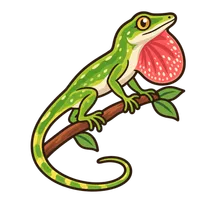
Green anoles are the little emerald lizards sold cheaply in almost every pet store — quick, alert, and endlessly watchable, with males that flash a vivid pink-orange throat fan (dewlap) to show off. That low price is a trap, though: because they're cheap they're widely treated as disposable, when in fact they need a proper tall, planted, humid, UV-lit setup to thrive. They're not a handling pet — they're fast and easily stressed — but as an active, colour-shifting display animal in a well-planted tank, a well-kept anole is a delight, and can live a decade.
Worried, or still setting up? Free tools
Or browse common Green Anole questions →
Care at a glance
| Adult size | 6–8 in (15–20 cm) including the long tail; males larger, with a pink-orange dewlap |
|---|---|
| Lifespan | Up to about 10 years with good care (often cut far shorter by poor care) |
| Enclosure | A TALL, planted, front-opening enclosure — minimum 24×24×24 in (60×60×60 cm) for one, larger preferred — because they’re semi-arboreal climbers that live up in the foliage. Pack it with branches, vines, and live or artificial plants to climb and hide in. House ONE (or a single male with females); males fight. |
| Basking / warm zone | A basking spot of 90°F (32°C) from an overhead heat bulb, placed over a branch up in the canopy where the anole will bask. |
| Cool side | Cool side 70–77°F (21–25°C), with a vertical gradient it can climb through. |
| Night | Night 65–75°F (18–24°C) — a natural drop is fine. |
| UVB & lighting | UVB is essential (diurnal, sun-loving): a T5 HO bulb (Arcadia Forest 6%) giving UVI ~3.0–4.0 at the basking branch (Ferguson Zone 3), plus a bright daylight LED. 14-hour summer / 10-hour winter photoperiod; replace the UVB bulb yearly. |
| Humidity | Average 60–70%, achieved by misting the enclosure morning and evening — anoles drink the droplets off leaves and will largely ignore a standing bowl, so misting is their main water source. A night fogger helps in dry homes. Live plants hold humidity and give cover. |
| Substrate | A moisture-holding, bioactive-style mix (topsoil/coconut fibre) with leaf litter and live plants — it holds humidity and supports the planting that makes an anole feel secure. Vertical cover matters more than floor space. |
| Diet | Insectivore — a varied menu of small feeders (crickets, dubia/discoid/red-runner nymphs, flightless fruit flies, black soldier fly larvae): juveniles eat as much as they’ll take daily; adults take 2–3 feeders, each slightly smaller than the anole’s head, every other day. Gut-load feeders 24–48 hours first. |
| Supplements | Dust feeders with a 50/50 calcium + multivitamin mix at every feeding — small, fast-metabolising insectivores are prone to calcium deficiency, so this plus UVB is what prevents metabolic bone disease. |
🦎 Did you know? — Green Anole fun facts
Little true delights about the green anole — each one checked against a named source, no pet-shop myths.
- Green anoles change colour between green, brown and grey using pigment cells called chromatophores, shifting with temperature and mood rather than to match backgrounds. Animal Diversity Web
- Male green anoles flash a pinkish throat fan called a dewlap to court females and to settle territory disputes with rivals. Animal Diversity Web
What it's like to live with a Green Anole
A green anole is a lizard to watch, not to hold. In a tall, planted tank it is genuinely lively for a small reptile — climbing, basking, stalking insects, shifting between bright green and brown with its mood and the temperature, and (for males) flaring that showy dewlap. They are fast and easily stressed, though, and handling frightens them, so they can drop their tail or rub their snout trying to escape. Appreciated as an active display animal in a well-planted vivarium, they are charming, inexpensive to feed, and full of personality; treated as a cheap throwaway, they suffer.
Your first month together
The settling-in period, in order — so you know what's normal and when not to worry.
- Set up the tall, planted, humid, UV-lit tank properly BEFORE the anole arrives — the "cheap starter lizard" reputation is exactly what kills them.
- Assume it may be wild-caught: quarantine a new anole and consider a vet fecal check, as many in the trade are imports.
- Mist morning and evening from day one — anoles drink droplets off leaves, so misting is life-or-death, not optional.
- Give it privacy and cover to settle; expect it to dart and hide at first, and to shift colour with mood and warmth (normal, not a warning).
- Interact by watching and tong-feeding rather than handling — a stressed anole drops its tail and rubs its snout raw trying to flee.
Through the year, and as they grow
Anoles track the seasons: appetite, colour, and a male’s dewlap displays all ramp up in the warm, bright months and quieten in winter (mirror this with the 14h/10h photoperiod). Females can lay small clutches of eggs in the warm season, so a gravid female needs good calcium and a moist spot to lay — a female who goes off food and becomes weak or straining needs a vet.
The pet store gets these wrong
Common myths, kindly corrected — no shame for having believed them.
- It’s cheap, so it’s a disposable, low-care lizard — false; that attitude is why anoles are so often kept badly. They need a proper tall, planted, UV-lit, humid setup.
- It changes colour to camouflage — mostly no; green↔brown tracks mood, temperature, and health.
- A small critter-keeper tank is fine — no; it’s a climber that needs height and dense planting.
- A water bowl is enough — no; anoles drink droplets from misting and largely ignore standing water.
- You can handle it like a beardie — no; it’s a fast, fragile display animal that stresses and drops its tail.
Before you buy
- A tall, planted 24×24×24 in (or larger) enclosure with branches and live/artificial plants.
- Real UVB, a 90°F basking spot, and a daily misting routine (they drink droplets, not from a bowl).
- Acceptance that it’s look-don’t-touch, and that many are wild-caught (quarantine + a vet fecal).
- A small varied insect supply with calcium/vitamin dusting, and an exotics vet who sees small lizards.
💷 The green anole itself is usually the cheapest part — see the real cost of keeping one (upfront + ongoing, no sales pitch).
See a reptile vet if…
We can't diagnose from afar — but these are the signs to stop watching and get a professional:
- A rubbery jaw, bowed or wavy limbs, tremors, or a soft spine (signs pointing to metabolic bone disease — very common in anoles kept without UVB/calcium).
- Sunken eyes, wrinkled skin, or lethargy (dehydration — usually from too little misting).
- A raw, rubbed snout (rostral abrasion from trying to escape a too-small or too-exposed enclosure).
- Open-mouth breathing or mucus (possible respiratory infection), or poor weight and abnormal droppings in a new import (parasites).
- A female straining and off her food (egg-binding), or any tissue protruding from the vent (prolapse).
Heading in? Print the free Green Anole vet-prep sheet — what to bring, what to tell the vet, and the questions to ask.
Never
- Never treat it as a cheap, disposable lizard — it needs a full tall, planted, UV-lit, humid setup.
- Never skip UVB or calcium — MBD is the classic way anoles are killed.
- Never rely on a water bowl — mist daily so it can drink droplets.
- Never handle it for fun — it’s a fast, fragile display animal that will drop its tail.
- Never house two males together — they fight.
Common green anole questions
How hard are Green Anoles to keep — are they good for beginners?
Beginner–Intermediate. Sold cheaply everywhere, which is exactly the problem — that cheap price tag drives some of the worst care in the hobby. A green anole is a small, fast, delicate arboreal lizard that needs a tall planted tank, real UVB and heat, and daily misting, and it is a look-don't-touch display animal. Simple needs, but they are non-negotiable.
What do Green Anoles eat?
Insectivore — a varied menu of small feeders (crickets, dubia/discoid/red-runner nymphs, flightless fruit flies, black soldier fly larvae): juveniles eat as much as they’ll take daily; adults take 2–3 feeders, each slightly smaller than the anole’s head, every other day. Gut-load feeders 24–48 hours first.
How big an enclosure do Green Anoles need?
A TALL, planted, front-opening enclosure — minimum 24×24×24 in (60×60×60 cm) for one, larger preferred — because they’re semi-arboreal climbers that live up in the foliage. Pack it with branches, vines, and live or artificial plants to climb and hide in. House ONE (or a single male with females); males fight.
What basking temperature do Green Anoles need?
A basking spot of 90°F (32°C) from an overhead heat bulb, placed over a branch up in the canopy where the anole will bask.
What should the cool side be for Green Anoles?
Cool side 70–77°F (21–25°C), with a vertical gradient it can climb through.
What night-time temperature do Green Anoles need?
Night 65–75°F (18–24°C) — a natural drop is fine.
What UVB and lighting do Green Anoles need?
UVB is essential (diurnal, sun-loving): a T5 HO bulb (Arcadia Forest 6%) giving UVI ~3.0–4.0 at the basking branch (Ferguson Zone 3), plus a bright daylight LED. 14-hour summer / 10-hour winter photoperiod; replace the UVB bulb yearly.
What humidity do Green Anoles need?
Average 60–70%, achieved by misting the enclosure morning and evening — anoles drink the droplets off leaves and will largely ignore a standing bowl, so misting is their main water source. A night fogger helps in dry homes. Live plants hold humidity and give cover.
What substrate do Green Anoles need?
A moisture-holding, bioactive-style mix (topsoil/coconut fibre) with leaf litter and live plants — it holds humidity and supports the planting that makes an anole feel secure. Vertical cover matters more than floor space.
What supplements do Green Anoles need?
Dust feeders with a 50/50 calcium + multivitamin mix at every feeding — small, fast-metabolising insectivores are prone to calcium deficiency, so this plus UVB is what prevents metabolic bone disease.
How big do Green Anoles get?
6–8 in (15–20 cm) including the long tail; males larger, with a pink-orange dewlap
How long do Green Anoles live?
Up to about 10 years with good care (often cut far shorter by poor care)
What are the signs Green Anoles are sick or need a vet?
See a reptile or exotics vet if you notice: A rubbery jaw, bowed or wavy limbs, tremors, or a soft spine (signs pointing to metabolic bone disease — very common in anoles kept without UVB/calcium).; Sunken eyes, wrinkled skin, or lethargy (dehydration — usually from too little misting).; A raw, rubbed snout (rostral abrasion from trying to escape a too-small or too-exposed enclosure).; Open-mouth breathing or mucus (possible respiratory infection), or poor weight and abnormal droppings in a new import (parasites).; A female straining and off her food (egg-binding), or any tissue protruding from the vent (prolapse)..
Your first two weeks · Taming & handling · Behaviours explained · Won't eat? · Stuck shed · When to see a vet

Get the free Green Anole Starter Kit
A one-page setup criteria checklist and a first-30-days plan for your first green anole — what to get, what makes each thing matter, and the honest bits the pet shop skips. Join the den and we’ll send it over.
Free reptile care cheat-sheet the moment you join. No spam — unsubscribe anytime. See how we handle your data in our privacy notice.Sources & further reading
This guide was written and fact-checked against these authorities. It's kind, general guidance — not a diagnosis or a substitute for an exotics vet:
- ReptiFiles — Green Anole Care Sheet — 6–8 in, to ~10 yr; min 24×24×24 in tall/planted; basking 90°F / cool 70–77°F / night 65–75°F; UVI ~3.0–4.0 (Arcadia Forest 6%, Zone 3), 14h/10h photoperiod; humidity 60–70% via AM/PM misting (drinks droplets); moisture-holding planted substrate; varied insectivore (juvenile daily, adult 2–3 feeders every other day) + 50/50 calcium-multivitamin every feeding; house solo; often wild-caught.
- Baines et al. (2016), “How much UVB does my reptile need? The UV-Tool” — Ferguson Zone 3 target UVI ~3.0 for a diurnal, sun-basking arboreal lizard.
- Association of Reptilian & Amphibian Veterinarians (ARAV) — Find-an-exotics-vet; MBD, dehydration, respiratory infection, parasites, dystocia.
- Merck Veterinary Manual — reptiles — Metabolic bone disease, dehydration, respiratory infection, endoparasites, dystocia.
Written and fact-checked by The Baskden Team against veterinarian-authored sources — if your reptile shows a red-flag sign above, see an exotics vet promptly.