
Species · Arboreal herbivore lizard
Green Iguana
Iguana iguana
The cute green hatchling that becomes a 6-foot, room-filling commitment — rewarding for a dedicated advanced keeper, heartbreaking as an impulse buy.
Difficulty: Advanced Printable care sheet →
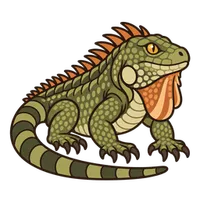
That cute little green lizard the size of your hand at the shop grows into a powerful, arboreal giant up to 6-7 feet long that needs a custom, room-sized enclosure and lives for 15-20+ years. Green iguanas are strict plant-eaters (folivores) who climb high, love to bask hot under strong UVB, and want humidity and a big tub to soak in. Get the space, the lighting, and the all-veggie diet right and they can be gentle, long-lived companions. Get them wrong and kidney disease is heartbreakingly common. We will be honest with you about what they really need.
Worried, or still setting up? Free tools
Or browse common Green Iguana questions →
Care at a glance
| Adult size | Very large. Males commonly reach 6-7 ft (1.8-2.1 m) total length including the tail; females rarely exceed 5 ft (1.5 m). A big adult weighs roughly 15-20 lb (about 7-9 kg). Much of that length is tail, but the body alone is substantial and heavy. |
|---|---|
| Lifespan | 15-20+ years is normal with good care, with exceptional well-kept individuals reaching into the low 20s. Sadly most captive iguanas die far younger from preventable husbandry failures (kidney disease, metabolic bone disease). This is a decades-long commitment on par with a dog or cat. |
| Enclosure | Adults need a custom, room-sized, VERTICAL enclosure, not a fish tank. Plan for a minimum around 10 ft long x 5 ft wide x 6 ft tall (3 x 1.5 x 1.8 m); an ideal build is closer to 12'L x 6'W x 6'H. As a rule of thumb, length should be at least twice the iguana's body length and height at least 6 ft, because these are arboreal climbers who need to get UP. Fill it with sturdy, thick climbing branches and broad basking shelves that can hold a 15-20 lb animal, plus solid smooth walls (no wire mesh they can rub their snouts raw on). Because iguanas soak and even swim, include a large, shallow water/soak area big enough to fit the whole body, at room-to-lukewarm temperature; change it daily and disinfect weekly. Hatchlings can start in a temporary 20-55 gallon setup but will outgrow it within a year, so budget for the adult space before you buy. |
| Basking / warm zone | A hot basking surface of about 120°F (50°C), measured at the branch or shelf with a temperature gun (not a stick-on dial). This gives them a proper spot to thermoregulate and digest. |
| Cool side | Ambient/cool end around 75-85°F (24-29°C), so the animal can move down the gradient to cool off. |
| Night | Should not drop below the low-to-mid 70s F; keep nights roughly 73-84°F (23-28°C). A gentle nighttime dip is fine, but never let it get cold. |
| UVB & lighting | STRONG UVB is non-negotiable for this rainforest baskers. Use a high-output linear T5 HO tube (e.g. Arcadia 12-14% or Zoo Med Reptisun 10.0), spanning much of the enclosure, mounted so the basking zone reads a UV Index (UVI) of about 3.0-4.0. With mesh in the path, that is roughly 13-24 inches from the animal depending on the bulb, so measure with a Solarmeter rather than guessing. Run it 10-13 hours a day and replace tubes on schedule (about every 6-12 months) since UV output fades long before the light dies. |
| Humidity | Fairly humid, reflecting their tropical origins: aim for roughly 60-80% during the day, with a higher spike toward 100% at night (misting or a humid microclimate). Chronically dry air contributes to poor sheds, dehydration, and kidney strain. Provide good airflow too, so damp does not become stagnant. |
| Substrate | Use a safe, absorbent substrate: a 2-4 inch (10-15 cm) layer of large-particle coconut husk or cypress mulch works well for holding humidity, or go simple with pelleted paper bedding or reptile carpet for easy cleaning. Avoid loose sand, fine particles, pine, and cedar (impaction and respiratory irritation risk). Spot-clean daily and refresh regularly. |
| Diet | 100% herbivore (folivore). The whole diet is plants: roughly 60-70% dark leafy greens (collard, dandelion, mustard greens, turnip greens, kale in rotation, escarole, watercress), about 20-30% other vegetables (squash, bell pepper, green beans, snap peas, grated carrot), and only about 10% fruit as a treat (berries, mango, papaya). NEVER feed animal protein, insects, dog or cat food, or "monkey biscuits." This is critical: iguanas are strict vegetarians in the wild, and animal protein is a leading cause of fatal kidney disease and gout in captive iguanas. Offer fresh food daily and remove uneaten produce before it spoils. |
| Supplements | Because captive greens rarely match wild browse, dust food with a calcium supplement and use a reptile multivitamin. A common schedule for growing iguanas is plain calcium (no phosphorus) several times a week plus a multivitamin a couple times a week; adults need less. An all-in-one herbivore supplement (e.g. Repashy SuperVeggie) at meals is a convenient option. With proper UVB you generally do NOT need heavy D3 dosing, but calcium is essential to prevent metabolic bone disease. When in doubt, ask your exotics vet to tailor the schedule. |
What it's like to live with a Green Iguana
Keep them solo. Green iguanas are territorial, especially mature males, and housing two together often ends in serious fights and stress. Males in breeding season can also become aggressive toward people. They are not a social "pair" animal and do not need a cagemate to be happy. Regular gentle handling from a young age helps them tolerate people, but respect that a large adult with a whip-like tail, claws, and a strong bite deserves careful, calm handling.
Your first month together
The settling-in period, in order — so you know what's normal and when not to worry.
- Have the FULL adult enclosure planned and the lighting/heat working before the iguana comes home, even if a hatchling starts in a smaller temporary setup.
- Verify your gradient with real tools: an infrared temp gun for the ~120°F basking spot and cool end, plus a Solarmeter to confirm UVI 3-4 at the basking zone.
- Establish the all-plant diet immediately with a variety of dark leafy greens; do not let anyone convince you to add insects or protein.
- Offer daily fresh water and a large shallow soak tub, and change/disinfect it regularly.
- Find and register with a qualified reptile/exotics vet BEFORE you need one, and consider a baseline health check.
- Handle gently and briefly each day to build trust, but give a new arrival a quiet week or two to settle first.
Through the year, and as they grow
Watch out for breeding-season behavior changes, usually in the cooler/dry months: mature males can become noticeably more aggressive and territorial, their coloration may brighten (orange flushes), and appetite can swing. Females may develop eggs even without a male present and can become egg-bound, so a gravid female needs a warm nesting/digging area and a vet on standby. Keep temperatures and UVB stable year-round; do not let winter chill the enclosure.
The pet store gets these wrong
Common myths, kindly corrected — no shame for having believed them.
- "They stay small" or "they only grow to the size of their tank." False, and dangerous. A green iguana grows to 5-7 feet regardless of enclosure size; a too-small cage just stunts and stresses them.
- "Baby iguanas need insects or protein for growth." This is an outdated, harmful practice. Animal protein drives kidney disease and gout. They are strict herbivores for life.
- "A big fish tank or a bookshelf cage is enough." No. Adults need a custom, room-sized VERTICAL space with real climbing structure, not a horizontal box.
- "They don't really need UVB if I give a vitamin." False. Strong UVB (UVI ~3-4) is essential; without it they develop metabolic bone disease. A pill is not a substitute for proper lighting.
- "Iguanas are cheap, easy starter lizards." One of the most-surrendered reptiles precisely because they are large, long-lived, and demanding. They are an advanced keeper's animal.
Before you buy
- Do you have the room for a 6-foot-tall, roughly 10-12 foot long custom enclosure (often a converted closet or a whole wall)?
- Can you commit for 15-25 years, through moves and life changes?
- Is there a qualified reptile/exotics vet within reach, and can you afford exotic vet bills?
- Can you provide a constant supply of fresh dark leafy greens and vegetables, every day, for decades?
- Are you ready to run strong UVB and heat (and the electricity bill that comes with a big warm enclosure)?
- Are you comfortable handling a powerful adult with claws, a whip tail, and a strong bite, including a male that may turn territorial in breeding season?
💷 The green iguana itself is usually the cheapest part — see the real cost of keeping one (upfront + ongoing, no sales pitch).
See a reptile vet if…
We can't diagnose from afar — but these are the signs to stop watching and get a professional:
- Swollen, stiff, or painful joints; reluctance to move, eat, or drink (possible gout, often diet-related) — see an exotics vet.
- Soft, rubbery, or bowed jaw/limbs, tremors, or a spongy 'rubber jaw' (signs of metabolic bone disease) — urgent vet visit.
- Not eating for several days, sudden weight loss, sunken eyes, or lethargy (possible kidney disease/dehydration) — see a vet promptly.
- Straining, a female who stops eating and seems restless or bloated (possible egg-binding) — this is an emergency.
- Increased or absent urates/droppings, or chalky white deposits, and any labored breathing or open-mouth breathing — see an exotics vet.
- Persistent stuck sheds around toes/tail (constriction can cost a digit), or wounds, abscesses, or a rubbed-raw snout from cage rubbing.
Heading in? Print the free Green Iguana vet-prep sheet — what to bring, what to tell the vet, and the questions to ask.
Never
- Never feed animal protein, insects, or dog/cat food — it causes fatal kidney disease and gout in this strict herbivore.
- Never keep an adult in a fish tank or any undersized, horizontal cage; they need a huge vertical space.
- Never skip UVB or rely on a supplement instead of proper lighting.
- Never house two iguanas together (especially males) — territorial fighting is common and can be lethal.
- Never let the enclosure get cold at night or run without a verified thermal gradient.
- Never use loose sand or fine/aromatic (pine, cedar) substrates that risk impaction or respiratory harm.
- Never release an unwanted iguana outdoors — rehome through a reptile rescue instead.
Common green iguana questions
How hard are Green Iguanas to keep — are they good for beginners?
Advanced. Green iguanas are one of the most commonly surrendered reptiles in the world, and it is almost always for the same reasons: people underestimate the size, the cost, and the sheer amount of space an adult needs. This is a two-metre, multi-decade, room-sized commitment with strict UVB, heat, humidity, and diet needs. Wonderful for a dedicated advanced keeper who plans for the full-grown animal from day one; heartbreaking as an impulse buy.
What do Green Iguanas eat?
100% herbivore (folivore). The whole diet is plants: roughly 60-70% dark leafy greens (collard, dandelion, mustard greens, turnip greens, kale in rotation, escarole, watercress), about 20-30% other vegetables (squash, bell pepper, green beans, snap peas, grated carrot), and only about 10% fruit as a treat (berries, mango, papaya). NEVER feed animal protein, insects, dog or cat food, or "monkey biscuits." This is critical: iguanas are strict vegetarians in the wild, and animal protein is a leading cause of fatal kidney disease and gout in captive iguanas. Offer fresh food daily and remove uneaten produce before it spoils.
How big an enclosure do Green Iguanas need?
Adults need a custom, room-sized, VERTICAL enclosure, not a fish tank. Plan for a minimum around 10 ft long x 5 ft wide x 6 ft tall (3 x 1.5 x 1.8 m); an ideal build is closer to 12'L x 6'W x 6'H. As a rule of thumb, length should be at least twice the iguana's body length and height at least 6 ft, because these are arboreal climbers who need to get UP. Fill it with sturdy, thick climbing branches and broad basking shelves that can hold a 15-20 lb animal, plus solid smooth walls (no wire mesh they can rub their snouts raw on). Because iguanas soak and even swim, include a large, shallow water/soak area big enough to fit the whole body, at room-to-lukewarm temperature; change it daily and disinfect weekly. Hatchlings can start in a temporary 20-55 gallon setup but will outgrow it within a year, so budget for the adult space before you buy.
What basking temperature do Green Iguanas need?
A hot basking surface of about 120°F (50°C), measured at the branch or shelf with a temperature gun (not a stick-on dial). This gives them a proper spot to thermoregulate and digest.
What should the cool side be for Green Iguanas?
Ambient/cool end around 75-85°F (24-29°C), so the animal can move down the gradient to cool off.
What night-time temperature do Green Iguanas need?
Should not drop below the low-to-mid 70s F; keep nights roughly 73-84°F (23-28°C). A gentle nighttime dip is fine, but never let it get cold.
What UVB and lighting do Green Iguanas need?
STRONG UVB is non-negotiable for this rainforest baskers. Use a high-output linear T5 HO tube (e.g. Arcadia 12-14% or Zoo Med Reptisun 10.0), spanning much of the enclosure, mounted so the basking zone reads a UV Index (UVI) of about 3.0-4.0. With mesh in the path, that is roughly 13-24 inches from the animal depending on the bulb, so measure with a Solarmeter rather than guessing. Run it 10-13 hours a day and replace tubes on schedule (about every 6-12 months) since UV output fades long before the light dies.
What humidity do Green Iguanas need?
Fairly humid, reflecting their tropical origins: aim for roughly 60-80% during the day, with a higher spike toward 100% at night (misting or a humid microclimate). Chronically dry air contributes to poor sheds, dehydration, and kidney strain. Provide good airflow too, so damp does not become stagnant.
What substrate do Green Iguanas need?
Use a safe, absorbent substrate: a 2-4 inch (10-15 cm) layer of large-particle coconut husk or cypress mulch works well for holding humidity, or go simple with pelleted paper bedding or reptile carpet for easy cleaning. Avoid loose sand, fine particles, pine, and cedar (impaction and respiratory irritation risk). Spot-clean daily and refresh regularly.
What supplements do Green Iguanas need?
Because captive greens rarely match wild browse, dust food with a calcium supplement and use a reptile multivitamin. A common schedule for growing iguanas is plain calcium (no phosphorus) several times a week plus a multivitamin a couple times a week; adults need less. An all-in-one herbivore supplement (e.g. Repashy SuperVeggie) at meals is a convenient option. With proper UVB you generally do NOT need heavy D3 dosing, but calcium is essential to prevent metabolic bone disease. When in doubt, ask your exotics vet to tailor the schedule.
How big do Green Iguanas get?
Very large. Males commonly reach 6-7 ft (1.8-2.1 m) total length including the tail; females rarely exceed 5 ft (1.5 m). A big adult weighs roughly 15-20 lb (about 7-9 kg). Much of that length is tail, but the body alone is substantial and heavy.
How long do Green Iguanas live?
15-20+ years is normal with good care, with exceptional well-kept individuals reaching into the low 20s. Sadly most captive iguanas die far younger from preventable husbandry failures (kidney disease, metabolic bone disease). This is a decades-long commitment on par with a dog or cat.
What are the signs Green Iguanas are sick or need a vet?
See a reptile or exotics vet if you notice: Swollen, stiff, or painful joints; reluctance to move, eat, or drink (possible gout, often diet-related) — see an exotics vet.; Soft, rubbery, or bowed jaw/limbs, tremors, or a spongy 'rubber jaw' (signs of metabolic bone disease) — urgent vet visit.; Not eating for several days, sudden weight loss, sunken eyes, or lethargy (possible kidney disease/dehydration) — see a vet promptly.; Straining, a female who stops eating and seems restless or bloated (possible egg-binding) — this is an emergency.; Increased or absent urates/droppings, or chalky white deposits, and any labored breathing or open-mouth breathing — see an exotics vet.; Persistent stuck sheds around toes/tail (constriction can cost a digit), or wounds, abscesses, or a rubbed-raw snout from cage rubbing..
Your first two weeks · Taming & handling · Behaviours explained · Won't eat? · Stuck shed · When to see a vet

Get the free Green Iguana Starter Kit
A one-page setup criteria checklist and a first-30-days plan for your first green iguana — what to get, what makes each thing matter, and the honest bits the pet shop skips. Join the den and we’ll send it over.
Free reptile care cheat-sheet the moment you join. No spam — unsubscribe anytime. See how we handle your data in our privacy notice.Sources & further reading
This guide was written and fact-checked against these authorities. It's kind, general guidance — not a diagnosis or a substitute for an exotics vet:
- ReptiFiles — Green Iguana Care Sheet — Enclosure size (10'L x 5'W x 6'H min), basking ~120°F, cool 75-85°F, night 73-84°F, UVB T5 HO with UVI 3-4, humidity 60-80% day/100% night, substrate depth, herbivore diet ratios, soak tub.
- PetMD — Green Iguana Care Sheet (vet-reviewed) — Adult size 4-6 ft and 15-20 lb, lifespan 15-20+ yrs, warm 100-120°F, cool ~80°F, humidity 70-90%, herbivore diet 70/20/10, calcium/multivitamin schedule, daily soak.
- Chicago Exotics Animal Hospital — Green Iguana Care — Exotic-vet warning that feeding animal/insect protein is outdated and harmful/fatal; strict herbivore; adult up to 7 ft and 20 lb; calcium and multivitamin dosing; UVB and humidity guidance.
- MSD (Merck) Veterinary Manual — Nutritional, Metabolic & Endocrine Diseases of Reptiles — Primary visceral gout caused by excessive dietary protein; MBD from low calcium:phosphorus, D3 deficiency, and lack of UVB in rapidly growing herbivorous lizards.
- Dubia.com — How to Care for Your Green Iguana — Ideal adult enclosure 12'L x 6'W x 6'H, adult 5-6 ft, lifespan up to 20 yrs, basking ~120°F, cool 75-85°F, night not below 75°F, UVB bulbs/distance, 100% herbivore diet, large shallow water tub.
Written and fact-checked by The Baskden Team against veterinarian-authored sources — if your reptile shows a red-flag sign above, see an exotics vet promptly.