
Species · Aquatic turtle
Northern Map Turtle
Graptemys geographica
The "aggressive basker" with contour-line shell markings — needs a genuinely hot dock and pristine water.
Difficulty: Intermediate Printable care sheet →
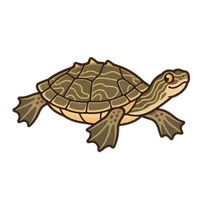
The Northern Map Turtle is one of the most beautiful little river turtles you can keep — those fine "contour line" markings on the shell are exactly where the name comes from. They're bright, fast, aggressive baskers who will happily pile onto a log in the sun, but they're also on the timid side and love clean, moving water. If you can give one a large tank, strong filtration, and a warm dry dock under real UVB, a map turtle is a rewarding, long-lived companion — just don't let a pet store talk you into a tiny setup.
Worried, or still setting up? Free tools
Or browse common Northern Map Turtle questions →
Care at a glance
| Adult size | Males stay small at about 4–6 in (10–15 cm) shell length; females are much larger at 7–10.75 in (18–27 cm). This big size gap matters — a female needs roughly double the tank of a male. |
|---|---|
| Lifespan | Commonly 20–30 years with good care — AnAge documents about 18 years in captivity and 20+ in the wild. A long commitment. |
| Tank | Think in swimming volume, not floor space. A single male needs a 75-gallon tank minimum; a single female needs a 125-gallon tank minimum (Austin's Turtle Page). A common rule of thumb is at least 10 US gallons of water per inch of adult shell length. Bigger is always better for these active swimmers — hatchlings can start in a 20-gallon long, but plan for the adult tank from day one. |
| Water temperature | 72-76°F (22-24°C) for adults and sub-adults; hatchlings and small juveniles do better a bit warmer at 78-80°F (26-27°C). A submersible aquarium heater (guarded so the turtle can't crack or burn on it) holds it steady. |
| Water depth | As deep as you can give them — map turtles are powerful, confident swimmers who thrive in deep, open water. Hatchlings start shallower at about 4-6 in with plenty of easy resting spots and structure to climb, then go progressively deeper as they grow. Always provide submerged rest ledges so they can pause without a hard swim to the surface. |
| Filtration | Heavy filtration is essential — these are clean-water river turtles and they're messy eaters. Use a canister filter rated for at least 2x the tank's actual water volume (turtle keepers routinely over-filter). Strong flow also oxygenates the water, which map turtles appreciate. Do partial water changes weekly regardless of filter size. |
| Basking dock | A completely dry basking dock (floating platform, cork slab, or above-water ledge) they can climb fully out onto and drip-dry. Map turtles are "aggressive baskers", so make it easy to reach and stable. Basking-surface temperature ~95–100°F (35–38°C), up to ~110°F at the hottest point for large adults (per Austin's Turtle Page), always with a cool side to move to. |
| Night | Lights and basking heat off at night is fine. Room temperature down to the mid-60s°F (around 18°C) is acceptable as long as the water stays in range; if the room gets cold, the water heater keeps the tank stable overnight. |
| UVB & lighting | Real UVB is non-negotiable. Use a linear T5 HO tube — Zoo Med ReptiSun T5 HO 5.0 or Arcadia Forest 6% — running the length of the basking end (about 50-75% of the tank length). Like the closely related slider (Ferguson Zone 3), aim for a UV Index of about 3.0-4.0 on the dry basking surface. Mount a 5.0/6% tube roughly 11-13 in (28-33 cm) above the platform (a 10.0/12% tube goes higher, 17-21 in), never closer than 10 in, and never behind glass or fine mesh — glass blocks ~95% of UVB and mesh ~30%. Replace the tube every 12 months even if it still glows. |
| Tank bottom | Bare bottom is easiest to keep clean and is perfectly fine. If you want a planted, natural look, use sand or river rock/gravel that's either too large to swallow or fine enough to pass — avoid the small-to-medium gravel a turtle could gulp and impact on. |
| Diet | Predominantly carnivorous, and mollusc-loving in particular. In the wild females crush snails, clams, and crayfish with their broad jaws while males take aquatic insects and smaller snails. In captivity, base the diet on a quality aquatic-turtle pellet (Mazuri, ReptoMin) plus whole prey — snails, earthworms, crayfish, krill, and the occasional feeder — with some leafy aquatic greens and plants offered too. Feed hatchlings daily; taper adults to protein 2-3x per week with more plant matter, to avoid overfeeding and shell/growth problems. |
| Supplements | Offer a cuttlebone or calcium block floating in the tank at all times — they'll gnaw it and it buffers the water. With proper UVB, extra vitamin-D3 dusting usually isn't needed; only supplement D3 if you cannot provide good UVB (which isn't recommended). Snails and other whole, shelled prey are also a natural calcium source. |
What it's like to live with a Northern Map Turtle
Living with a map turtle is mostly about the tank, not the turtle. Day to day they're low-fuss: they swim, they bask, they beg at feeding time. But they're genuinely shy — a new or nervous map turtle will bolt off the basking dock and dive the moment you walk up, and a stressed one may refuse food. Give them a calm room, sight lines they can retreat from, and time to settle, and the shyness fades a lot. The real work is upkeep: a big tank, a strong canister filter, weekly water changes, and keeping the water clear and warm. They're not cuddly — this is a watch-and-admire pet, not a handle-often one — but a healthy map turtle cruising a clean tank and stacking on the basking log is a genuinely lovely thing to keep.
Your first month together
The settling-in period, in order — so you know what's normal and when not to worry.
- Set up and fully cycle the tank BEFORE the turtle comes home — heater, canister filter running, basking dock, and UVB + heat lamp all tested and reading correct temps and a UVI around 3-4 on the dock.
- Expect a shy, skittish turtle at first. Diving off the basking spot when you approach is completely normal for map turtles — don't take it as a bad sign.
- Offer food but don't panic if a newly-moved turtle skips meals for a few days to a week while it settles; keep water clean and temps correct.
- Watch that it's actually basking and drying off fully each day within the first week or two — a turtle that never leaves the water needs its dock, temps, and UVB double-checked.
- By the end of the month you should see confident swimming, regular basking, and a steady appetite. Establish your weekly routine: partial water change, filter check, and temp/UVI spot-checks.
Through the year, and as they grow
Two shifts to plan for. First, growth: hatchlings want warmer water (78-80°F) and daily protein-heavy feeding, then you cool the water toward 72-76°F and cut back protein to 2-3x weekly as they mature, leaning more on plants — this prevents overly fast, pyramided growth. Second, day length: many keepers run a longer photoperiod in summer (around 14 hours) and shorter in winter (around 10 hours) to mirror the seasons. Northern map turtles do brumate in the wild, but home brumation is an advanced, health-gated project — a beginner should simply keep the turtle warm, lit, and active year-round rather than attempting it.
The pet store gets these wrong
Common myths, kindly corrected — no shame for having believed them.
- "Turtles only grow to fit their tank." False and dangerous — a turtle in a too-small tank doesn't stay small, it gets sick and stunted from poor water and stress while still trying to grow. Size the tank for the adult.
- "A 20-gallon tank is plenty." That's a hatchling starter at best. A single adult male needs 75 gallons and a female 125 gallons minimum — plan for the big tank from the start.
- "They don't really need UVB, a heat lamp is enough." No. Without UVB (or D3 supplementation) they can't use calcium properly and develop metabolic bone disease and shell rot. A heat lamp warms; it doesn't replace UVB.
- "Map turtles are easy beginner turtles like sliders." They're a bit more demanding — shyer, keener on very clean, well-oxygenated water, and quicker to sulk and stop eating if conditions are off.
- "You can keep the water shallow to be safe." These are deep-water river swimmers; they want depth (with rest ledges), not a puddle.
Before you buy
- Space and budget for a 75-125 gallon tank plus a big canister filter — this is the single biggest commitment.
- Sex matters for planning: a female needs roughly double the tank of a male, and you often can't tell for sure until they've grown.
- This is a 15-20+ year animal. That's a long relationship and a long utility bill for heaters and lights.
- Buy captive-bred, never wild-caught — Northern map turtles are protected or of conservation concern in parts of their range, and wild-caught animals are stressed and often ill.
- You'll need an exotics/reptile vet available before problems start — not every vet sees turtles.
- It's a look-don't-touch pet. If you want a turtle to handle and cuddle, this isn't the one.
💷 The northern map turtle itself is usually the cheapest part — see the real cost of keeping one (upfront + ongoing, no sales pitch).
See a reptile vet if…
We can't diagnose from afar — but these are the signs to stop watching and get a professional:
- Swollen, puffy, or shut eyes, or a runny nose, whistling, or open-mouth breathing — possible respiratory infection or vitamin-A issue; see an exotics vet.
- Soft, spongy, or pyramided shell, or a beak that won't stop growing — signs of poor calcium/UVB and metabolic bone disease.
- White, red, pitted, foul-smelling, or flaking patches on the shell or skin — possible shell rot or fungal/bacterial infection.
- Refusing food for more than a week or two once settled, sudden lethargy, or floating lopsided/unable to dive evenly — get it checked.
- Basking constantly and never entering the water, or staying underwater and never basking — a behavior change worth a vet call once husbandry is ruled out.
Heading in? Print the free Northern Map Turtle vet-prep sheet — what to bring, what to tell the vet, and the questions to ask.
Never
- Never keep one in a tiny tank believing it will "stay small" — it won't, it'll just get sick.
- Never skip UVB, and never rely on UVB shining through glass or fine mesh (it filters out most of it).
- Never use small swallowable gravel as substrate — impaction risk.
- Never leave a submersible heater unguarded where the turtle can crack it or burn on it.
- Never take a turtle from the wild, and never release a pet turtle into the wild — it's illegal in many places and spreads disease.
- Never house map turtles with fin-nipping or aggressive tankmates, or crowd multiple turtles into too little space.
Common northern map turtle questions
How hard are Northern Map Turtles to keep — are they good for beginners?
Intermediate. Not hard to feed or handle, but genuinely demanding on space and water quality. Map turtles are strong, active river swimmers who need a big, well-filtered tank with clean, oxygenated water, plus a proper heat-and-UVB basking setup. They're also famously shy and prone to skipping meals or hiding when stressed, so they reward a calm, patient keeper more than a fussy one.
What do Northern Map Turtles eat?
Predominantly carnivorous, and mollusc-loving in particular. In the wild females crush snails, clams, and crayfish with their broad jaws while males take aquatic insects and smaller snails. In captivity, base the diet on a quality aquatic-turtle pellet (Mazuri, ReptoMin) plus whole prey — snails, earthworms, crayfish, krill, and the occasional feeder — with some leafy aquatic greens and plants offered too. Feed hatchlings daily; taper adults to protein 2-3x per week with more plant matter, to avoid overfeeding and shell/growth problems.
How big a tank do Northern Map Turtles need?
Think in swimming volume, not floor space. A single male needs a 75-gallon tank minimum; a single female needs a 125-gallon tank minimum (Austin's Turtle Page). A common rule of thumb is at least 10 US gallons of water per inch of adult shell length. Bigger is always better for these active swimmers — hatchlings can start in a 20-gallon long, but plan for the adult tank from day one.
What water temperature do Northern Map Turtles need?
72-76°F (22-24°C) for adults and sub-adults; hatchlings and small juveniles do better a bit warmer at 78-80°F (26-27°C). A submersible aquarium heater (guarded so the turtle can't crack or burn on it) holds it steady.
What water depth do Northern Map Turtles need?
As deep as you can give them — map turtles are powerful, confident swimmers who thrive in deep, open water. Hatchlings start shallower at about 4-6 in with plenty of easy resting spots and structure to climb, then go progressively deeper as they grow. Always provide submerged rest ledges so they can pause without a hard swim to the surface.
What filtration do Northern Map Turtles need?
Heavy filtration is essential — these are clean-water river turtles and they're messy eaters. Use a canister filter rated for at least 2x the tank's actual water volume (turtle keepers routinely over-filter). Strong flow also oxygenates the water, which map turtles appreciate. Do partial water changes weekly regardless of filter size.
What basking dock do Northern Map Turtles need?
A completely dry basking dock (floating platform, cork slab, or above-water ledge) they can climb fully out onto and drip-dry. Map turtles are "aggressive baskers", so make it easy to reach and stable. Basking-surface temperature ~95–100°F (35–38°C), up to ~110°F at the hottest point for large adults (per Austin's Turtle Page), always with a cool side to move to.
What night-time temperature do Northern Map Turtles need?
Lights and basking heat off at night is fine. Room temperature down to the mid-60s°F (around 18°C) is acceptable as long as the water stays in range; if the room gets cold, the water heater keeps the tank stable overnight.
What UVB and lighting do Northern Map Turtles need?
Real UVB is non-negotiable. Use a linear T5 HO tube — Zoo Med ReptiSun T5 HO 5.0 or Arcadia Forest 6% — running the length of the basking end (about 50-75% of the tank length). Like the closely related slider (Ferguson Zone 3), aim for a UV Index of about 3.0-4.0 on the dry basking surface. Mount a 5.0/6% tube roughly 11-13 in (28-33 cm) above the platform (a 10.0/12% tube goes higher, 17-21 in), never closer than 10 in, and never behind glass or fine mesh — glass blocks ~95% of UVB and mesh ~30%. Replace the tube every 12 months even if it still glows.
What substrate do Northern Map Turtles need?
Bare bottom is easiest to keep clean and is perfectly fine. If you want a planted, natural look, use sand or river rock/gravel that's either too large to swallow or fine enough to pass — avoid the small-to-medium gravel a turtle could gulp and impact on.
What supplements do Northern Map Turtles need?
Offer a cuttlebone or calcium block floating in the tank at all times — they'll gnaw it and it buffers the water. With proper UVB, extra vitamin-D3 dusting usually isn't needed; only supplement D3 if you cannot provide good UVB (which isn't recommended). Snails and other whole, shelled prey are also a natural calcium source.
How big do Northern Map Turtles get?
Males stay small at about 4–6 in (10–15 cm) shell length; females are much larger at 7–10.75 in (18–27 cm). This big size gap matters — a female needs roughly double the tank of a male.
How long do Northern Map Turtles live?
Commonly 20–30 years with good care — AnAge documents about 18 years in captivity and 20+ in the wild. A long commitment.
What are the signs Northern Map Turtles are sick or need a vet?
See a reptile or exotics vet if you notice: Swollen, puffy, or shut eyes, or a runny nose, whistling, or open-mouth breathing — possible respiratory infection or vitamin-A issue; see an exotics vet.; Soft, spongy, or pyramided shell, or a beak that won't stop growing — signs of poor calcium/UVB and metabolic bone disease.; White, red, pitted, foul-smelling, or flaking patches on the shell or skin — possible shell rot or fungal/bacterial infection.; Refusing food for more than a week or two once settled, sudden lethargy, or floating lopsided/unable to dive evenly — get it checked.; Basking constantly and never entering the water, or staying underwater and never basking — a behavior change worth a vet call once husbandry is ruled out..
Your first two weeks · Taming & handling · Behaviours explained · Won't eat? · Stuck shed · When to see a vet

Get the free Northern Map Turtle Starter Kit
A one-page setup criteria checklist and a first-30-days plan for your first northern map turtle — what to get, what makes each thing matter, and the honest bits the pet shop skips. Join the den and we’ll send it over.
Free reptile care cheat-sheet the moment you join. No spam — unsubscribe anytime. See how we handle your data in our privacy notice.Sources & further reading
This guide was written and fact-checked against these authorities. It's kind, general guidance — not a diagnosis or a substitute for an exotics vet:
- Austin's Turtle Page — Care Sheet: Northern Map Turtle (Graptemys geographica) — Adult sizes (M 4-6", F 7-10.75"), tank 75gal male / 125gal female, water 72-76°F adults / 78-80°F hatchlings, basking mid-80s up to 110°F (85-90°F recommended), water depth, ReptiSun 5.0/10.0, filter 2x, substrate, diet.
- Austin's Turtle Page — Care Sheet: Northern (Common) Map — Tank minimums (40/55gal male, 90/100gal female), air low-mid 80s, basking high 80s-low 90s, water low-mid 70s, 'aggressive baskers,' substrate sand-to-gravel, diet.
- DubiaRoaches.com — Common Map Turtle Care Sheet — 10 gal/inch rule, water temps by age, basking 100-110°F max, UVB models (ReptiSun T5 HO 5.0 / Arcadia Forest 6%), 12-month replacement, mounting distance, photoperiod 14h/10h, canister 2x, water depth 4-6" hatchlings, diet ratios by age, cuttlebone, 20+ yr lifespan.
- ReptiFiles — UVB & Lighting (Emydid basking turtle, Ferguson Zone 3) — Target UVI 3.0-4.0 on basking surface; T5 HO bulb list; mount 5.0/6% at 11-13", 10.0/12% at 17-21", never closer than 10"; bulb length 50-75% of tank; glass blocks ~95% and mesh ~30% of UVB.
- Animal Diversity Web — Graptemys geographica — Family Emydidae; adult carapace F 7-10.5" / M 3.5-6.5"; mollusc/crayfish/insect diet; sexual size dimorphism.
- Wikipedia — Northern map turtle — Family Emydidae; carapace M 10-16 cm / F 18-27 cm; mollusc-dominant diet; 'map' shell markings that fade with age; North American range.
Written and fact-checked by The Baskden Team against veterinarian-authored sources — if your reptile shows a red-flag sign above, see an exotics vet promptly.