
Species · Aquatic turtle
Painted Turtle
Chrysemys picta
The classic colourful native basker — hardy and personable, but a full heated, filtered aquarium turtle for life.
Difficulty: Intermediate Printable care sheet →
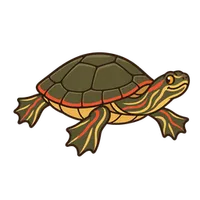
The painted turtle is the friendly, sun-loving turtle you probably spotted stacked up on a log at the local pond. They're genuinely hardy and full of personality, which is exactly why so many end up in tanks that are far too small with no real UVB. Get them a big water body, a warm dry dock, and a proper UVB bulb, and a painted turtle is one of the most rewarding animals you can keep. Just know going in: this is a decades-long friend, not a starter pet you'll outgrow.
Worried, or still setting up? Free tools
Or browse common Painted Turtle questions →
Care at a glance
| Adult size | Carapace about 5-10 in (roughly 12-25 cm); Animal Diversity Web gives a range of 90-250 mm. Females are noticeably larger and heavier-bodied; males stay smaller with long front claws and a longer, thicker tail. |
|---|---|
| Lifespan | Commonly 25-30 years with good care, and 30-40+ years is realistic; some captives have reached nearly 50. Plan for a multi-decade commitment. |
| Tank | Think water volume, not "a tank." The modern rule is at least 10 gallons of water per inch of shell length, so a full-grown 8-10 in turtle needs a 75-100+ gallon system, and 150-200 gallons is better. As a footprint, aim for at least 36-48 in wide and 12+ in deep. A stock tank, tortoise/Waterland tub, or 100-gallon+ aquarium beats a cramped starter kit every time. One turtle per enclosure is easiest. |
| Water temperature | Adults/subadults: about 70-76°F (21-24°C). Juveniles: warmer, about 78-80°F (25-27°C). Hold it with a guarded submersible heater sized to the volume and verify with a separate thermometer. |
| Water depth | Deeper than people expect: at least 1.5 times the turtle's shell length so they can swim, dive, and right themselves if flipped. Painted turtles are strong swimmers and use the whole water column, so more depth (with easy access to the dock) is better. |
| Filtration | Turtles are messy, so over-filter: run a canister or filter rated for at least 2-3x the actual water volume in the tank (e.g. a large canister like a Fluval FX-series on a 100+ gallon system). Back it up with a partial water change of ~30% every 1-2 weeks. |
| Basking dock | A dry, sturdy dock (rock, log, or floating platform) big enough for the turtle to haul completely out and dry off. Basking-surface temperature about 85–95°F (29–35°C) via a focused halogen/basking flood — ReptiFiles cites up to ~104°F, so give a warm dock with a clear cool side; measure it with an infrared thermometer, don't guess. |
| Night | Turn the lamps off at night. As long as the room stays around 70-75°F (21-24°C), no night heat is needed; the water heater holds the water steady. Avoid prolonged drops much below that outside a deliberate, vet-informed brumation. |
| UVB & lighting | A linear T5 HO UVB tube is the standard, e.g. Arcadia T5 HO 6% or Zoo Med ReptiSun 5.0 T5 HO, mounted roughly 13-14 in above the dry dock to land a UV Index of about 3.0-4.0 on the basking surface (Ferguson Zone 3). Never filter it through glass or plastic. Replace the bulb every ~6-12 months per the maker even if it still glows, since UVB output fades. |
| Tank bottom | Bare-bottom is easiest, cleanest, and has the lowest impaction risk, ideal for beginners. If you want a natural look, use large smooth river rocks each bigger than the turtle's head so they can't be swallowed. Avoid fine gravel and loose sand, which can be ingested and cause impaction. |
| Diet | Omnivores whose ratio shifts with age. Juveniles (under ~1 yr): roughly 50% animal protein / 50% plants, fed daily. Adults: shift toward ~25% protein / 75% plants, offering protein or a quality aquatic-turtle pellet only 2-3x/week with leafy greens/aquatic plants daily. Protein sources include pellets, feeder fish/worms, and insects; skip fatty meats and iceberg lettuce. |
| Supplements | Leave a cuttlebone floating in the water at all times for free-choice calcium and replace it every 1-2 months. With real UVB plus a varied diet and cuttlebone, most keepers don't need heavy powder supplementation; a light calcium (with D3 optional under good UVB) dusting on protein for growing juveniles is a reasonable extra. |
What it's like to live with a Painted Turtle
Living with a painted turtle is a lot like keeping a big, curious fish that also needs to climb out and sunbathe. They're active, visible, and will beg at the glass, which is a big part of the charm. The daily reality, though, is water management: they eat messily and poop constantly, so even with a strong filter you're doing regular water changes and wiping down the basking area. They're best watched, not cuddled, since handling stresses them and every turtle can carry Salmonella (wash hands, and this is a poor fit for homes with very young kids). Do the water and lighting right and they're genuinely low-drama; cut corners and water quality problems show up fast.
Your first month together
The settling-in period, in order — so you know what's normal and when not to worry.
- Set the whole system up and run it empty for a few days first: heater dialed to temperature, filter cycling, UVB and basking lamp on a timer, and a basking surface reading in the 95-104°F range before the turtle ever goes in.
- Expect a shy, hidey new turtle. A fresh painted turtle may not eat or may dive whenever you approach for the first days to a week; give it space and keep water clean.
- Offer food in the water and watch, but don't panic over a slow start; remove uneaten food promptly so it doesn't foul the water.
- Confirm normal basking within the first week or two: a healthy turtle hauls out under the lamp and dries off. No basking at all is an early husbandry red flag (check temps and UVB).
- Weigh and photograph your turtle so you have a baseline, and get the water into a steady cleaning rhythm (partial change ~every 1-2 weeks) before problems can build.
- Line up an exotics/reptile vet now, before you need one, so you're not scrambling in an emergency.
Through the year, and as they grow
Diet shifts with age: hatchlings and juveniles are protein-heavy and fed daily to fuel growth, then you dial protein down and greens up as they mature. Seasonally, painted turtles are wired to brumate (a reptile dormancy) in cold months, and many keepers simply keep them warm and active year-round indoors, which is perfectly fine. If you deliberately brumate a healthy adult, it's done cool (about 40-50°F / 4-10°C, never freezing) for roughly 8-16 weeks after a vet check and a gradual cool-down. Never brumate a hatchling, a juvenile, or any turtle that isn't robustly healthy; they lack the reserves and it can be fatal.
The pet store gets these wrong
Common myths, kindly corrected — no shame for having believed them.
- "Turtles only grow as big as their tank." False, and dangerous. A cramped tank doesn't keep a turtle cute and small; it stresses them and, combined with poor UVB/diet, drives metabolic bone disease, which stunts growth and deforms the shell and skeleton. They need room to actually thrive.
- "A little starter tank is fine, they're tiny." That adorable hatchling is a 5-10 inch adult in a few years. Buying the small kit just means buying a big setup again later; size for the adult from the start.
- "Turtles don't really need UVB, a normal light is enough." Without proper UVB (or vet-directed D3), painted turtles can't process calcium and develop metabolic bone disease. Real UVB over the dry dock is non-negotiable.
- "They live in water, so they don't need to get fully dry." They must be able to haul completely out and dry off under heat and UVB. A too-small or half-submerged dock leads to shell rot and other skin problems.
- "Painted turtles are a low-effort beginner pet." They're hardy, but the water volume, heating, filtration, UVB, and 25-40 year lifespan make them a real commitment, not a throwaway first pet.
Before you buy
- This is a 25-40+ year animal; are you ready for a friend that could outlast your current home, job, or relationship?
- Budget for the real setup up front: a 75-150+ gallon water system, a canister filter rated 2-3x the volume, a submersible heater, a basking lamp, and a genuine T5 HO UVB fixture. It costs more than the turtle.
- You'll be doing regular water changes and cleaning for decades; are you okay with the ongoing wet, messy maintenance?
- Every turtle can carry Salmonella; this is a watch-and-admire pet, not a cuddle pet, and a poor match for households with kids under 5 or immunocompromised people.
- Locate an exotics/reptile vet in your area before you buy, and never take a native painted turtle from the wild (it's often illegal and bad for both the turtle and local populations).
💷 The painted turtle itself is usually the cheapest part — see the real cost of keeping one (upfront + ongoing, no sales pitch).
See a reptile vet if…
We can't diagnose from afar — but these are the signs to stop watching and get a professional:
- Swollen, puffy, or crusted eyes, or eyes sealed shut with discharge, a classic sign of vitamin A deficiency and infection.
- Bubbles from the nose or mouth, wheezing, open-mouth or neck-stretched breathing, or swimming lopsided/tilted to one side, which point to a respiratory infection or pneumonia.
- A soft, spongy, pyramided, or deformed shell, or weak/bowed legs, all warning signs of metabolic bone disease.
- Shell that is pitting, flaking, foul-smelling, discolored, or has open sores (shell rot), or any open wound or abscess/lump on the head, mouth, or limbs.
- Refusing food for an extended period, unexplained weight loss, lethargy, or a turtle that never basks or can't swim/right itself normally.
- When in doubt, see an exotics vet promptly; these notes are triage cues, not a diagnosis.
Heading in? Print the free Painted Turtle vet-prep sheet — what to bring, what to tell the vet, and the questions to ask.
Never
- Never keep them in unheated, unfiltered, or dirty water; cold and poor water quality cause most illnesses.
- Never skip real UVB or filter it through glass/plastic; it causes metabolic bone disease.
- Never house them in a tank too small to swim in or without a dry basking dock they can fully climb onto.
- Never feed a diet of iceberg lettuce, fatty meats, or protein-only; it drives vitamin A deficiency and obesity.
- Never let the basking dock stay damp or the turtle stay wet 24/7; it invites shell rot.
- Never brumate a hatchling, juvenile, or any unhealthy turtle, and never let water reach freezing.
- Never release a pet painted turtle into the wild, and never take one from the wild.
Common painted turtle questions
How hard are Painted Turtles to keep — are they good for beginners?
Intermediate. Hardy and forgiving temperament-wise, but the setup is the hard part: a big, heated, heavily filtered water body plus a proper dry basking dock under real UVB. The husbandry bar is higher than most beginners expect, and this is a 25-40 year commitment.
What do Painted Turtles eat?
Omnivores whose ratio shifts with age. Juveniles (under ~1 yr): roughly 50% animal protein / 50% plants, fed daily. Adults: shift toward ~25% protein / 75% plants, offering protein or a quality aquatic-turtle pellet only 2-3x/week with leafy greens/aquatic plants daily. Protein sources include pellets, feeder fish/worms, and insects; skip fatty meats and iceberg lettuce.
How big a tank do Painted Turtles need?
Think water volume, not "a tank." The modern rule is at least 10 gallons of water per inch of shell length, so a full-grown 8-10 in turtle needs a 75-100+ gallon system, and 150-200 gallons is better. As a footprint, aim for at least 36-48 in wide and 12+ in deep. A stock tank, tortoise/Waterland tub, or 100-gallon+ aquarium beats a cramped starter kit every time. One turtle per enclosure is easiest.
What water temperature do Painted Turtles need?
Adults/subadults: about 70-76°F (21-24°C). Juveniles: warmer, about 78-80°F (25-27°C). Hold it with a guarded submersible heater sized to the volume and verify with a separate thermometer.
What water depth do Painted Turtles need?
Deeper than people expect: at least 1.5 times the turtle's shell length so they can swim, dive, and right themselves if flipped. Painted turtles are strong swimmers and use the whole water column, so more depth (with easy access to the dock) is better.
What filtration do Painted Turtles need?
Turtles are messy, so over-filter: run a canister or filter rated for at least 2-3x the actual water volume in the tank (e.g. a large canister like a Fluval FX-series on a 100+ gallon system). Back it up with a partial water change of ~30% every 1-2 weeks.
What basking dock do Painted Turtles need?
A dry, sturdy dock (rock, log, or floating platform) big enough for the turtle to haul completely out and dry off. Basking-surface temperature about 85–95°F (29–35°C) via a focused halogen/basking flood — ReptiFiles cites up to ~104°F, so give a warm dock with a clear cool side; measure it with an infrared thermometer, don't guess.
What night-time temperature do Painted Turtles need?
Turn the lamps off at night. As long as the room stays around 70-75°F (21-24°C), no night heat is needed; the water heater holds the water steady. Avoid prolonged drops much below that outside a deliberate, vet-informed brumation.
What UVB and lighting do Painted Turtles need?
A linear T5 HO UVB tube is the standard, e.g. Arcadia T5 HO 6% or Zoo Med ReptiSun 5.0 T5 HO, mounted roughly 13-14 in above the dry dock to land a UV Index of about 3.0-4.0 on the basking surface (Ferguson Zone 3). Never filter it through glass or plastic. Replace the bulb every ~6-12 months per the maker even if it still glows, since UVB output fades.
What substrate do Painted Turtles need?
Bare-bottom is easiest, cleanest, and has the lowest impaction risk, ideal for beginners. If you want a natural look, use large smooth river rocks each bigger than the turtle's head so they can't be swallowed. Avoid fine gravel and loose sand, which can be ingested and cause impaction.
What supplements do Painted Turtles need?
Leave a cuttlebone floating in the water at all times for free-choice calcium and replace it every 1-2 months. With real UVB plus a varied diet and cuttlebone, most keepers don't need heavy powder supplementation; a light calcium (with D3 optional under good UVB) dusting on protein for growing juveniles is a reasonable extra.
How big do Painted Turtles get?
Carapace about 5-10 in (roughly 12-25 cm); Animal Diversity Web gives a range of 90-250 mm. Females are noticeably larger and heavier-bodied; males stay smaller with long front claws and a longer, thicker tail.
How long do Painted Turtles live?
Commonly 25-30 years with good care, and 30-40+ years is realistic; some captives have reached nearly 50. Plan for a multi-decade commitment.
What are the signs Painted Turtles are sick or need a vet?
See a reptile or exotics vet if you notice: Swollen, puffy, or crusted eyes, or eyes sealed shut with discharge, a classic sign of vitamin A deficiency and infection.; Bubbles from the nose or mouth, wheezing, open-mouth or neck-stretched breathing, or swimming lopsided/tilted to one side, which point to a respiratory infection or pneumonia.; A soft, spongy, pyramided, or deformed shell, or weak/bowed legs, all warning signs of metabolic bone disease.; Shell that is pitting, flaking, foul-smelling, discolored, or has open sores (shell rot), or any open wound or abscess/lump on the head, mouth, or limbs.; Refusing food for an extended period, unexplained weight loss, lethargy, or a turtle that never basks or can't swim/right itself normally.; When in doubt, see an exotics vet promptly; these notes are triage cues, not a diagnosis..
Your first two weeks · Taming & handling · Behaviours explained · Won't eat? · Stuck shed · When to see a vet

Get the free Painted Turtle Starter Kit
A one-page setup criteria checklist and a first-30-days plan for your first painted turtle — what to get, what makes each thing matter, and the honest bits the pet shop skips. Join the den and we’ll send it over.
Free reptile care cheat-sheet the moment you join. No spam — unsubscribe anytime. See how we handle your data in our privacy notice.Sources & further reading
This guide was written and fact-checked against these authorities. It's kind, general guidance — not a diagnosis or a substitute for an exotics vet:
- ReptiFiles - Painted Turtle Care Sheet — Modern best-practice specs: 5-10 in adult, up to 40 yr, 10 gal water per inch of shell, water 78-80F juv / 70-76F adult, basking 95-104F, T5 HO UVB (Arcadia 6% / ReptiSun 5.0) at UVI 3.0-4.0 mounted 13-14 in above dock, filtration 2-3x volume, diet ratios (50/50 juv, 25/75 adult), cuttlebone every 1-2 months.
- PetMD - Painted Turtle (vet-reviewed) — Enclosure dimensions 36-48 in wide x 12+ in deep, water depth at least 1.5x turtle length, UVB required and not through glass, calcium block, and health red flags (swollen eyes, breathing difficulty/bubbles from nose, inability to swim, weight change).
- Animal Diversity Web - Chrysemys picta — Taxonomy: family Emydidae; carapace 90-250 mm; lifespan up to ~35-40 yr wild, ~30 yr documented captivity; female larger than male.
- VCA Animal Hospitals - Common Diseases of Aquatic Turtles — Vet source for vetFlags/myths: metabolic bone disease (misshapen shell/bones, from poor UVB+diet), vitamin A deficiency (swollen eyelids w/ discharge), respiratory infection (mouth/nose bubbles, neck extension), pneumonia (tilting while swimming), shell rot from dirty water.
- Reptiles Magazine - Painted Turtle Care Sheet — Corroborating water temp (~75-80F), basking zone (85-95F+), UVB with 6-month replacement, large enclosure and strong filtration guidance.
Written and fact-checked by The Baskden Team against veterinarian-authored sources — if your reptile shows a red-flag sign above, see an exotics vet promptly.