
Species · Omnivorous skink
Sandfish Skink
Scincus scincus
The skink that 'swims' through sand — a mesmerising desert oddity that spends most of its life buried.
Difficulty: Intermediate Printable care sheet →
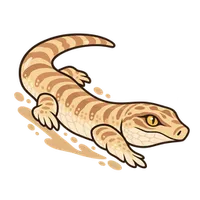
The sandfish is the reptile world's magic trick: a little golden desert skink that dives into loose sand and "swims" through it with an eel-like wriggle, limbs tucked flat against its sides. They're small, tough, and endlessly watchable when they surface to hunt. The catch is that most of the day they're buried, so you're really keeping a slice of Sahara dune — get the sand deep and clean, the basking spot hot, and the cool end dry, and this becomes one of the easiest desert lizards to keep happy.
Worried, or still setting up? Free tools
Or browse common Sandfish Skink questions →
Care at a glance
| Adult size | About 6–8 in (15–20 cm) total length, including the short tail. A palm-sized lizard. |
|---|---|
| Lifespan | Roughly 6–10 years with good care; up to about 10 years is realistic. |
| Enclosure | Minimum 30 x 12 x 12 in (75 x 30 x 30 cm) — a 20-gallon "long" — for one adult. Better: 36 x 18 x 18 in (90 x 45 x 45 cm / ~40 gallon). Floor space and sand depth matter far more than height. Add at least ~1 sq ft (10 gal) per extra skink if grouping. |
| Basking / warm zone | Basking surface 130–140°F (54–60°C). Yes, that's hot — it's a surface temp on the sand under the lamp, not air temp. Use an overhead halogen flood on a thermostat/dimmer and confirm with an infrared temp gun. |
| Cool side | Cool end 80–90°F (26–32°C). The whole enclosure should offer a real gradient so the skink can dive down and cool off — the sand a couple inches below the surface runs noticeably cooler than the basking spot. |
| Night | Night drop to about 70–80°F (21–26°C). Turn heat and UVB off at night; a normal cool room usually handles this with no extra night heat. |
| UVB & lighting | Yes — they're diurnal desert lizards and benefit from UVB. Ferguson Zone 1: aim for a UV Index of about 1.0–2.0 at the basking surface, leaning to the higher end. A T5 HO tube such as Arcadia Forest 6% or Zoo Med ReptiSun 5.0 at ~14–20 in, or an Arcadia ShadeDweller 7% at ~8–12 in, works well. Replace UVB bulbs every 12 months. Photoperiod ~12 hours/day (some keepers cycle ~13h summer / ~11h winter). |
| Humidity | Low — desert dry, generally under ~50% ambient. Don't spray the whole tank. Instead keep a small shallow water bowl and dampen a lower pocket of sand (e.g. via a buried tube) so the skink can find moisture underground if it wants it. |
| Substrate | Deep, clean, fine desert sand — this is the whole point of the species. At least 4–6 in (10–15 cm) so they can burrow and "swim"; deeper is better. Use washed play sand or a low-dust reptile sand (Jurassic Sands, Zoo Med ReptiSand, Exo Terra Desert Sand). Avoid calcium/vitamin "sands," sandblasting sand (free silica), and anything that isn't sand — carpet, coco fiber, and aspen all defeat the purpose. |
| Diet | Insectivore. Staples: crickets, dubia/discoid/red-runner roaches, black soldier fly larvae, small locusts, mealworms, small superworms, darkling beetles. Occasional treats: small hornworms, silkworms, waxworms, butterworms. Keep prey no wider than the skink's head; offer what it eats in ~5 minutes. |
| Supplements | Lightly dust feeders with a plain calcium powder at nearly every feeding (skip on naturally calcium-rich prey like hornworms/isopods). Add a reptile multivitamin occasionally — err toward too little rather than too much. Extra vitamin D3 usually isn't needed if UVB is correct; a low-D3 calcium is a safe way to top up. |
What it's like to live with a Sandfish Skink
Best kept singly. Two males fight, especially in breeding season. A male-female pair breeds readily and breeding is hard on females, so only pair up if you're ready to incubate eggs. A colony of females can sometimes work in a larger enclosure with ~1 sq ft added per skink, but always be ready to separate if squabbling starts.
Your first month together
The settling-in period, in order — so you know what's normal and when not to worry.
- Build the desert BEFORE the skink arrives: 4–6 in+ of clean sand, hot basking surface (130–140°F), Zone 1 UVB, dry cool end.
- Verify the basking SURFACE temp with an infrared temp gun and the cool end with a separate thermometer — air temps lie for a sand-dweller.
- Expect it to vanish. A new sandfish will bury itself and stay hidden for days; that's normal, not a problem.
- Offer a few appropriately sized, calcium-dusted insects every 1–2 days and watch (from a distance) for surfacing to hunt.
- Provide a shallow water bowl and dampen one lower sand pocket; keep the surface and cool end dry.
- Handle rarely at first — let it settle. These are watch-don't-hold lizards, and being grabbed stresses them.
Through the year, and as they grow
A gentle seasonal light cycle (longer days in summer, shorter in winter) supports natural rhythms and breeding condition. Some keepers give a mild cool-down in winter. In hot weather, watch that the basking end doesn't run away above target — the deep sand gradient is the skink's escape valve, so never let the whole tank cook.
The pet store gets these wrong
Common myths, kindly corrected — no shame for having believed them.
- 'Sandfish need to be handled to tame down.' No — they're a display animal. They swim through sand to escape threats, and repeated handling just stresses them. Enjoy the sand-swimming show instead.
- 'Any sand works.' It doesn't. Calcium/vitamin sands and sharp sandblasting sand can cause problems; clean washed play sand or a proper reptile sand is what you want — and it must be DEEP, not a token dusting.
- 'A shallow layer of substrate is fine.' Sandfish literally live inside the substrate. Under ~4 in and you've taken away the single behavior the species exists for.
- 'They're a desert lizard, so no UVB or water needed.' They're diurnal and do benefit from Zone 1 UVB, and while the air is dry they'll use a shallow bowl and a damp underground pocket. Bone-dry does not mean zero moisture.
- 'Two are better than one / they're social.' They're not. Males fight and breeding taxes females — one skink in a good desert setup is the low-stress default.
Before you buy
- A deep sand bed (4–6 in+) is non-negotiable — buy the enclosure and the sand budget together.
- You need a real hot basking SURFACE (130–140°F) plus a dry, cooler end — that's a proper thermostat, halogen lamp, and an infrared temp gun.
- This is a watch-not-hold pet that spends most of the day buried; if you want a lizard that interacts, look elsewhere.
- Feeding means a steady supply of live insects (roaches, crickets, BSFL) plus calcium — no pellet shortcut.
- Ongoing costs include an annual UVB bulb replacement and electricity for the heat lamp.
- Check the animal's origin — many are wild-caught; a settled, feeding captive individual is a far better first sandfish.
💷 The sandfish skink itself is usually the cheapest part — see the real cost of keeping one (upfront + ongoing, no sales pitch).
See a reptile vet if…
We can't diagnose from afar — but these are the signs to stop watching and get a professional:
- Not eating for an extended stretch, or visible weight loss / a thinning tail base — see an exotics vet.
- Won't burrow, sits listless on the surface, or is repeatedly exposed and not thermoregulating — a red flag for illness or a setup problem.
- Swollen or rubbery jaw, tremors, or trouble moving the limbs — possible metabolic bone disease; get UVB/calcium checked and see a vet.
- Retained shed (especially around toes or the tail tip) that could constrict circulation.
- Runny or bubbly nose, open-mouth breathing, or wheezing — possible respiratory infection, often from too much damp; see a vet.
- Any deep wound or persistent swelling from a cage-mate fight — separate the animals and have injuries assessed.
Heading in? Print the free Sandfish Skink vet-prep sheet — what to bring, what to tell the vet, and the questions to ask.
Never
- Never use a shallow substrate — under ~4 in of sand robs a sandfish of the ability to burrow and swim.
- Never use calcium/vitamin 'sand' or sharp sandblasting sand as substrate.
- Never rely on air temperature alone — measure the basking SURFACE with an infrared temp gun.
- Never keep the enclosure humid or soggy; damp cool ends invite respiratory and scale infection in a desert species.
- Never house two males together, and don't pair a male and female unless you're prepared to breed and incubate eggs.
- Never skip UVB and calcium — the combination prevents metabolic bone disease.
- Never make a sandfish a handling pet; it's a display animal that stresses when grabbed.
Common sandfish skink questions
How hard are Sandfish Skinks to keep — are they good for beginners?
Intermediate. Hardy and small, but the needs are specific and a little unusual: a deep bed of clean sand to "swim" in, a genuinely hot basking surface, and a bone-dry cool end. That combination — plus the fact they hide underground most of the day — is why we call them intermediate rather than beginner. Get the desert setup right and they're low-drama.
What do Sandfish Skinks eat?
Insectivore. Staples: crickets, dubia/discoid/red-runner roaches, black soldier fly larvae, small locusts, mealworms, small superworms, darkling beetles. Occasional treats: small hornworms, silkworms, waxworms, butterworms. Keep prey no wider than the skink's head; offer what it eats in ~5 minutes.
How big an enclosure do Sandfish Skinks need?
Minimum 30 x 12 x 12 in (75 x 30 x 30 cm) — a 20-gallon "long" — for one adult. Better: 36 x 18 x 18 in (90 x 45 x 45 cm / ~40 gallon). Floor space and sand depth matter far more than height. Add at least ~1 sq ft (10 gal) per extra skink if grouping.
What basking temperature do Sandfish Skinks need?
Basking surface 130–140°F (54–60°C). Yes, that's hot — it's a surface temp on the sand under the lamp, not air temp. Use an overhead halogen flood on a thermostat/dimmer and confirm with an infrared temp gun.
What should the cool side be for Sandfish Skinks?
Cool end 80–90°F (26–32°C). The whole enclosure should offer a real gradient so the skink can dive down and cool off — the sand a couple inches below the surface runs noticeably cooler than the basking spot.
What night-time temperature do Sandfish Skinks need?
Night drop to about 70–80°F (21–26°C). Turn heat and UVB off at night; a normal cool room usually handles this with no extra night heat.
What UVB and lighting do Sandfish Skinks need?
Yes — they're diurnal desert lizards and benefit from UVB. Ferguson Zone 1: aim for a UV Index of about 1.0–2.0 at the basking surface, leaning to the higher end. A T5 HO tube such as Arcadia Forest 6% or Zoo Med ReptiSun 5.0 at ~14–20 in, or an Arcadia ShadeDweller 7% at ~8–12 in, works well. Replace UVB bulbs every 12 months. Photoperiod ~12 hours/day (some keepers cycle ~13h summer / ~11h winter).
What humidity do Sandfish Skinks need?
Low — desert dry, generally under ~50% ambient. Don't spray the whole tank. Instead keep a small shallow water bowl and dampen a lower pocket of sand (e.g. via a buried tube) so the skink can find moisture underground if it wants it.
What substrate do Sandfish Skinks need?
Deep, clean, fine desert sand — this is the whole point of the species. At least 4–6 in (10–15 cm) so they can burrow and "swim"; deeper is better. Use washed play sand or a low-dust reptile sand (Jurassic Sands, Zoo Med ReptiSand, Exo Terra Desert Sand). Avoid calcium/vitamin "sands," sandblasting sand (free silica), and anything that isn't sand — carpet, coco fiber, and aspen all defeat the purpose.
What supplements do Sandfish Skinks need?
Lightly dust feeders with a plain calcium powder at nearly every feeding (skip on naturally calcium-rich prey like hornworms/isopods). Add a reptile multivitamin occasionally — err toward too little rather than too much. Extra vitamin D3 usually isn't needed if UVB is correct; a low-D3 calcium is a safe way to top up.
How big do Sandfish Skinks get?
About 6–8 in (15–20 cm) total length, including the short tail. A palm-sized lizard.
How long do Sandfish Skinks live?
Roughly 6–10 years with good care; up to about 10 years is realistic.
What are the signs Sandfish Skinks are sick or need a vet?
See a reptile or exotics vet if you notice: Not eating for an extended stretch, or visible weight loss / a thinning tail base — see an exotics vet.; Won't burrow, sits listless on the surface, or is repeatedly exposed and not thermoregulating — a red flag for illness or a setup problem.; Swollen or rubbery jaw, tremors, or trouble moving the limbs — possible metabolic bone disease; get UVB/calcium checked and see a vet.; Retained shed (especially around toes or the tail tip) that could constrict circulation.; Runny or bubbly nose, open-mouth breathing, or wheezing — possible respiratory infection, often from too much damp; see a vet.; Any deep wound or persistent swelling from a cage-mate fight — separate the animals and have injuries assessed..
Your first two weeks · Taming & handling · Behaviours explained · Won't eat? · Stuck shed · When to see a vet

Get the free Sandfish Skink Starter Kit
A one-page setup criteria checklist and a first-30-days plan for your first sandfish skink — what to get, what makes each thing matter, and the honest bits the pet shop skips. Join the den and we’ll send it over.
Free reptile care cheat-sheet the moment you join. No spam — unsubscribe anytime. See how we handle your data in our privacy notice.Sources & further reading
This guide was written and fact-checked against these authorities. It's kind, general guidance — not a diagnosis or a substitute for an exotics vet:
- ReptiFiles — Sandfish Care Guide (Temperatures, UVB & Humidity) — Basking 130–140°F, cool side 80–90°F, night 70–80°F, Ferguson Zone 1 UVI 1.0–2.0, bulb/distance recs, 12-month bulb replacement, ~12h photoperiod.
- ReptiFiles — Sandfish Terrarium Size — Minimum 30x12x12 in (20-gal long); optimal 36x18x18 in; cohabitation guidance and per-skink space.
- ReptiFiles — Sandfish Substrate — 4–6 in (10–15 cm) clean sand; recommended sands and substrates to avoid.
- ReptiFiles — Sandfish Food, Water & Supplements — Feeder list, feeding schedule by size, calcium/multivitamin protocol, shallow water bowl (max 1 in).
- ReptiFiles — Sandfish Care Guide (overview) — Adult size 6–8 in, 6–10 year lifespan, insectivore diet.
- Dubia.com — Sandfish Skink Care Sheet — Second source corroborating enclosure, temps, humidity <50%, substrate depth, feeding schedule, Repashy Calcium Plus LoD supplement.
- Wikipedia — Scincus scincus — Family Scincidae, ~20 cm adult length, Sahara/Arabian range, insectivore, sand-swimming undulatory locomotion.
Written and fact-checked by The Baskden Team against veterinarian-authored sources — if your reptile shows a red-flag sign above, see an exotics vet promptly.