
Species · Chameleon
Veiled Chameleon
Chamaeleo calyptratus
The iconic colour-shifting, swivel-eyed lizard — mesmerising to watch, but a look-don't-touch display animal.
Difficulty: Intermediate Printable care sheet →
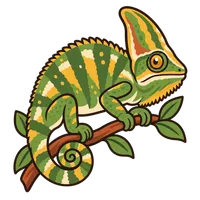
Veiled chameleons are living special effects — independently swivelling eyes, a prehensile tail, a ballistic tongue, a tall helmet-like casque, and slow, deliberate colour shifts. They are utterly mesmerising to watch and the most beginner-friendly chameleon there is. The catch: they're a look-don't-touch display animal that stresses easily, they drink only moving water (droplets, not a bowl), and dehydration is the number-one thing that kills them. Nail the hydration and ventilation and they're a wonder to keep.
Worried, or still setting up? Free tools
Or browse common Veiled Chameleon questions →
Care at a glance
| Adult size | Males ~17–24 in with tail; females smaller, ~10–14 in |
|---|---|
| Lifespan | 6–8 years (females often shorter, from the toll of egg-laying) |
| Enclosure | A front-opening 24×24×48 in mesh cage minimum, larger preferred — they’re arboreal, so height and dense planting matter. Full-mesh suits humid climates; in a very dry home a partly solid (glass/PVC) enclosure holds humidity better. House ONE per cage — chameleons are solitary and stressed by company. |
| Basking / warm zone | A gentle basking spot of 85°F (29°C) — the heat lamp only needs to be on for about 3 hours in the morning. They do NOT want a hot all-day basking zone. |
| Cool side | General temperature 72–78°F (22–25°C), with a vertical gradient (warmer at the top, cooler below) so it can thermoregulate by climbing. |
| Night | Night 55–65°F (13–18°C) — a genuine night-time drop is healthy. |
| UVB & lighting | UVB is essential (diurnal, arboreal): a T5 HO bulb (Arcadia Forest 6% or Zoo Med ReptiSun 5.0) giving UVI ~3.0 at basking height (Ferguson Zone 3), plus a bright 6500K daylight LED for wellbeing. 12-hour photoperiod; replace the UVB bulb yearly. |
| Humidity | Low by day, high at night: 40–50% during the day and 80–100% at night. Crucially, they drink DROPLETS, not standing water — provide water by misting morning and evening, a dripper in the afternoon, and ideally a fogger before “sunrise”. A water bowl will be ignored. |
| Substrate | Because so much water passes through daily, most keepers run a bare floor with a drainage system rather than loose substrate (which saturates and poses an impaction risk). Live potted plants add cover and humidity. |
| Diet | Insectivore — a varied, gut-loaded insect menu (crickets, dubia, hornworms, silkworms, black soldier fly larvae): juveniles daily, adults every 1–2 days. Veiled chameleons also nibble non-toxic live plants (pothos, hibiscus), which is normal. |
| Supplements | Dust insects with plain calcium at most feedings, a little calcium + D3 lightly (alongside UVB), and a multivitamin about every 2 weeks. Getting the supplement schedule right matters — too much D3 or vitamin A causes its own problems. |
🦎 Did you know? — Veiled Chameleon fun facts
Little true delights about the veiled chameleon — each one checked against a named source, no pet-shop myths.
- The veiled chameleon catches prey by firing out its sticky tongue, which it also uses to smell and taste. Animal Diversity Web
- It is one of the few chameleons that also eats leaves — a way to sip moisture from plants during the dry season. Animal Diversity Web
- After mating, a female veiled chameleon switches from light green to blackish-green with blue and yellow spots within just 18 hours. Animal Diversity Web
What it's like to live with a Veiled Chameleon
A veiled chameleon is a living jewel to watch, not a pet to hold. The whole joy of one is observational — the independently swivelling eyes, the slow-motion stalk, the projectile tongue, and the shifting colours that track mood and temperature. They are solitary and genuinely stressed by handling, so the kindest keeper is a patient watcher. They need a screen cage, strong lighting, and moving-water hydration from a dripper or misting system. This is the most demanding species on our beginner-adjacent list — a rewarding step up for a committed keeper, not most people's first reptile.
Your first month together
The settling-in period, in order — so you know what's normal and when not to worry.
- Give it near-total privacy at first; handling is a stressor, so resist it and let the chameleon settle by observation alone.
- Set up a dripper or automatic misting before it arrives — chameleons drink moving droplets and will not use a water bowl, so this is life-or-death, not optional.
- Watch that it is drinking and hunting; colour changes with mood and warmth are normal and fascinating, not a warning sign by themselves.
- Keep disturbance to a minimum — a calm, unbothered chameleon in a well-planted cage is the goal.
- Learn its resting and basking spots so you can spot when something changes.
Through the year, and as they grow
A crucial welfare point: female veiled chameleons can produce (infertile) eggs even with no male present, and a gravid female must have a suitable lay bin of moist substrate to dig in — without it, egg-binding is a real and dangerous risk. Appetite, colour, and activity all track temperature and daylight, so expect a livelier chameleon in the warmer, brighter months.
The pet store gets these wrong
Common myths, kindly corrected — no shame for having believed them.
- Chameleons change colour to camouflage — mostly no; colour mainly signals mood, temperature, and health.
- You can handle a chameleon like a bearded dragon — no; they’re display animals and handling chronically stresses them.
- Just put a water bowl in — they won’t use it; they only drink moving droplets from misting or a dripper.
- A mesh cage is right in every climate — in a very dry home, a partly solid enclosure holds humidity far better.
- A lone female won’t lay eggs — she will, and egg-binding can be fatal; provide a lay bin.
Before you buy
- A tall, ventilated, densely planted cage with a drainage setup.
- A misting system and/or dripper (ideally automatic) plus a fogger — hydration is the No. 1 killer.
- Acceptance that it’s look-don’t-touch, and a lay bin if you have a female.
- An exotics/reptile vet who actually sees chameleons, and a 6–8 year commitment.
💷 The veiled chameleon itself is usually the cheapest part — see the real cost of keeping one (upfront + ongoing, no sales pitch).
See a reptile vet if…
We can't diagnose from afar — but these are the signs to stop watching and get a professional:
- Sunken eyes, eyes closed during the day, or dry/orange stringy urate (dehydration — the No. 1 chameleon problem).
- A rubbery jaw, bowed limbs, or a curled/kinked tail (signs pointing to metabolic bone disease).
- A female who goes off food, digs restlessly, then becomes weak and straining (egg-binding — an emergency).
- Gaping with mucus, or puffing/whistling (possible respiratory infection).
- Persistent dark, stressed colouration with lethargy, or swollen, gritty joints (gout, often from over-supplementation).
Heading in? Print the free Veiled Chameleon vet-prep sheet — what to bring, what to tell the vet, and the questions to ask.
Never
- Never handle it for fun — it causes chronic stress.
- Never rely on a water bowl — it will dehydrate; use misting/dripper/fogger.
- Never skip UVB, and never over-supplement D3 or vitamin A.
- Never house two chameleons together.
- Never leave a gravid female without a lay site — egg-binding can kill her.
Common veiled chameleon questions
How hard are Veiled Chameleons to keep — are they good for beginners?
Intermediate. The hardiest, most forgiving chameleon and the best one to start with — but chameleons are demanding: precise hydration, a well-ventilated cage, a hands-off approach, and (for females) a real egg-binding risk.
What do Veiled Chameleons eat?
Insectivore — a varied, gut-loaded insect menu (crickets, dubia, hornworms, silkworms, black soldier fly larvae): juveniles daily, adults every 1–2 days. Veiled chameleons also nibble non-toxic live plants (pothos, hibiscus), which is normal.
How big an enclosure do Veiled Chameleons need?
A front-opening 24×24×48 in mesh cage minimum, larger preferred — they’re arboreal, so height and dense planting matter. Full-mesh suits humid climates; in a very dry home a partly solid (glass/PVC) enclosure holds humidity better. House ONE per cage — chameleons are solitary and stressed by company.
What basking temperature do Veiled Chameleons need?
A gentle basking spot of 85°F (29°C) — the heat lamp only needs to be on for about 3 hours in the morning. They do NOT want a hot all-day basking zone.
What should the cool side be for Veiled Chameleons?
General temperature 72–78°F (22–25°C), with a vertical gradient (warmer at the top, cooler below) so it can thermoregulate by climbing.
What night-time temperature do Veiled Chameleons need?
Night 55–65°F (13–18°C) — a genuine night-time drop is healthy.
What UVB and lighting do Veiled Chameleons need?
UVB is essential (diurnal, arboreal): a T5 HO bulb (Arcadia Forest 6% or Zoo Med ReptiSun 5.0) giving UVI ~3.0 at basking height (Ferguson Zone 3), plus a bright 6500K daylight LED for wellbeing. 12-hour photoperiod; replace the UVB bulb yearly.
What humidity do Veiled Chameleons need?
Low by day, high at night: 40–50% during the day and 80–100% at night. Crucially, they drink DROPLETS, not standing water — provide water by misting morning and evening, a dripper in the afternoon, and ideally a fogger before “sunrise”. A water bowl will be ignored.
What substrate do Veiled Chameleons need?
Because so much water passes through daily, most keepers run a bare floor with a drainage system rather than loose substrate (which saturates and poses an impaction risk). Live potted plants add cover and humidity.
What supplements do Veiled Chameleons need?
Dust insects with plain calcium at most feedings, a little calcium + D3 lightly (alongside UVB), and a multivitamin about every 2 weeks. Getting the supplement schedule right matters — too much D3 or vitamin A causes its own problems.
How big do Veiled Chameleons get?
Males ~17–24 in with tail; females smaller, ~10–14 in
How long do Veiled Chameleons live?
6–8 years (females often shorter, from the toll of egg-laying)
What are the signs Veiled Chameleons are sick or need a vet?
See a reptile or exotics vet if you notice: Sunken eyes, eyes closed during the day, or dry/orange stringy urate (dehydration — the No. 1 chameleon problem).; A rubbery jaw, bowed limbs, or a curled/kinked tail (signs pointing to metabolic bone disease).; A female who goes off food, digs restlessly, then becomes weak and straining (egg-binding — an emergency).; Gaping with mucus, or puffing/whistling (possible respiratory infection).; Persistent dark, stressed colouration with lethargy, or swollen, gritty joints (gout, often from over-supplementation)..
Your first two weeks · Taming & handling · Behaviours explained · Won't eat? · Stuck shed · When to see a vet

Get the free Veiled Chameleon Starter Kit
A one-page setup criteria checklist and a first-30-days plan for your first veiled chameleon — what to get, what makes each thing matter, and the honest bits the pet shop skips. Join the den and we’ll send it over.
Free reptile care cheat-sheet the moment you join. No spam — unsubscribe anytime. See how we handle your data in our privacy notice.Sources & further reading
This guide was written and fact-checked against these authorities. It's kind, general guidance — not a diagnosis or a substitute for an exotics vet:
- ReptiFiles — Veiled Chameleon Care Sheet — Min 24×24×48 mesh, basking 85°F (~3h/morning) / general 72–78°F / night 55–65°F, UVI ~3.0 (Forest 6% / ReptiSun 5.0, Zone 3) + 6500K LED, humidity 40–50% day / 80–100% night via misting+dripper+fogger (drinks droplets), gut-loaded insectivore + supplement schedule, drainage substrate, 6–8 yr, house solo.
- Baines et al. (2016), “How much UVB does my reptile need? The UV-Tool” — Ferguson Zone 3 target UVI ~3.0 for a diurnal arboreal lizard.
- Association of Reptilian & Amphibian Veterinarians (ARAV) — Find-an-exotics-vet; dehydration, MBD, dystocia (egg-binding), gout.
- Merck Veterinary Manual — reptiles — Metabolic bone disease, dehydration, dystocia, hypervitaminosis.
Written and fact-checked by The Baskden Team against veterinarian-authored sources — if your reptile shows a red-flag sign above, see an exotics vet promptly.