
Species · Semi-aquatic lizard
Chinese Water Dragon
Physignathus cocincinus
The 'little dinosaur by a jungle stream' — a striking semi-aquatic lizard that needs a big heated pool AND a planted, UVB-lit land side.
Difficulty: Advanced Printable care sheet →
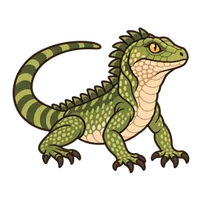
Chinese water dragons are the emerald, streamlined lizards you picture when you think "little dinosaur by a jungle stream." In the wild they perch on branches overhanging water and, when startled, drop straight in and swim off — they can stay under for a remarkably long time. That single fact drives their whole setup: they need a real, big, warm, clean body of water to dive into, PLUS a warm, planted, UVB-lit land side to climb and bask. Get the water, heat, humidity, and space right and they're rewarding, curious animals; skimp and they stress, rub their snouts raw on the glass, and get sick.
Worried, or still setting up? Free tools
Or browse common Chinese Water Dragon questions →
Care at a glance
| Adult size | Males reach about 3 ft (0.9 m) nose-to-tail; females average smaller, around 2 ft (0.6 m). Most of that length is tail. They're slim and arboreal, not bulky. |
|---|---|
| Lifespan | Commonly 10-15 years with good care; some individuals reach ~20. Many die young from preventable husbandry problems, so that range assumes the setup below is actually met. |
| Enclosure | Adult minimum roughly 6 ft tall x 3 ft wide x 6 ft long (about 1.8 x 0.9 x 1.8 m); bigger is strongly recommended, and height matters because they climb. Build it as a paludarium: a large, heated pool that occupies about one-third to one-half of the floor space and is at least 6 in (15 cm) deep — deep enough for the dragon to fully submerge and swim, since these lizards dive to escape and can hold their breath underwater for many minutes. Keep the water warm (basking-warm surface, roughly 80s F / high-20s to low-30s C during the day) and, critically, filtered and moving — a canister or submersible filter plus weekly water changes (or sooner if soiled), because they defecate in the water and stagnant water breeds infection. Densely plant the land side and add visual barriers to stop snout-rubbing on the glass (see below). A single pet-store 75-gallon tank is a temporary juvenile home at best, not an adult enclosure. |
| Basking / warm zone | Warm land basking spot around 90-95°F (32-35°C), measured at the surface where the dragon actually sits. Provide sturdy horizontal branches under the basking lamp so it can thermoregulate above the water. |
| Cool side | Cool end around 77-86°F (25-30°C) per ReptiFiles, so the animal has a real thermal gradient to move through. |
| Night | Night around 75-77°F (24-25°C); a modest natural drop is fine, but do not let it fall below about 65°F (18°C). Sustained cold is a leading cause of respiratory infection in this species. Use a non-light heat source (ceramic heat emitter or radiant panel on a thermostat) if the room drops. |
| UVB & lighting | Yes — UVB is essential. Use a high-output T5 HO linear tube: an Arcadia 12% (Desert) or Zoo Med ReptiSun 10.0, spanning roughly half to two-thirds of the enclosure in a reflective fixture, aiming for a basking-zone UV Index of about 3.0-4.0 (Ferguson Zone 3). Mount it about 11-15 in (30-38 cm) above the basking branch if over mesh, or 16-20 in (40-50 cm) if inside the enclosure. Replace the bulb every 6-12 months — UV output fades before the visible light does. Pair it with a bright ~6500K daylight LED, since a UVB tube alone isn't bright enough for their needs. |
| Humidity | High: daytime average around 60-80%. Achieve it with the large water feature plus misting 1-2x daily (or an automatic mister/fogger) and a moisture-holding substrate. Good ventilation still matters — high humidity with stagnant air invites respiratory and skin infections, so aim for humid but airy, not swampy-stale. |
| Substrate | On the land side, a deep (about 4 in / 10 cm) moisture-holding layer such as coconut fiber, sphagnum/peat moss, or a bioactive soil mix — it holds humidity and cushions falls. Avoid loose particulate that could be swallowed with prey. Some vets prefer easy-clean paper towel or vinyl for hospital/quarantine setups; for a permanent enclosure, a naturalistic moist substrate suits the species better. |
| Diet | Insectivore-leaning omnivore. Juveniles are almost entirely insect-eaters; adults take roughly 80-90% insects (crickets, dubia roaches, black soldier fly larvae, silkworms, the occasional worm) with the remainder as leafy greens, vegetables, and small amounts of fruit. Gut-load feeder insects for 24-72 hours before offering. Adults typically eat insects every few days with salad available more often; feed juveniles more frequently. Offer appropriately sized prey (no wider than the space between the eyes). |
| Supplements | Dust feeders with a plain calcium (no D3) at most feedings, a calcium-with-D3 supplement about once weekly, and a reptile multivitamin every couple of weeks — or use an all-in-one balanced dust (e.g., Repashy Calcium Plus LoD) as directed. Exact schedule depends on how strong your UVB is, so follow the product and, ideally, your exotics vet's guidance. Correct calcium/D3/UVB together prevents metabolic bone disease. |
What it's like to live with a Chinese Water Dragon
Best kept singly unless you have the space and experience for a group. Males are territorial and will fight; never house two males together. A single male with one or more females can work only in a very large, well-planted enclosure with multiple basking and hiding spots — and only if you can separate animals quickly if bullying starts. Do not mix with other species. Watch for one animal monopolizing heat, water, or food.
Your first month together
The settling-in period, in order — so you know what's normal and when not to worry.
- Have the full adult enclosure — tall, planted, with a large heated, filtered pool — set up and holding correct temps, humidity, and UVI on thermostats/timers BEFORE the dragon comes home.
- Verify with real tools: a probe thermometer at the basking spot, a hygrometer, and ideally a UV Index meter (Solarmeter 6.5). Guesswork is how these animals get cold and sick.
- Expect a shy, flighty new arrival. Minimize handling for the first 1-2 weeks; let it settle, explore, and start eating and swimming.
- Densely plant and add visual barriers along the glass right away so a stressed newcomer can't start nose-rubbing.
- Offer food and observe eating, drinking, swimming, and pooping (they usually defecate in the water — scoop/change it promptly).
- Book an exotics-vet new-pet check, including a fecal for parasites, since many are wild-caught or imported and arrive with parasite loads.
Through the year, and as they grow
A mild seasonal shift is natural: keepers often run a slightly longer photoperiod and warmth in summer (around 13 hours of light) and a slightly shorter, cooler winter (around 11 hours, with a modest night drop). Keep humidity up year-round — dry indoor winter heating can crash enclosure humidity and trigger poor sheds and respiratory issues. Never let winter cooling drift into genuine cold.
The pet store gets these wrong
Common myths, kindly corrected — no shame for having believed them.
- 'They stay small / a 20-40 gallon tank is fine.' No. Adults are ~2-3 ft long and arboreal; they need a roughly 6-foot-tall enclosure. That cute little green lizard in a small tank is a growing animal that will outgrow it fast.
- 'A water bowl is enough — they don't really need to swim.' False. This is a semi-aquatic species that dives to escape and can hold its breath underwater for many minutes. They need a large pool deep enough to fully submerge, not a dish.
- 'They're a good beginner lizard because they're cheap and common.' Being common in the pet trade doesn't make them easy — the space, humidity, heated filtered water, and UVB demands put them firmly in advanced territory.
- 'Nose-rubbing on the glass is just a quirky habit.' It's a welfare red flag — usually stress, wanting to escape, or not seeing the barrier. Left unaddressed it causes chronic snout abrasions and infections.
- 'Any bright bulb gives them UVB.' No. They need a proper high-output UVB tube at the right UVI and distance, replaced on schedule — regular LED/heat bulbs provide none.
Before you buy
- Space and budget for a ~6-foot-tall planted enclosure with a large, heated, FILTERED pool — this is the biggest, most expensive part and can't be skipped.
- Willingness to maintain high humidity and warm water daily, plus regular water changes and filter upkeep.
- Correct lighting: a high-output UVB tube plus bright daylight LED, and the discipline to replace UVB every 6-12 months.
- Access to a reptile/exotics vet — many are imported or wild-caught and need a parasite check, and they're prone to respiratory infections and MBD.
- Understanding they can be flighty and may not tolerate frequent handling, especially at first; they are a watch-and-admire animal as much as a hands-on one.
- A long-term commitment of 10-15+ years.
💷 The chinese water dragon itself is usually the cheapest part — see the real cost of keeping one (upfront + ongoing, no sales pitch).
See a reptile vet if…
We can't diagnose from afar — but these are the signs to stop watching and get a professional:
- Open-mouth breathing, wheezing, popping/clicking sounds, mucus around the mouth or nose, or lethargy — possible respiratory infection; see an exotics vet promptly, and check that your temps aren't running cold.
- Soft, bent, or rubbery jaw/limbs, tremors, twitching, difficulty climbing, or repeated failed shedding — signs consistent with metabolic bone disease / calcium-D3-UVB problems.
- Persistent raw, scraped, or swollen snout/chin from rubbing the glass — needs husbandry fixes (planting, barriers, reducing stress) and vet care if the skin is broken or infected.
- Not eating, sudden weight loss, sunken eyes, or no droppings for an extended period.
- Straining, a bulge, or no defecation with a distended belly — possible impaction; an emergency if paired with lethargy.
- Trauma, a hard fall, obvious limb deformity, seizures, or clear overheating — treat as urgent.
Heading in? Print the free Chinese Water Dragon vet-prep sheet — what to bring, what to tell the vet, and the questions to ask.
Never
- Never house them in a small tank or a setup without a large pool they can fully submerge in — a water bowl is not enough for a semi-aquatic species.
- Never let the enclosure run cold day or night; sustained low temperatures drive respiratory infections.
- Never skip UVB or keep using an expired UVB bulb.
- Never house two males together, and don't crowd animals — territorial fighting causes serious injury.
- Never leave the pool stagnant and soiled; unfiltered, dirty water breeds skin and systemic infections.
- Never ignore chronic glass-rubbing as 'just a habit' — address the stress and add visual barriers.
- Never use hot rocks or unguarded heat sources they can burn on, or bare glass with no planting/cover.
Common chinese water dragon questions
How hard are Chinese Water Dragons to keep — are they good for beginners?
Advanced. Big, active, water-loving lizards with steep, non-negotiable needs: a tall 6-foot enclosure, a large heated pool they can fully dive into, high humidity, and correct UVB. They don't forgive poor husbandry, and their habit of nose-rubbing glass makes them genuinely harder than a "starter" reptile despite how often pet stores sell them cheap and small.
What do Chinese Water Dragons eat?
Insectivore-leaning omnivore. Juveniles are almost entirely insect-eaters; adults take roughly 80-90% insects (crickets, dubia roaches, black soldier fly larvae, silkworms, the occasional worm) with the remainder as leafy greens, vegetables, and small amounts of fruit. Gut-load feeder insects for 24-72 hours before offering. Adults typically eat insects every few days with salad available more often; feed juveniles more frequently. Offer appropriately sized prey (no wider than the space between the eyes).
How big an enclosure do Chinese Water Dragons need?
Adult minimum roughly 6 ft tall x 3 ft wide x 6 ft long (about 1.8 x 0.9 x 1.8 m); bigger is strongly recommended, and height matters because they climb. Build it as a paludarium: a large, heated pool that occupies about one-third to one-half of the floor space and is at least 6 in (15 cm) deep — deep enough for the dragon to fully submerge and swim, since these lizards dive to escape and can hold their breath underwater for many minutes. Keep the water warm (basking-warm surface, roughly 80s F / high-20s to low-30s C during the day) and, critically, filtered and moving — a canister or submersible filter plus weekly water changes (or sooner if soiled), because they defecate in the water and stagnant water breeds infection. Densely plant the land side and add visual barriers to stop snout-rubbing on the glass (see below). A single pet-store 75-gallon tank is a temporary juvenile home at best, not an adult enclosure.
What basking temperature do Chinese Water Dragons need?
Warm land basking spot around 90-95°F (32-35°C), measured at the surface where the dragon actually sits. Provide sturdy horizontal branches under the basking lamp so it can thermoregulate above the water.
What should the cool side be for Chinese Water Dragons?
Cool end around 77-86°F (25-30°C) per ReptiFiles, so the animal has a real thermal gradient to move through.
What night-time temperature do Chinese Water Dragons need?
Night around 75-77°F (24-25°C); a modest natural drop is fine, but do not let it fall below about 65°F (18°C). Sustained cold is a leading cause of respiratory infection in this species. Use a non-light heat source (ceramic heat emitter or radiant panel on a thermostat) if the room drops.
What UVB and lighting do Chinese Water Dragons need?
Yes — UVB is essential. Use a high-output T5 HO linear tube: an Arcadia 12% (Desert) or Zoo Med ReptiSun 10.0, spanning roughly half to two-thirds of the enclosure in a reflective fixture, aiming for a basking-zone UV Index of about 3.0-4.0 (Ferguson Zone 3). Mount it about 11-15 in (30-38 cm) above the basking branch if over mesh, or 16-20 in (40-50 cm) if inside the enclosure. Replace the bulb every 6-12 months — UV output fades before the visible light does. Pair it with a bright ~6500K daylight LED, since a UVB tube alone isn't bright enough for their needs.
What humidity do Chinese Water Dragons need?
High: daytime average around 60-80%. Achieve it with the large water feature plus misting 1-2x daily (or an automatic mister/fogger) and a moisture-holding substrate. Good ventilation still matters — high humidity with stagnant air invites respiratory and skin infections, so aim for humid but airy, not swampy-stale.
What substrate do Chinese Water Dragons need?
On the land side, a deep (about 4 in / 10 cm) moisture-holding layer such as coconut fiber, sphagnum/peat moss, or a bioactive soil mix — it holds humidity and cushions falls. Avoid loose particulate that could be swallowed with prey. Some vets prefer easy-clean paper towel or vinyl for hospital/quarantine setups; for a permanent enclosure, a naturalistic moist substrate suits the species better.
What supplements do Chinese Water Dragons need?
Dust feeders with a plain calcium (no D3) at most feedings, a calcium-with-D3 supplement about once weekly, and a reptile multivitamin every couple of weeks — or use an all-in-one balanced dust (e.g., Repashy Calcium Plus LoD) as directed. Exact schedule depends on how strong your UVB is, so follow the product and, ideally, your exotics vet's guidance. Correct calcium/D3/UVB together prevents metabolic bone disease.
How big do Chinese Water Dragons get?
Males reach about 3 ft (0.9 m) nose-to-tail; females average smaller, around 2 ft (0.6 m). Most of that length is tail. They're slim and arboreal, not bulky.
How long do Chinese Water Dragons live?
Commonly 10-15 years with good care; some individuals reach ~20. Many die young from preventable husbandry problems, so that range assumes the setup below is actually met.
What are the signs Chinese Water Dragons are sick or need a vet?
See a reptile or exotics vet if you notice: Open-mouth breathing, wheezing, popping/clicking sounds, mucus around the mouth or nose, or lethargy — possible respiratory infection; see an exotics vet promptly, and check that your temps aren't running cold.; Soft, bent, or rubbery jaw/limbs, tremors, twitching, difficulty climbing, or repeated failed shedding — signs consistent with metabolic bone disease / calcium-D3-UVB problems.; Persistent raw, scraped, or swollen snout/chin from rubbing the glass — needs husbandry fixes (planting, barriers, reducing stress) and vet care if the skin is broken or infected.; Not eating, sudden weight loss, sunken eyes, or no droppings for an extended period.; Straining, a bulge, or no defecation with a distended belly — possible impaction; an emergency if paired with lethargy.; Trauma, a hard fall, obvious limb deformity, seizures, or clear overheating — treat as urgent..
Your first two weeks · Taming & handling · Behaviours explained · Won't eat? · Stuck shed · When to see a vet

Get the free Chinese Water Dragon Starter Kit
A one-page setup criteria checklist and a first-30-days plan for your first chinese water dragon — what to get, what makes each thing matter, and the honest bits the pet shop skips. Join the den and we’ll send it over.
Free reptile care cheat-sheet the moment you join. No spam — unsubscribe anytime. See how we handle your data in our privacy notice.Sources & further reading
This guide was written and fact-checked against these authorities. It's kind, general guidance — not a diagnosis or a substitute for an exotics vet:
- ReptiFiles — Chinese Water Dragon Care Sheet — Enclosure 6'L x 3'W x 6'H min; basking 90-95°F; cool 77-86°F; night 75-77°F; UVB T5 HO 12%/10.0 at UVI 3.0-4.0, 12-18 in distance; humidity 60-80%; pool ~65 gal+; up to 25-min breath-hold; snout/rostral-rubbing prevention.
- Long Island Bird & Exotics Veterinary Clinic — Chinese Water Dragon Care Guide — Vet source: 4-6 ft high enclosure, basking 95°F, ambient 80-88°F, night not below 65°F, ~80% humidity, supplement schedule, and health red flags incl. respiratory infection, MBD, and nose/chin abrasions from glass-rubbing.
- PetMD (vet-reviewed) — Chinese Water Dragon (Physignathus cocincinus) — Adult ~3 ft males / ~2 ft females; lifespan 10-15 yrs (some ~20); basking 90°F, day 80°F, night no colder than 75°F; can remain submerged ~25 min; ~85-90% insect diet.
- Dubia Roaches — Chinese Water Dragon Care Sheet (ReptiFiles-based) — Pool at least 6 in deep occupying 1/3-1/2 of floor space; substrate ~4 in deep moisture-holding; UVB bulb/distance specifics; 11-13 hr seasonal photoperiod; weekly water changes/filtration.
Written and fact-checked by The Baskden Team against veterinarian-authored sources — if your reptile shows a red-flag sign above, see an exotics vet promptly.