
Species · Beginner snake
Corn Snake
Pantherophis guttatus
The forgiving, reliable-feeding first snake — hardy and endlessly bred in beautiful morphs.
Difficulty: Beginner Printable care sheet →
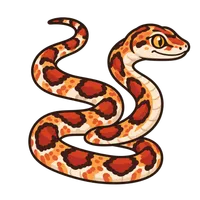
Corn snakes are the friendly, brightly-patterned rat snakes that top almost every "best beginner snake" list — and deservedly so. They eat readily, tolerate a range of conditions, stay a manageable size, and come in a rainbow of morphs. Give them a secure enclosure (they're Houdinis), a proper warm-to-cool gradient, and frozen/thawed mice, and they're wonderfully low-drama.
Worried, or still setting up? Free tools
Or browse common Corn Snake questions →
Care at a glance
| Adult size | 3–5 ft (90–150 cm) |
|---|---|
| Lifespan | 15–20+ years |
| Enclosure | Adult minimum 4×2×2 ft (48×24×24 in, a 120-gallon footprint), ≥2 ft tall. A tight-fitting, locking lid is essential — corn snakes are legendary escape artists. |
| Basking / warm zone | Basking/warm surface 90°F (32°C) from an overhead heat source, on a thermostat. |
| Cool side | Cool side ~75–82°F (24–28°C), giving a full thermal gradient with hides on both ends. |
| Night | Night at room temperature (~75°F/24°C is fine); no coloured night bulbs. |
| UVB & lighting | UVB is recommended: a T5 HO bulb giving UVI 2.0–3.0 at the basking spot (Ferguson Zone). Replace yearly. |
| Humidity | Ambient 65–75% — more than the old bone-dry caresheets suggested; helps with clean shedding. |
| Substrate | Aspen, cypress mulch, coconut fibre, or a topsoil/coco mix hold up well. Avoid pine and cedar. Keep moist enough to support the humidity range. |
| Diet | Carnivore — appropriately-sized frozen/thawed mice (about the width of the snake at its thickest). Frequency by size: hatchlings every 5–7 days, juveniles every 7–10, subadults every 10–12, adults every 14–21 (older adults ~10–14). |
| Supplements | None needed — whole-prey rodents are a complete diet. |
🦎 Did you know? — Corn Snake fun facts
Little true delights about the corn snake — each one checked against a named source, no pet-shop myths.
- The harmless corn snake is often mistaken for the venomous copperhead, but it has a narrower head and square-shaped blotches. Animal Diversity Web
- In corn snakes the mother’s chromosomes decide the babies’ sex, using a ZW system opposite to the XY system in humans. Animal Diversity Web
- Corn snakes are agile climbers and burrowers, found everywhere from woodlands to barns across the eastern and central United States. Animal Diversity Web
What it's like to live with a Corn Snake
The corn snake is the snake most keepers recommend to start with, and living with one shows you why. They are active and curious without being demanding, reliably good eaters (a welcome contrast to the fussy ball python), and hardy enough to forgive a beginner's learning curve. A corn snake will explore at dusk, periscope up to look around, and settle calmly in the hand. The one thing to respect is that they are legendary escape artists — if there is a gap, a corn snake will find it, so a secure lid is non-negotiable.
Your first month together
The settling-in period, in order — so you know what's normal and when not to worry.
- Leave it be for a week or two before handling — a new corn snake will explore and hide as it learns the enclosure.
- Offer the first meal after a few days of settling; corns are usually keen feeders, so a refusal here is worth noting but rarely a crisis.
- Triple-check the lid and every gap the day it arrives — this is the species that teaches people about escapes the hard way.
- Expect evening activity and "periscoping"; that curiosity is a healthy, settled corn snake, not distress.
- Start brief handling once it has taken one or two meals, keeping sessions calm and short at first.
Through the year, and as they grow
Corn snakes often eat less in the cooler, darker months as they follow a natural winter slowdown — normal in a healthy adult holding weight. Feeding also scales with age: hatchlings eat every week or so, while adults are fed every one to three weeks. Judge by body condition and a smooth, steady weight rather than by the calendar.
The pet store gets these wrong
Common myths, kindly corrected — no shame for having believed them.
- A 10–20-gallon tank is fine for life — no; an adult needs at least 4×2×2 ft.
- Snakes don't need UVB — it's now recommended for corn snakes.
- Corn snakes must be kept bone-dry — no; ~65–75% humidity suits them and helps shedding.
Before you buy
- A 4×2×2 ft enclosure with a genuinely secure, locking lid.
- Comfort feeding frozen/thawed mice (never live).
- A 15–20+ year commitment.
- An exotics/reptile vet within reach.
💷 The corn snake itself is usually the cheapest part — see the real cost of keeping one (upfront + ongoing, no sales pitch).
See a reptile vet if…
We can't diagnose from afar — but these are the signs to stop watching and get a professional:
- Open-mouth breathing, wheezing, or mucus (possible respiratory infection).
- Regurgitating meals, or refusing food with real weight loss.
- Repeated stuck sheds or retained eye caps.
- Mites (tiny moving specks) or cheesy matter in the mouth (possible mouth rot).
- Any tissue protruding from the vent (prolapse).
Heading in? Print the free Corn Snake vet-prep sheet — what to bring, what to tell the vet, and the questions to ask.
Never
- Never feed live mice — use frozen/thawed to protect the snake.
- Never use pine or cedar substrate.
- Never trust a loose or lightweight lid — they will escape.
- Never handle for ~48 hours after a meal.
- Never house two snakes together.
Common corn snake questions
How hard are Corn Snakes to keep — are they good for beginners?
Beginner. The textbook first snake: hardy, reliable feeders, tolerant of small mistakes, and calm to handle. The only thing they excel at that you must respect is escaping.
What do Corn Snakes eat?
Carnivore — appropriately-sized frozen/thawed mice (about the width of the snake at its thickest). Frequency by size: hatchlings every 5–7 days, juveniles every 7–10, subadults every 10–12, adults every 14–21 (older adults ~10–14).
How big an enclosure do Corn Snakes need?
Adult minimum 4×2×2 ft (48×24×24 in, a 120-gallon footprint), ≥2 ft tall. A tight-fitting, locking lid is essential — corn snakes are legendary escape artists.
What basking temperature do Corn Snakes need?
Basking/warm surface 90°F (32°C) from an overhead heat source, on a thermostat.
What should the cool side be for Corn Snakes?
Cool side ~75–82°F (24–28°C), giving a full thermal gradient with hides on both ends.
What night-time temperature do Corn Snakes need?
Night at room temperature (~75°F/24°C is fine); no coloured night bulbs.
What UVB and lighting do Corn Snakes need?
UVB is recommended: a T5 HO bulb giving UVI 2.0–3.0 at the basking spot (Ferguson Zone). Replace yearly.
What humidity do Corn Snakes need?
Ambient 65–75% — more than the old bone-dry caresheets suggested; helps with clean shedding.
What substrate do Corn Snakes need?
Aspen, cypress mulch, coconut fibre, or a topsoil/coco mix hold up well. Avoid pine and cedar. Keep moist enough to support the humidity range.
What supplements do Corn Snakes need?
None needed — whole-prey rodents are a complete diet.
How big do Corn Snakes get?
3–5 ft (90–150 cm)
How long do Corn Snakes live?
15–20+ years
What are the signs Corn Snakes are sick or need a vet?
See a reptile or exotics vet if you notice: Open-mouth breathing, wheezing, or mucus (possible respiratory infection).; Regurgitating meals, or refusing food with real weight loss.; Repeated stuck sheds or retained eye caps.; Mites (tiny moving specks) or cheesy matter in the mouth (possible mouth rot).; Any tissue protruding from the vent (prolapse)..
Your first two weeks · Taming & handling · Behaviours explained · Won't eat? · Stuck shed · When to see a vet

Get the free Corn Snake Starter Kit
A one-page setup criteria checklist and a first-30-days plan for your first corn snake — what to get, what makes each thing matter, and the honest bits the pet shop skips. Join the den and we’ll send it over.
Free reptile care cheat-sheet the moment you join. No spam — unsubscribe anytime. See how we handle your data in our privacy notice.Sources & further reading
This guide was written and fact-checked against these authorities. It's kind, general guidance — not a diagnosis or a substitute for an exotics vet:
- ReptiFiles — Corn Snake Care — Min 4×2×2 ft, basking 90°F / cool 75–82°F / night ~75°F, UVI 2.0–3.0, humidity 65–75%, F/T mouse feeding schedule by size, substrate.
- Association of Reptilian & Amphibian Veterinarians (ARAV) — Find-an-exotics-vet; respiratory infection, mouth rot.
- Merck Veterinary Manual — reptiles — Respiratory infection, dysecdysis, regurgitation.
Written and fact-checked by The Baskden Team against veterinarian-authored sources — if your reptile shows a red-flag sign above, see an exotics vet promptly.