
Species · Tortoise (chelonian)
Indian Star Tortoise
Geochelone elegans
The stunning star-patterned tortoise — beautiful but demanding, and wrapped in strict international trade law.
Difficulty: Advanced Printable care sheet →
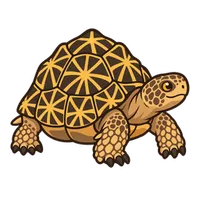
The Indian star tortoise is a genuine showstopper: a domed, black shell etched with radiating golden-yellow stars, each one a little different. Behind that beauty is a demanding animal from the seasonally wet-and-dry grasslands and dry forests of India, Pakistan and Sri Lanka, where life swings between a hot dry season and a green monsoon. Get the balance of heat, strong UVB, room to graze and just-right moisture and they're hardy, characterful long-lived companions. Get it wrong and they pyramid, get respiratory infections, or fade. This is a species to grow into, not to start with.
Worried, or still setting up? Free tools
Or browse common Indian Star Tortoise questions →
Care at a glance
| Adult size | Females are notably larger than males. Males reach roughly 15-20 cm (6-8 in) shell length; females about 25-30 cm (10-12 in), with a record female near 38 cm (15 in). Weight ranges from about 1 kg up to 6.6 kg (2-14+ lb) depending on sex and size. |
|---|---|
| Lifespan | A multi-decade commitment. Well-kept captives commonly live 30-50+ years, and wild lifespans are estimated at 35-80 years. Long-lived-record claims (approaching 80) exist but are poorly documented; plan realistically for this tortoise to outlast a large chunk of your life and to need a plan for its future. |
| Enclosure | Bigger is always better; adults do best with a large open tortoise table or, ideally, a secure outdoor pen in warm weather. As a practical indoor minimum for one adult, aim for at least ~16 sq ft of floor (e.g. a 4 x 4 ft pen) with 8 in solid walls; a 4 x 2 ft table is the bare floor of what one adult can tolerate. Outdoors, a 4 x 4 ft pen is a starting minimum and much larger is preferred. Double the space for any additional tortoise, and never house with other species. |
| Basking / warm zone | A hot basking spot of about 95-105°F (35-40°C) under a halogen/incandescent flood; some sources give 90-100°F (32-38°C). Position the heat lamp so the shell top sits roughly 8+ in below it and the tortoise can move away. |
| Cool side | A warm ambient of about 75-80°F (24-27°C) at the cool end, so there's a clear gradient across the floor. The cool side should not sit cold-and-damp; chilled, wet conditions are dangerous for this species. |
| Night | A modest night drop is fine and even helpful: down to about 60-70°F (15-21°C) is widely used indoors, and outdoor adults tolerate short dips to around 50°F (10°C). Avoid heating that never lets the temperature fall; a cool-but-not-cold night is normal. |
| UVB & lighting | Strong UVB is non-negotiable for shell and bone health. Use a high-output linear tube such as a Zoo Med Reptisun 10.0 T5 HO or Arcadia 12% T5 HO running most of the enclosure length, 10-12 hours a day. Mount per the maker's guidance for the fixture (roughly 6-8 in above the shell for an unmeshed Zoo Med hood, ~17-18 in for an Arcadia ProT5 reflector) and replace the tube about every 12 months even if it still glows. Best of all is real unfiltered sunlight outdoors, which needs no artificial UVB. |
| Humidity | This is the part people get wrong in both directions. Star tortoises are NOT true desert animals; their homeland has a humid monsoon season, so they need more moisture than a Mediterranean tortoise but not a swamp. Aim for roughly 40-75% ambient humidity for adults, with the higher end and a humid hide especially important for hatchlings and juveniles (often 70-80% in their microclimate) to prevent shell pyramiding. Pair humid hides and misting with a well-ventilated, not soggy, main floor. |
| Substrate | A deep, moisture-holding but breathable substrate: topsoil, coir/coconut fibre, or a topsoil-play-sand mix (around 60/40), often topped with grass hay. Provide depth at least as deep as the tortoise's legs are long (aim for 6+ in / 15+ cm) so it can dig and burrow to self-regulate moisture. Spot-clean daily and change fully on a regular schedule. Avoid dusty, resinous or dyed beddings. |
| Diet | A high-fibre grazing herbivore: think roughly 90% grasses and weeds, ~10% leafy greens. Good staples include lawn grass and hay, dandelion, clover, plantain (Plantago), chickweed, honeysuckle, sow thistle, mulberry and grape leaves, watercress, rocket, kale, spring greens and other dark leafy greens, plus opuntia (cactus) pads. Use The Tortoise Table to check any plant. Skip regular fruit and high-protein or high-sugar foods; feed low-and-slow. Provide constant fresh water in a shallow dish and soak young tortoises regularly. |
| Supplements | Dust food with a phosphorus-free calcium (calcium carbonate) most feeds, and offer a cuttlebone to gnaw. A balanced reptile multivitamin (with vitamin A and D3) a couple of times a week supports animals without unfiltered sunlight; go lighter on vitamins for well-sunned adults. Don't over-supplement D3 if the tortoise has strong UVB or real sun. |
What it's like to live with a Indian Star Tortoise
Best kept singly or, if you have the space, in small groups with far more room than the minimum. Males can harass and ram females and each other, so watch for bullying, stress and refused food. Double the floor space for each extra tortoise and give multiple feeding stations, hides and sight-breaks. Never mix with other tortoise or reptile species: it invites aggression and cross-species disease.
Your first month together
The settling-in period, in order — so you know what's normal and when not to worry.
- Confirm provenance BEFORE anything else: this is CITES Appendix I, so get paperwork proving a legal, captive-bred animal and keep it.
- Have the full setup running and stable for days before the tortoise arrives: verified basking spot ~95-105°F (35-40°C), warm cool-end ~75-80°F (24-27°C), and a live UVB tube.
- Check gradients and humidity with an accurate digital thermometer at shell height and a digital hygrometer, not guesswork.
- Set up a shallow water dish plus a humid hide, and soak the tortoise in shallow lukewarm water 2-3 times a week (more for hatchlings) to keep it hydrated.
- Offer a grass-and-weed based diet with calcium dusting; log what it actually eats, drinks and passes.
- Book a new-pet check with a reptile-experienced (exotics) vet, including a faecal parasite test.
- Watch daily for alert behaviour, clear eyes/nose and steady appetite; write down any change.
Through the year, and as they grow
Their calendar is built around a monsoon. In the wild they're most active and breed in the warm, wet season and hunker down (aestivate) in the hottest, driest stretch and cool northern winters. In captivity you can gently mirror this with a warmer, slightly more humid "active" season and a cooler, drier rest period, but true Mediterranean-style hibernation (brumation) is NOT appropriate for this tropical species. Keep them warm year-round; a sustained cold, damp spell can trigger deadly respiratory infection.
The pet store gets these wrong
Common myths, kindly corrected — no shame for having believed them.
- Myth: it's a desert tortoise, so keep it bone-dry. Reality: its habitat has a humid monsoon; too-dry conditions, especially for young tortoises, drive shell pyramiding. Aim for moderate humidity with humid hides, not aridity.
- Myth: those raised, pyramided scutes are just how the species grows. Reality: pyramiding is a husbandry problem tied to low humidity/dehydration, too much protein and poor UVB - largely preventable with correct care.
- Myth: they stay small, so a tabletop tank is plenty. Reality: females reach 25-30 cm and all of them are active grazers that need real floor space; cramped setups cause stress and poor health.
- Myth: you can hibernate them like a Hermann's or Russian tortoise. Reality: this is a tropical species that must stay warm; it does not do a Mediterranean-style hibernation.
- Myth: a cheap star tortoise online is a fine deal. Reality: they're the most-trafficked tortoise on Earth and CITES Appendix I; a suspiciously cheap or paperwork-free animal is likely wild-caught, illegal, stressed and parasitised.
Before you buy
- This is an Advanced, decades-long commitment (potentially 30-80 years) - have a real long-term and inheritance plan.
- Legality first: Geochelone elegans is CITES Appendix I and the single most-confiscated tortoise in the illegal trade. Buy only a documented, captive-bred animal from a reputable breeder and keep the paperwork.
- Budget for space: a large table or an outdoor pen, not a small enclosure - and roughly double the space per extra tortoise.
- Budget for correct kit: strong high-output UVB (replaced yearly), quality heat lamp, deep substrate, thermometers and a hygrometer.
- Find a reptile-experienced (exotics) vet BEFORE you buy, and factor in check-ups and parasite testing.
- You'll need a steady year-round supply of grasses, weeds and greens - a pesticide-free garden or reliable forage source helps a lot.
- They're not cuddly display pets; they're shy grazers that do best when largely left to potter and graze.
💷 The indian star tortoise itself is usually the cheapest part — see the real cost of keeping one (upfront + ongoing, no sales pitch).
See a reptile vet if…
We can't diagnose from afar — but these are the signs to stop watching and get a professional:
- Runny or bubbly nose, mouth bubbles, wheezing, or open-mouth/labored breathing - possible respiratory infection; see an exotics vet promptly.
- Soft, flexible or misshapen shell, bendy or swollen limbs, or a beak that won't close - possible metabolic bone disease.
- Pitting, soft spots, weeping, foul smell or discoloured areas on the shell - possible shell rot/infection.
- Swollen eyelids, closed or discharging eyes, or loss of appetite with lethargy - could signal vitamin A deficiency or infection.
- Not eating for an extended period, ongoing weight loss, or a sunken/dull-eyed 'dehydrated' look.
- Straining, a female restlessly digging and going off food (possible egg-binding), or straining to pass stool.
- Any prolapse of tissue from the tail/vent, or a serious shell crack or injury - treat as urgent.
- Persistent diarrhoea or visible worms - get a faecal parasite check.
Heading in? Print the free Indian Star Tortoise vet-prep sheet — what to bring, what to tell the vet, and the questions to ask.
Never
- Never keep it as a bone-dry desert tortoise - too-dry, dehydrating conditions cause pyramiding and ill health.
- Never hibernate/brumate it like a Mediterranean tortoise; it's tropical and must stay warm.
- Never let it sit cold and damp; chilled, wet conditions invite fatal respiratory infection.
- Never buy without CITES/captive-bred paperwork - wild-caught star tortoises are illegal, and buying them fuels a devastating trade.
- Never feed a diet of fruit, dog/cat food, or other high-protein items - it drives pyramiding, gut and kidney problems.
- Never rely on a UVB bulb through glass/plastic (it blocks UVB) or on an expired tube - and never skip UVB entirely.
- Never house it with other tortoise or reptile species, and don't overcrowd males together.
- Never use a too-small enclosure, dusty/cedar/pine or dyed substrate, or a heat source with no way to escape it.
Common indian star tortoise questions
How hard are Indian Star Tortoises to keep — are they good for beginners?
Advanced. Not a beginner tortoise. Star tortoises are sensitive to husbandry errors, need a warm gradient with a big basking spot AND carefully managed moisture (dry-but-not-arid, with humid hides), and grow slowly over decades. On top of that, they're CITES Appendix I and the single most-confiscated tortoise in the illegal trade, so sourcing a legal, captive-bred animal is itself a real hurdle. Great for an experienced keeper who has room and patience; frustrating and often fatal for a first tortoise.
What do Indian Star Tortoises eat?
A high-fibre grazing herbivore: think roughly 90% grasses and weeds, ~10% leafy greens. Good staples include lawn grass and hay, dandelion, clover, plantain (Plantago), chickweed, honeysuckle, sow thistle, mulberry and grape leaves, watercress, rocket, kale, spring greens and other dark leafy greens, plus opuntia (cactus) pads. Use The Tortoise Table to check any plant. Skip regular fruit and high-protein or high-sugar foods; feed low-and-slow. Provide constant fresh water in a shallow dish and soak young tortoises regularly.
How big an enclosure do Indian Star Tortoises need?
Bigger is always better; adults do best with a large open tortoise table or, ideally, a secure outdoor pen in warm weather. As a practical indoor minimum for one adult, aim for at least ~16 sq ft of floor (e.g. a 4 x 4 ft pen) with 8 in solid walls; a 4 x 2 ft table is the bare floor of what one adult can tolerate. Outdoors, a 4 x 4 ft pen is a starting minimum and much larger is preferred. Double the space for any additional tortoise, and never house with other species.
What basking temperature do Indian Star Tortoises need?
A hot basking spot of about 95-105°F (35-40°C) under a halogen/incandescent flood; some sources give 90-100°F (32-38°C). Position the heat lamp so the shell top sits roughly 8+ in below it and the tortoise can move away.
What should the cool side be for Indian Star Tortoises?
A warm ambient of about 75-80°F (24-27°C) at the cool end, so there's a clear gradient across the floor. The cool side should not sit cold-and-damp; chilled, wet conditions are dangerous for this species.
What night-time temperature do Indian Star Tortoises need?
A modest night drop is fine and even helpful: down to about 60-70°F (15-21°C) is widely used indoors, and outdoor adults tolerate short dips to around 50°F (10°C). Avoid heating that never lets the temperature fall; a cool-but-not-cold night is normal.
What UVB and lighting do Indian Star Tortoises need?
Strong UVB is non-negotiable for shell and bone health. Use a high-output linear tube such as a Zoo Med Reptisun 10.0 T5 HO or Arcadia 12% T5 HO running most of the enclosure length, 10-12 hours a day. Mount per the maker's guidance for the fixture (roughly 6-8 in above the shell for an unmeshed Zoo Med hood, ~17-18 in for an Arcadia ProT5 reflector) and replace the tube about every 12 months even if it still glows. Best of all is real unfiltered sunlight outdoors, which needs no artificial UVB.
What humidity do Indian Star Tortoises need?
This is the part people get wrong in both directions. Star tortoises are NOT true desert animals; their homeland has a humid monsoon season, so they need more moisture than a Mediterranean tortoise but not a swamp. Aim for roughly 40-75% ambient humidity for adults, with the higher end and a humid hide especially important for hatchlings and juveniles (often 70-80% in their microclimate) to prevent shell pyramiding. Pair humid hides and misting with a well-ventilated, not soggy, main floor.
What substrate do Indian Star Tortoises need?
A deep, moisture-holding but breathable substrate: topsoil, coir/coconut fibre, or a topsoil-play-sand mix (around 60/40), often topped with grass hay. Provide depth at least as deep as the tortoise's legs are long (aim for 6+ in / 15+ cm) so it can dig and burrow to self-regulate moisture. Spot-clean daily and change fully on a regular schedule. Avoid dusty, resinous or dyed beddings.
What supplements do Indian Star Tortoises need?
Dust food with a phosphorus-free calcium (calcium carbonate) most feeds, and offer a cuttlebone to gnaw. A balanced reptile multivitamin (with vitamin A and D3) a couple of times a week supports animals without unfiltered sunlight; go lighter on vitamins for well-sunned adults. Don't over-supplement D3 if the tortoise has strong UVB or real sun.
How big do Indian Star Tortoises get?
Females are notably larger than males. Males reach roughly 15-20 cm (6-8 in) shell length; females about 25-30 cm (10-12 in), with a record female near 38 cm (15 in). Weight ranges from about 1 kg up to 6.6 kg (2-14+ lb) depending on sex and size.
How long do Indian Star Tortoises live?
A multi-decade commitment. Well-kept captives commonly live 30-50+ years, and wild lifespans are estimated at 35-80 years. Long-lived-record claims (approaching 80) exist but are poorly documented; plan realistically for this tortoise to outlast a large chunk of your life and to need a plan for its future.
What are the signs Indian Star Tortoises are sick or need a vet?
See a reptile or exotics vet if you notice: Runny or bubbly nose, mouth bubbles, wheezing, or open-mouth/labored breathing - possible respiratory infection; see an exotics vet promptly.; Soft, flexible or misshapen shell, bendy or swollen limbs, or a beak that won't close - possible metabolic bone disease.; Pitting, soft spots, weeping, foul smell or discoloured areas on the shell - possible shell rot/infection.; Swollen eyelids, closed or discharging eyes, or loss of appetite with lethargy - could signal vitamin A deficiency or infection.; Not eating for an extended period, ongoing weight loss, or a sunken/dull-eyed 'dehydrated' look.; Straining, a female restlessly digging and going off food (possible egg-binding), or straining to pass stool.; Any prolapse of tissue from the tail/vent, or a serious shell crack or injury - treat as urgent.; Persistent diarrhoea or visible worms - get a faecal parasite check..
Your first two weeks · Taming & handling · Behaviours explained · Won't eat? · Stuck shed · When to see a vet

Get the free Indian Star Tortoise Starter Kit
A one-page setup criteria checklist and a first-30-days plan for your first indian star tortoise — what to get, what makes each thing matter, and the honest bits the pet shop skips. Join the den and we’ll send it over.
Free reptile care cheat-sheet the moment you join. No spam — unsubscribe anytime. See how we handle your data in our privacy notice.Sources & further reading
This guide was written and fact-checked against these authorities. It's kind, general guidance — not a diagnosis or a substitute for an exotics vet:
- Animal Diversity Web - Geochelone elegans (size, weight, lifespan, family, habitat, behavior) — Males ~15-20 cm, females ~25-30 cm (record 38 cm); mass 1-6.6 kg; Testudinidae; monsoon-tolerant habitat
- Dubia.com - Indian Star Tortoise Care Sheet (temps, humidity, substrate, enclosure, diet) — Basking 95-105°F/35-40°C; warm side 75-80°F; night ~60°F/50°F outdoor; humidity 40-75% (juv 70-80%); 6 in+ substrate; UVB 10-12% T5 HO
- Reptile Centre - Indian Star Tortoise Care Sheet (enclosure size, night temp, diet, supplements) — Vivarium min 1150mm / table 900mm; night 70°F/21°C; safe plant list; daily calcium
- VCA Animal Hospitals - Common Diseases of Tortoises (vet flags) — Signs of MBD, respiratory infection, shell rot, vitamin A deficiency, abscesses, parasites
- Tree of Life Exotic Pet Medical Center - Pyramiding in Tortoises (humidity/diet/UVB causes) — Low humidity/dehydration, excess protein and poor UVB drive pyramiding; humid hides + soaking help prevent it
- CITES CoP18 Prop. 36 - uplisting Geochelone elegans to Appendix I — Appendix I (2019); most-confiscated tortoise in illegal trade; IUCN Vulnerable
- IUCN Tortoise & Freshwater Turtle Specialist Group - Geochelone elegans account — Conservation biology, distribution and status reference
Written and fact-checked by The Baskden Team against veterinarian-authored sources — if your reptile shows a red-flag sign above, see an exotics vet promptly.