
Species · Aquatic turtle
Red-Eared Slider
Trachemys scripta elegans
The classic pet turtle — cheap and cute as a hatchling, but a big, long-lived aquatic animal that needs a serious filtered tank.
Difficulty: Intermediate Printable care sheet →
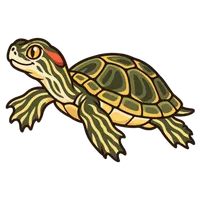
Red-eared sliders are the classic pet turtle — the palm-sized hatchling in the pet-store tank. The catch is that the hatchling becomes a dinner-plate-sized, 20-to-40-year aquatic animal that needs a huge volume of heated, filtered water to swim in plus a dry, warm, UV-lit dock to haul out and bask on. Get that right and they are hardy, personable, genuinely interactive display animals that will beg at the glass. Get it wrong — a little bowl, no filter, no basking heat — and they are among the most neglected reptiles there are. The market is flooded, so please consider adopting from a rescue before buying.
Worried, or still setting up? Free tools
Or browse common Red-Eared Slider questions →
Care at a glance
| Adult size | Up to 12 in (31 cm) shell; most reach 8–11 in. Females are larger than males |
|---|---|
| Lifespan | 20–30 years, and 40+ is not unheard of — a multi-decade commitment |
| Tank | The rule is 10 gallons of water per inch of shell length (a 4 in turtle → 40 gal; a 12 in adult → 120 gal). Because they reach dinner-plate size, buy the adult-size setup from the start: a 100 US gallon (379 L) minimum, ideally 120–125 gal, or an indoor/outdoor pond. Water is extremely heavy — a 100 gal glass tank of water weighs ~830 lb (377 kg), so set it up on a ground floor or basement that can take the load. |
| Water temperature | Water 78–82°F (24–29°C), warmer for hatchlings and unwell turtles. Use a guarded aquarium heater on larger setups. |
| Water depth | At least as deep as the turtle is long (deeper is better) so it can swim freely and right itself if it flips — never keep a slider in shallow "dish" water. |
| Filtration | A powerful canister filter rated for at least 2–3× the water volume — ordinary aquarium filters are sized for tidy fish, and turtles are far messier. Back it up with regular partial water changes; dirty water is a direct cause of shell and eye infections. |
| Basking dock | A dry haul-out dock big enough to fit the whole turtle out of the water, with a stone surface (flagstone is ideal — it warms evenly), heat and UVB mounted directly above. Basking-surface temperature 104°F (40°C), from an overhead halogen. The turtle must be able to climb fully out and dry off completely. |
| Night | Turn the basking lamp and UVB off at night. The large water volume holds heat well, so a natural night-time drop is fine and no night heat is needed in a normally-heated room. |
| UVB & lighting | Strong UVB is essential for a diurnal basker: a T5 HO bulb giving a UVI of 3.0–4.0 at the basking surface (Ferguson Zone 3), running 50–75% of the enclosure length and mounted ≥10 in above the dock alongside the heat lamp. Replace every 12 months. Real sunshine in an outdoor pond is ideal (never filtered through glass). |
| Tank bottom | Bare-bottom is easiest and safest to keep clean. If you want a planted look, use large smooth river stones too big for the turtle to swallow — avoid small gravel, which turtles eat and can become impacted on. |
| Diet | An OMNIVORE whose ratio flips with age. Under 1 year: roughly 50% animal protein / 50% vegetables — protein and greens daily, turtle pellets every other day. Over 1 year: roughly 25% protein / 75% vegetables — protein only 1–2×/week, leafy greens daily, pellets 2–3×/week. Pellets should be no more than ~25% of the diet. Variety is the key to good nutrition, and they eat in the water. |
| Supplements | Keep a cuttlebone floating in the tank at all times — a calcium source that also keeps the beak trimmed. Powdered supplements wash straight off food underwater, so minerals come from a quality pellet, varied whole foods, and that cuttlebone. Dark leafy greens matter too — too little vitamin A causes swollen eyes. |
🦎 Did you know? — Red-Eared Slider fun facts
Little true delights about the red-eared slider — each one checked against a named source, no pet-shop myths.
- A red-eared slider’s sex is set by nest temperature: cool nests below about 28.6°C produce all males, warm nests above 29.6°C all females. Animal Diversity Web
- Once released from the pet trade, red-eared sliders have colonised the wild on nearly every continent — Europe, Africa, Asia, Australia and beyond. Animal Diversity Web
What it's like to live with a Red-Eared Slider
A red-eared slider is a display animal, not a handling pet — but "display" undersells how interactive they are. A settled slider is bold, curious, and shamelessly food-motivated: it will swim to the glass, beg, and watch the room. The honest way to picture life with one is running a large, heated aquarium: most of the animal's day is spent swimming and hauling out to bask, and most of YOUR work is water quality — a serious canister filter and regular water changes. It is closer to fishkeeping than to keeping a lizard, and for the right person that is a genuinely rewarding, low-drama, decades-long pet.
Your first month together
The settling-in period, in order — so you know what's normal and when not to worry.
- Buy the adult-size tank (100+ gal) and a strong canister filter from the start — a hatchling in a big tank is fine; an adult in a small one is not.
- Get the water temperature (78–82°F), the 104°F basking dock, UVB, and filtration all running and stable BEFORE the turtle comes home.
- Expect a shy first week or two: a new slider may bask nervously and dive the moment you move. That is normal caution, not illness.
- Watch for steady eating, active swimming, and regular hauling-out to bask — those are your core "settling in well" signs.
- Handle as little as possible (it stresses them, and turtles carry Salmonella — always wash hands), and interact through feeding instead.
Through the year, and as they grow
Sliders are strongly seasonal animals: healthy adults can brumate through winter in cool water, but most pet keepers simply keep them warm, lit, and active year-round, which is easier and safer for a beginner. In a suitable climate they do wonderfully in an outdoor pond over summer (with a secure, predator-proof, escape-proof enclosure). The diet ratio also flips as they grow — protein-heavy as a fast-growing hatchling, vegetable-heavy as an adult.
The pet store gets these wrong
Common myths, kindly corrected — no shame for having believed them.
- A turtle only grows to the size of its tank — false and harmful; a slider reaches dinner-plate size regardless, and a cramped one just suffers.
- A little turtle bowl or a 10-gallon "starter kit" is enough — false; an adult needs 100+ gallons of filtered water plus a basking dock.
- They're cheap, easy starter pets — the hatchling is cheap; the tank, canister filter, lighting, and 20–40 years are not.
- You can release it in a local pond if it gets too big — NEVER; released sliders are a destructive invasive species, and it is illegal in many places.
- Supplements make up for no UVB — false; dusting powders wash off underwater, so a UVB lamp and a good diet do the work.
Before you buy
- A large aquarium or pond — 100+ gallons for an adult — plus a canister filter rated 2–3× the water volume.
- A floor that can carry the weight (100 gal of water ≈ 830 lb) — a ground floor or basement.
- A heated basking dock, UVB, an aquarium water heater, and the ongoing electricity and water-change effort of fishkeeping.
- Awareness that turtles carry Salmonella — strict hand-washing, and not ideal in homes with under-5s or anyone immunocompromised (US law bans selling turtles under 4 in for this reason).
- A 20–40 year commitment, and an exotics/reptile vet who treats aquatic turtles.
💷 The red-eared slider itself is usually the cheapest part — see the real cost of keeping one (upfront + ongoing, no sales pitch).
See a reptile vet if…
We can't diagnose from afar — but these are the signs to stop watching and get a professional:
- Floating lopsided or unable to dive, open-mouth breathing, bubbling or mucus from the nose, wheezing, or basking constantly and refusing the water (possible respiratory infection).
- Soft, pitting, discoloured, weeping, or foul-smelling patches on the shell (possible shell rot).
- A soft shell, or a bumpy "pyramided" shell (signs pointing to metabolic bone disease / poor diet or lighting).
- Swollen, puffy, or shut eyes (often a vitamin A deficiency from a poor diet).
- An overgrown beak, not eating, lethargy, or any tissue protruding from the vent (prolapse).
Heading in? Print the free Red-Eared Slider vet-prep sheet — what to bring, what to tell the vet, and the questions to ask.
Never
- Never release a slider into the wild — it is a destructive invasive species, and illegal to release in many places.
- Never keep it in a small "turtle bowl", in unfiltered water, or in water too shallow to swim and right itself.
- Never use small gravel it can swallow — go bare-bottom, or use stones too big to fit in its mouth.
- Never skip the dry basking dock, its heat, or UVB — a turtle that can't haul out and dry off gets shell rot and respiratory infections.
- Never rely on powdered supplements dusted on food (they wash off underwater) — use a good varied diet plus a cuttlebone.
Common red-eared slider questions
How hard are Red-Eared Sliders to keep — are they good for beginners?
Intermediate. The turtle itself is famously hardy and forgiving — the difficulty is the setup, not the animal. A single slider needs a 100+ gallon heated, filtered aquarium (or pond), which is genuinely fishkeeping-level equipment, cost, and ongoing maintenance. Underestimating that is why it is one of the most-abused reptiles in the hobby.
What do Red-Eared Sliders eat?
An OMNIVORE whose ratio flips with age. Under 1 year: roughly 50% animal protein / 50% vegetables — protein and greens daily, turtle pellets every other day. Over 1 year: roughly 25% protein / 75% vegetables — protein only 1–2×/week, leafy greens daily, pellets 2–3×/week. Pellets should be no more than ~25% of the diet. Variety is the key to good nutrition, and they eat in the water.
How big a tank do Red-Eared Sliders need?
The rule is 10 gallons of water per inch of shell length (a 4 in turtle → 40 gal; a 12 in adult → 120 gal). Because they reach dinner-plate size, buy the adult-size setup from the start: a 100 US gallon (379 L) minimum, ideally 120–125 gal, or an indoor/outdoor pond. Water is extremely heavy — a 100 gal glass tank of water weighs ~830 lb (377 kg), so set it up on a ground floor or basement that can take the load.
What water temperature do Red-Eared Sliders need?
Water 78–82°F (24–29°C), warmer for hatchlings and unwell turtles. Use a guarded aquarium heater on larger setups.
What water depth do Red-Eared Sliders need?
At least as deep as the turtle is long (deeper is better) so it can swim freely and right itself if it flips — never keep a slider in shallow "dish" water.
What filtration do Red-Eared Sliders need?
A powerful canister filter rated for at least 2–3× the water volume — ordinary aquarium filters are sized for tidy fish, and turtles are far messier. Back it up with regular partial water changes; dirty water is a direct cause of shell and eye infections.
What basking dock do Red-Eared Sliders need?
A dry haul-out dock big enough to fit the whole turtle out of the water, with a stone surface (flagstone is ideal — it warms evenly), heat and UVB mounted directly above. Basking-surface temperature 104°F (40°C), from an overhead halogen. The turtle must be able to climb fully out and dry off completely.
What night-time temperature do Red-Eared Sliders need?
Turn the basking lamp and UVB off at night. The large water volume holds heat well, so a natural night-time drop is fine and no night heat is needed in a normally-heated room.
What UVB and lighting do Red-Eared Sliders need?
Strong UVB is essential for a diurnal basker: a T5 HO bulb giving a UVI of 3.0–4.0 at the basking surface (Ferguson Zone 3), running 50–75% of the enclosure length and mounted ≥10 in above the dock alongside the heat lamp. Replace every 12 months. Real sunshine in an outdoor pond is ideal (never filtered through glass).
What substrate do Red-Eared Sliders need?
Bare-bottom is easiest and safest to keep clean. If you want a planted look, use large smooth river stones too big for the turtle to swallow — avoid small gravel, which turtles eat and can become impacted on.
What supplements do Red-Eared Sliders need?
Keep a cuttlebone floating in the tank at all times — a calcium source that also keeps the beak trimmed. Powdered supplements wash straight off food underwater, so minerals come from a quality pellet, varied whole foods, and that cuttlebone. Dark leafy greens matter too — too little vitamin A causes swollen eyes.
How big do Red-Eared Sliders get?
Up to 12 in (31 cm) shell; most reach 8–11 in. Females are larger than males
How long do Red-Eared Sliders live?
20–30 years, and 40+ is not unheard of — a multi-decade commitment
What are the signs Red-Eared Sliders are sick or need a vet?
See a reptile or exotics vet if you notice: Floating lopsided or unable to dive, open-mouth breathing, bubbling or mucus from the nose, wheezing, or basking constantly and refusing the water (possible respiratory infection).; Soft, pitting, discoloured, weeping, or foul-smelling patches on the shell (possible shell rot).; A soft shell, or a bumpy "pyramided" shell (signs pointing to metabolic bone disease / poor diet or lighting).; Swollen, puffy, or shut eyes (often a vitamin A deficiency from a poor diet).; An overgrown beak, not eating, lethargy, or any tissue protruding from the vent (prolapse)..
Your first two weeks · Taming & handling · Behaviours explained · Won't eat? · Stuck shed · When to see a vet

Get the free Red-Eared Slider Starter Kit
A one-page setup criteria checklist and a first-30-days plan for your first red-eared slider — what to get, what makes each thing matter, and the honest bits the pet shop skips. Join the den and we’ll send it over.
Free reptile care cheat-sheet the moment you join. No spam — unsubscribe anytime. See how we handle your data in our privacy notice.Sources & further reading
This guide was written and fact-checked against these authorities. It's kind, general guidance — not a diagnosis or a substitute for an exotics vet:
- ReptiFiles — Red-Eared Slider Care Guide (Mariah Healey) — Adult up to 12 in / most 8–11 in, 20–30+ yr; 10 gal water per inch of shell, 100 gal min (ideally 120–125); water depth ≥ shell length; water 78–82°F; basking surface 104°F; UVI 3.0–4.0 (T5 HO, 50–75% length, ≥10 in); canister filter 2–3× volume; bare-bottom / large stones; omnivore 50/50 protein-veg under 1 yr → 25/75 over 1 yr, pellets ≤25%; cuttlebone; Salmonella.
- Roman Muryn (reptile heating expert), cited by ReptiFiles — Basking-surface temperature recommendation of 104°F (40°C) for the dry dock.
- Baines et al. (2016), "How much UVB does my reptile need? The UV-Tool" — Ferguson Zone 3 target UVI 3.0–4.0 for a diurnal open-water basking turtle.
- Merck Veterinary Manual — reptiles / chelonians — Respiratory infection, shell rot, metabolic bone disease, hypovitaminosis A (swollen eyes).
- CDC — Salmonella and Reptiles / US FDA small-turtle sale ban (21 CFR 1240.62) — Turtle-associated salmonellosis; the federal ban on selling turtles with shells under 4 in.
- Association of Reptilian & Amphibian Veterinarians (ARAV) — Find-an-exotics-vet; aquatic-turtle respiratory infection, shell rot, vitamin A deficiency.
Written and fact-checked by The Baskden Team against veterinarian-authored sources — if your reptile shows a red-flag sign above, see an exotics vet promptly.