

Bearded Dragon Morphs & Genetics, Explained (Hypo, Trans, Leatherback, Silkback & 'Fancy')
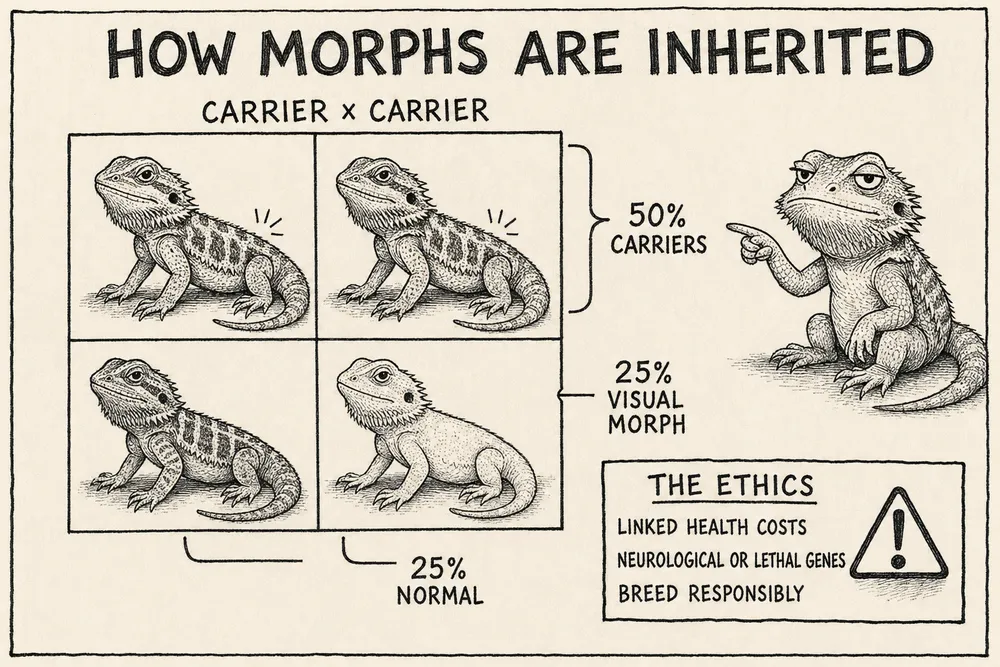
You’ve got the setup dialled, your dragon’s thriving, and now you’re down the rabbit hole of what exactly you’re keeping — is it a hypo? a trans? what does “leatherback zero” even mean, and is a “fancy” from the pet store actually special? This is the advanced companion to our beginner-facing what morph or species is my reptile? guide: that one answers “how do I find out and does it change care?” across all species; this one goes deep on bearded dragon genetics specifically — the real trait lines, how they’re inherited, the marketing traps, and the single morph that genuinely changes how you keep it.
🧬 The 30-second version: a morph is a heritable trait (hypo, trans, leatherback, silkback, dunner) or a selectively-bred colour line (red, citrus, white/witblits, zero) — and most dragons are combinations of several. “Fancy” and “premium” are marketing, not genetics. Colour-changing (darkening when cold or cross) is behaviour, not morph. And for almost every morph the care is identical — the one real exception is silkback and very pale/translucent dragons, which need reduced UVB and gentler handling. Exact numbers live on the care reference.
Why we wrote this one
When we mined what bearded dragon keepers actually search for (our own demand pull across autocomplete and the keeping communities — the same method behind what reptile keepers actually ask), the beginner questions dominated. But sitting underneath them was a steady stream of advanced queries we hadn’t answered: morph, hypo, hypo zero, mutations, fancy bearded dragon vs bearded dragon, premium bearded dragon vs bearded dragon, do they change colors, white / yellow / orange bearded dragon. That’s a keeper who’s moved past “is it healthy?” and into “what have I actually got?” — and if we don’t answer it honestly, they go to a forum guess or a seller’s sales page. So here’s the straight version.
What a “morph” actually is
In the hobby, morph is a loose umbrella covering two genuinely different things:
- Trait morphs — a heritable change to structure, scale type, or pigment, usually tied to a describable gene:
- Hypomelanistic (“hypo”) — reduced dark (melanin) pigment. Brighter overall, and the tell is clear/translucent nails rather than dark ones.
- Translucent (“trans”) — clearer, less opaque skin, often with solid black eyes. Trans dragons can be more light-sensitive.
- Leatherback — a co-dominant trait that reduces scale size, giving a smoother look and often more vivid colour (fewer scales to break it up).
- Silkback (“silkie”, scaleless) — the result of two leatherbacks bred together; essentially no scales at all. This is the one with real welfare implications (below).
- Dunner — a different scale-direction and pattern layout (scales point in varied directions; pattern is more scattered).
- Colour lines — selectively-bred intensity of colour rather than one clean switch: red, citrus/orange, yellow, white (witblits), and “zero” (a patternless, near-white dragon). These are built up over generations of choosing the brightest offspring, so they don’t inherit as tidily as a single-gene trait.
Almost every dragon you’ll meet is a stack of these — “hypo trans leatherback”, “red hypo”, “leatherback zero”. Each part is doing its own job.
How the genetics work (the keeper-level version)
You don’t need a genetics degree, just three ideas:
- Recessive traits (like translucent, or witblits) need two copies to show. An animal with one hidden copy is “het” (heterozygous) — it looks normal but can pass the trait on. This is why two ordinary-looking dragons can surprise you with a translucent clutch.
- Co-dominant / incomplete-dominant traits (leatherback is the classic) show with one copy, and two copies produce something different — two leatherback copies is what yields a silkback.
- Colour lines are polygenic (many small genes) plus selective breeding, so “how red will the babies be?” is a probability, not a Punnett-square certainty.
A morph calculator (as covered in the general morph guide) works from known parent genetics — which is exactly why the animal’s history matters more than its label.
The “fancy” / “premium” trap
Here’s the honest bit sellers won’t put on the tag: “fancy”, “premium”, “special”, and “citrus fancy” are not morphs. They’re retail and wholesale marketing for “has a bit more colour than a plain brown normal.” A “fancy bearded dragon” at a chain store tells you nothing reliable about its genes or its parents — two shops’ “fancies” can be genetically unrelated.
If genetics matter to you (for breeding, or just to know what you have), the only trustworthy source is a breeder who can name the parent traits. For a pet, it changes nothing — a “fancy” and a “normal” need the same care and are equally wonderful. Just don’t pay a “premium” markup expecting genetic information you’re not actually getting.
Colour change is not a morph
One of the most-searched confusions, so let’s separate it cleanly. Your dragon changing colour day-to-day is physiology and behaviour, entirely independent of its genetic colour line:
- Temperature — dragons darken when cool (dark skin absorbs more heat) and lighten when warm.
- Mood / display — the black beard is a threat/stress display; darkening can signal annoyance or discomfort.
- Shedding — dull, greyish, then brighter after the shed.
- Time of day and health — a settled, warm, healthy dragon shows its best colour.
A “red” morph still goes dark when it’s cold; a plain normal still blackens its beard when cross. If your dragon is persistently dark, read it as a husbandry or mood signal — see what is my reptile doing? behaviours explained — not a morph question.
The one morph that genuinely changes care: silkback (and pale/translucent)
For 95% of morphs, care is identical — don’t let anyone upsell you a “special morph setup”. The real exception is scale reduction and pale pigment:
- Silkbacks have no scales, so they lose water fast, abrade easily on rough surfaces, get retained shed around toes and eyes, and — critically — have no scale protection against UVB. They need reduced UVB (aim for a basking-spot UVI around 3.0, never the 4.0–4.5 a normal gets — see the exact figures on the care reference), softer substrate, careful humidity, and hands-off, gentle handling.
- Translucent and very pale/white dragons sit on a milder version of the same spectrum — a little more light-sensitive, worth erring gentler on UVB.
Why UVB precision matters so much here ties straight back to the leading husbandry disease in reptiles. As Stephen J. Divers, BVetMed, DACZM, DECZM, FRCVS, lead author of the Merck Veterinary Manual’s chapter on reptile metabolic disease, puts it:
“Secondary nutritional hyperparathyroidism is the most common bone disease encountered in reptile practice. It is caused by poor diet (low calcium:phosphorus ratio, vitamin D3 deficiency) or poor husbandry (lack of UVB light, inadequate thermal provision).”
Too little UVB causes metabolic bone disease; too much is a real risk for a scaleless animal that can’t self-shade behind scales. Getting the dose right is the whole game for a silkback.
The ethics question, answered honestly
Should silkbacks be bred at all? It’s genuinely debated, and we’d rather give you the real picture than dodge it. Because silkbacks come from leatherback × leatherback pairings and live with lifelong fragility, many welfare-minded keepers and breeders choose not to produce them. That’s a defensible position. If you already keep a silkback, it can live a good life with the reduced-UVB, soft-surface, diligent-care approach above. The responsible line most experienced keepers land on: don’t breed scaleless-to-scaleless, and go in with eyes open rather than chasing novelty. (More on breeding responsibly in breeding bearded dragons responsibly.)
🦎 Knowing your morph is a lovely part of getting deeper into the hobby — just keep two things straight: for almost every dragon it changes nothing about the care, and the genetics live in the parents, never the pet-store tag. The animal in front of you deserves the same great setup whatever its label.
Where to next: identify what you’ve got → what morph or species is my reptile? · the exact UVB numbers (incl. the silkback exception) → bearded dragon care reference · does my reptile need UVB & a heat lamp? · thinking about a clutch → breeding bearded dragons responsibly · back to the start → the complete bearded dragon guide.
Sources & further reading
This guide was written and fact-checked against these authorities. It’s honest general guidance — not a diagnosis. Quotes are reproduced verbatim from their original publications:
- Divers SJ, Comolli JR. Nutritional, Metabolic, and Endocrine Diseases of Reptiles. Merck Veterinary Manual (peer-reviewed by João Brandão), last updated Jul 2025 — for the cause of metabolic bone disease and the UVB link.
- ReptiFiles — Bearded Dragon Care — for UVI targets (4.0–4.5 for normals; reduced for silkback/translucent) and the silkback welfare discussion.
- Association of Reptilian & Amphibian Veterinarians (ARAV) — find-an-exotics-vet, MBD references.
Written and fact-checked by The Baskden Team against veterinarian-authored sources — if a scaleless, translucent or pale dragon shows shedding trouble, skin damage, or signs of MBD (a soft or rubbery jaw, tremors, weakness), see a reptile/exotics vet promptly.
Common questions
Does a bearded dragon's morph change how I care for it?
For almost every morph, no — a normal, a hypo, a leatherback and a red all need the identical setup: strong T5 UVB, a hot basking zone, a big enclosure, and an age-appropriate diet. There is one real exception: silkback (scaleless) and, to a lesser degree, translucent and very pale dragons are far more sensitive to UVB and to abrasion and dehydration. They need reduced UVB (UVI no higher than ~3.0 at the basking spot, versus 4.0–4.5 for a normal), gentler surfaces, and closer monitoring. So knowing your morph matters mostly for that one welfare reason.
What's the difference between a 'trait' morph and a colour morph?
A trait morph changes the dragon's structure or scale type and is inherited on a specific gene — leatherback (reduced, smoother scales), silkback (no scales), translucent/'trans' (clearer skin and often solid black eyes), dunner (a different scale-direction pattern), and hypomelanistic/'hypo' (reduced dark pigment, clear nails). A colour line — red, citrus, orange, yellow, white/witblits, 'zero' — is selectively bred intensity of colour rather than a single clean gene. Most animals are combinations, e.g. a 'hypo trans leatherback'.
Are 'fancy' and 'premium' bearded dragons a real morph?
No. 'Fancy', 'premium', 'special' and similar are pet-store and wholesaler marketing labels, not genetic morphs. They usually just mean 'a bit more colour or pattern than a plain brown one' and carry no reliable information about the animal's actual genetics or parents. If the genetics matter to you, the only trustworthy source is a breeder who can name the parent traits — a shop 'fancy' label tells you almost nothing.
Why does my bearded dragon change colour if colour isn't about morph?
Colour change is behaviour and physiology, not morph. Bearded dragons darken or lighten with temperature (dark absorbs heat when cool), mood and stress (a black beard is a display), time of day, shedding, and health. That's completely separate from the fixed genetic colour line they were bred from. A 'red' morph dragon still darkens when cold; a normal still blackens its beard when annoyed.
Is it wrong to breed or buy a silkback bearded dragon?
It's genuinely debated, and we think it deserves an honest answer rather than a sales pitch. Silkbacks (scaleless dragons) are produced by pairing two leatherbacks, and their lack of scales leaves them prone to skin damage, dehydration, retained shed around toes and eyes, and UVB over-exposure. Many experienced keepers and welfare-minded breeders avoid producing them for those reasons. If you already keep one, it can live well with reduced UVB, careful humidity, soft surfaces and diligent care — but going in with eyes open, and not breeding scaleless-to-scaleless, is the responsible position.
📚 More bearded dragon guides
- Bearded Dragon Facts: Third Eye, Size, Lifespan & More
- Bearded Dragon Health Red Flags: Not Moving, Prolapse, Impaction, Mites & When to See a Vet
- Bearded Dragon Personality & Temperament: Bonding & Handling
- The Complete Bearded Dragon Guide: Your First Year, Start to Finish
- What Do Bearded Dragons Eat? Greens, Insects & Schedule