

The Complete Bearded Dragon Guide: Your First Year, Start to Finish
So you’re thinking about a bearded dragon — or one is already settling into your living room and you want to do right by it. Good. Beardies are the reason so many people fall in love with reptiles, and this guide walks the whole journey with you: deciding if one fits your life, getting set up, the nervous first week, the fast-changing baby-to-adult phase, and the calm rhythm of adulthood. For the exact, fact-checked care numbers, this pairs with the full bearded dragon care reference — think of that page as the spec sheet and this one as the story of living with one.
🦎 The 30-second version: A bearded dragon is a wonderful, hand-tame first reptile — but the setup is the pet. Get the care numbers right (strong T5 UVB, a hot basking zone, a big enclosure), buy the whole setup before the dragon, feed a baby lots of insects and an adult lots of greens, and commit for 10–15 years. Do the boring part properly and the rewarding part takes care of itself.
What real bearded dragon keepers actually worry about
We didn’t guess at any of this. Baskden began by reading what reptile keepers actually say — over 3,100 real posts and comments across the big keeping communities — and pulling out every genuine question. (Here’s the full analysis.)
Across all 388 care questions in that study, feeding was the single most-asked topic (about 32%), followed by health (“is my reptile sick?”), setup, behaviour, and — the defining reptile challenge — heat and UVB. For bearded dragons specifically, the same handful of questions surface again and again:
- “Does a bearded dragon really need UVB?” and “How big a tank does it actually need?” — the setup questions this whole guide is built around.
- “What do bearded dragons eat?” — feeding, the number-one worry across every reptile.
- “Is sand bad for bearded dragons?” — the impaction fear.
- “It’s slowing down for winter — is that normal?”, “Why does my beardie have a black beard?”, “Why does it wave its arm?” — the behaviour questions that send new keepers into a spiral.
The thread underneath every one of them is the same: they come from people who care and are anxious about getting it right. If that’s you, you’re in exactly the right place — and the worry itself means you’re already doing better than you fear.
How we use this: these are real questions from the keeping community — a signal of what people worry about, never our source for what’s true. Every care fact in this guide is checked against the vets and sources cited throughout. Get the answers in our bearded dragon Q&A.
1. Is a bearded dragon right for you?
Before the fun part, an honest gut-check. A beardie is a great fit if you:
- Have space for a 4×2×2 ft enclosure at minimum (6×2×2 ft is the modern best-practice standard). This is a big piece of furniture.
- Are okay with the lighting cost and effort — strong UVB and a proper basking lamp on controllers are non-negotiable, and the biggest part of the budget.
- Can commit for a decade-plus — beardies live 8–15+ years.
- Don’t mind feeding both bugs and salad — you’ll keep feeder insects and a supply of fresh greens.
Not sure a beardie beats the alternatives? Compare it head-to-head with a leopard gecko or another starter on the compare tool, or read what’s the best beginner reptile? first. There’s no shame in deciding a different species fits your life better — that’s a win for you and the animal.
2. Before you bring one home
The golden rule of reptile keeping: buy the setup before you buy the animal. For a beardie, that means the full desert habitat built and running before the dragon arrives, so you can dial in temperatures over a few days rather than scrambling with a live animal already stressed in a too-cold tank.
Your shopping list, in order of importance:
- The enclosure — sized for the adult, not the baby. Buying a small tank first just means buying twice.
- UVB — a linear T5 HO bulb and fixture spanning much of the enclosure. Coil bulbs and “UVB not needed” advice are both wrong and dangerous.
- A basking cluster + thermostat/dimmer, and a digital thermometer to verify the basking-surface temperature (not a stick-on dial).
- Hides, a shallow water dish, and a naturalistic, burrowable substrate.
Why the lighting is worth doing properly: Stephen J. Divers, BVetMed, DACZM, DECZM, FRCVS, a specialist in zoological medicine at the University of Georgia and lead author of the Merck Veterinary Manual’s chapter on reptile metabolic disease, traces the most common bone disease in reptiles — clinically secondary nutritional hyperparathyroidism, the umbrella term for what keepers call metabolic bone disease — straight back to husbandry:
“Secondary nutritional hyperparathyroidism is the most common bone disease encountered in reptile practice. It is caused by poor diet (low calcium:phosphorus ratio, vitamin D3 deficiency) or poor husbandry (lack of UVB light, inadequate thermal provision).”
In plain terms: weak or missing UVB and the wrong temperatures are the road to a broken, deformed dragon — and both are entirely in your control.
For the exact bulb strengths, temperatures, and enclosure dimensions, work from the bearded dragon care reference and check your build against the setup checker. The full cost breakdown lives in the reptile buying guide.
3. The first week: settling in
Your new beardie’s first days will probably be underwhelming — and that’s exactly right. A newly-homed dragon is stressed and wary; expect it to hide, glass-surf, or eat little while it works out that this is home. That is normal settling behaviour, not illness.
- Leave it alone. Do essential husbandry (fresh water, spot-cleaning) but skip real handling for the first several days to a week.
- Watch, don’t intervene. Look for a settled basking rhythm and that first good poop — your early “this is going well” signs.
- Don’t panic over appetite. A baby usually finds its appetite within a week once it feels secure; keep offering, keep temperatures correct.
The cross-species version of this stage — for any new reptile — is walked through in your first two weeks. Then, once it’s basking and eating well, start short, calm handling and build up slowly, using how to tame and handle your reptile.
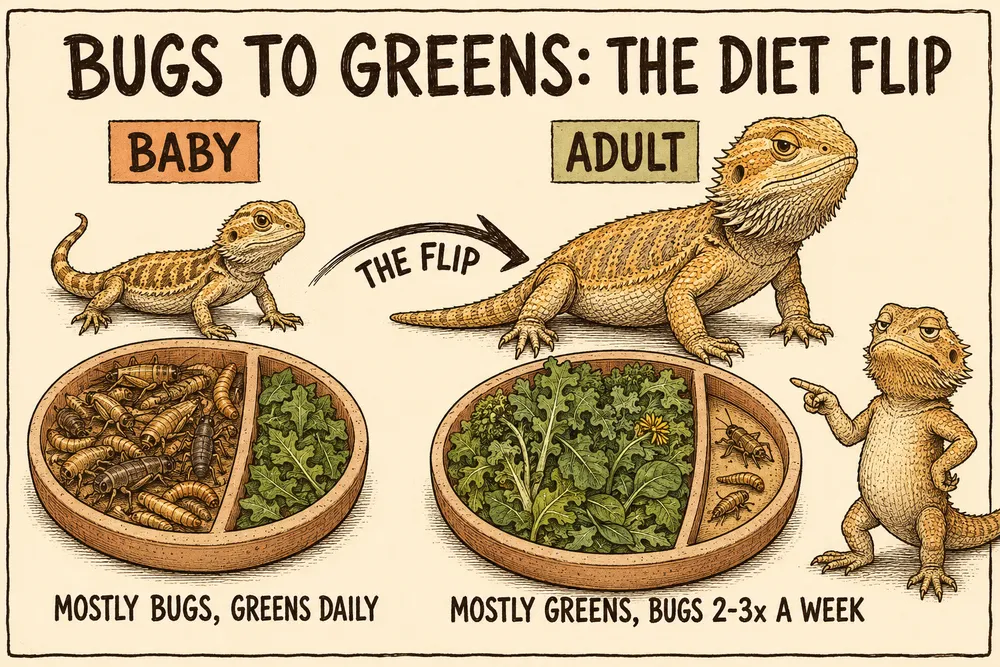
4. Growing up: the baby-to-adult flip
This is the phase new keepers most often get wrong, so it’s worth understanding the arc:
- Baby (0–6 months): an insect-eating machine. Feed insects generously and often, offer salad they’ll mostly ignore, and expect rapid growth. Under-feeding insects here stunts a growing dragon.
- Juvenile (6–12 months): the ratio starts to shift. Insects taper; greens become a bigger part of the plate.
- Adult (12+ months): the flip completes — mostly leafy greens daily, with head-sized insects only a couple of times a week. Over-feeding insects to an adult is the road to obesity.
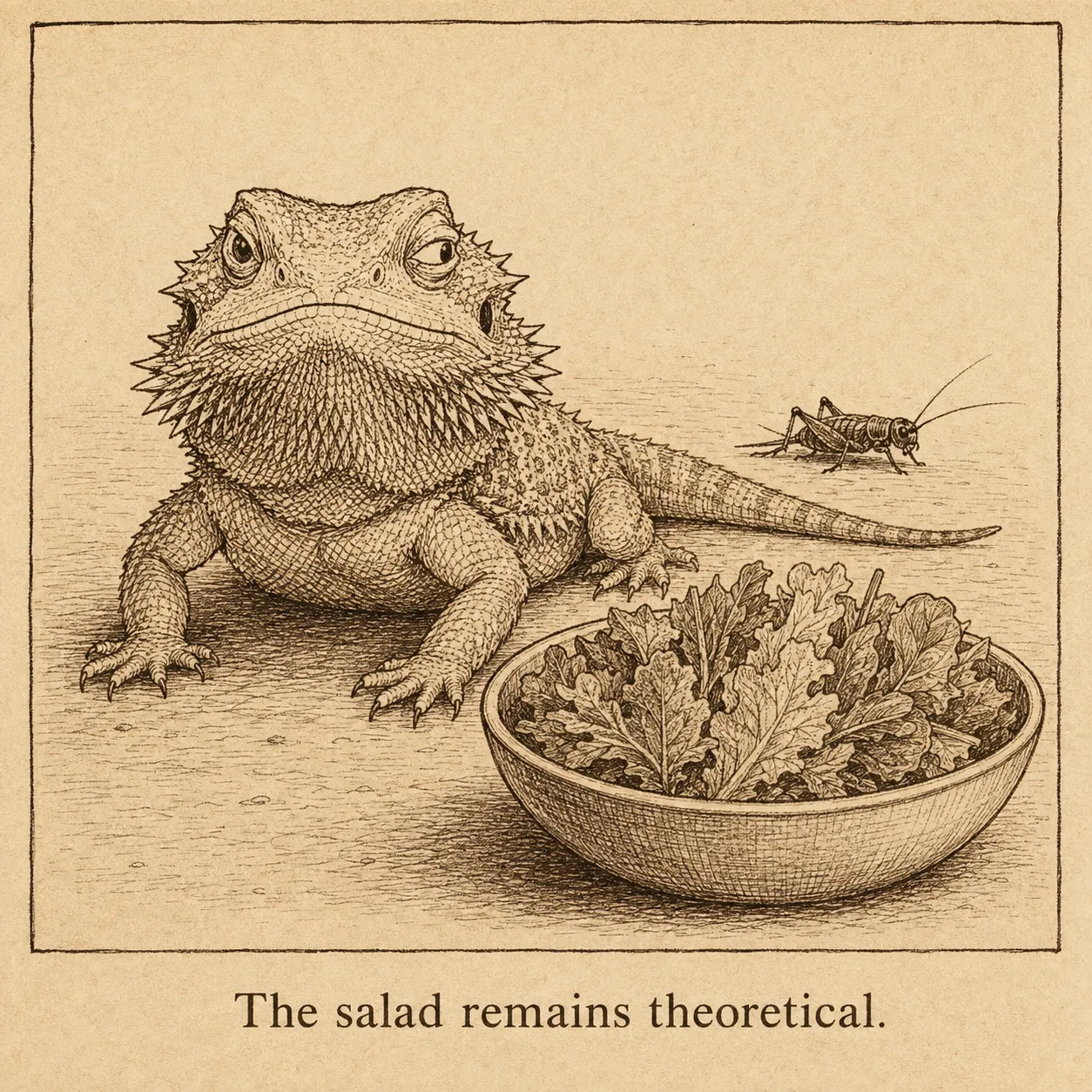
Every keeper of a young beardie knows the stand-off: the salad remains theoretical.
Two things to keep steady across all of it: a light dusting of calcium/vitamins (“like salting food, not a blizzard”), and correct temperatures so it can actually digest. If your dragon ever looks too round or too thin, the body-condition tool helps you read it.
5. Adulthood, brumation, and the long haul
An adult beardie settles into a calm, rewarding routine: morning basking, mooching for greens, dozing, and genuinely interacting with you. Two adult-life things to expect:
- Brumation. In cooler, darker months many adults slow right down — basking less, sleeping more, going off food for weeks. In a healthy adult on correct temperatures this can be normal; the key is to be sure it’s brumation and not illness. Weigh weekly, and if the slowdown comes with weight loss or other symptoms, see a vet. (More on the seasonal rhythm in should my reptile brumate?.)
- Knowing your vet early. Have an exotics vet’s number before you need it, and learn the red flags on the care reference and when to see a vet — a soft rubbery jaw, tremors, laboured breathing, or a swollen belly with no droppings all mean stop watching and get help.
6. The beginner mistakes worth skipping
You don’t have to learn these the hard way:
- A too-small “starter kit” tank. Buy for the adult from the start.
- Weak or missing UVB (coil bulbs, or none). This is the leading cause of metabolic bone disease in beardies.
- Keeping it bone-dry. 30–60% humidity is correct — “as dry as possible” is a myth.
- Feeding an adult like a baby. Too many insects, too few greens, is how adult beardies get fat.
- Guessing temperatures. Measure the basking surface with a real thermometer; a cold dragon can’t digest, which cascades into every other problem.
🌵 A bearded dragon rewards you for getting the unglamorous parts right. Nail the lighting, the heat, the space, and the diet-that-changes-with-age, and you get a decade-plus of one of the most characterful, interactive animals in the hobby. You’ve got this.
Go deeper (the basics): the fact-checked bearded dragon care reference · bearded dragon facts: third eye, water, size & origins · personality, bonding & handling · health red flags & when to see a vet · what do they eat? full feeding guide · printable care sheet · does my reptile need UVB & heat? · UVB by species · bearded dragon questions answered.
🎓 Ready to go further — the advanced tier. Once the basics are second nature and you want to grow with your dragon (same plain voice, no topic ceiling): morphs & genetics explained · can bearded dragons live together? · breeding responsibly (read first) · bioactive setup: isopods & a living desert floor.
Sources & further reading
This guide is the plain-language companion to our bearded dragon care reference, where every husbandry number is traced to authoritative sources. Quotes above are quoted verbatim from their original publications:
- Divers SJ, Comolli JR. Nutritional, Metabolic, and Endocrine Diseases of Reptiles. Merck Veterinary Manual (peer-reviewed by João Brandão), last updated Jul 2025.
- Zayas M, DVM (reviewed by Witherell M, DVM). Bearded Dragon Care Sheet. PetMD, updated Jun 2024.
It’s honest general guidance, written and fact-checked by The Baskden Team — not veterinary advice. For a sick dragon, see an exotics vet.
Common questions
Is a bearded dragon a good first reptile?
Yes — a bearded dragon is one of the best first reptiles there is, because they're hardy, hand-tame, and genuinely interactive. The one honest catch is that they are not low-effort: they need strong linear T5 UVB, a hot basking zone, a large enclosure, and a mix of insects and fresh greens. If you're happy to get the lighting and heat right and commit for 10–15 years, a beardie is a wonderful, rewarding first reptile.
How much does a bearded dragon cost to set up and keep?
Budget roughly $300–600 for a proper adult setup — and the lighting, not the animal, is the expensive part. The dragon itself is usually $40–100, but a large enclosure, a strong linear T5 HO UVB bulb and fixture, and a basking cluster on controllers add up. Running costs are about $25–45 a month for insects, greens, and electricity, plus a yearly UVB bulb replacement (~$30–60) and a vet fund.
How long do bearded dragons live?
A well-kept bearded dragon typically lives 8–15 years, and some reach even older. That makes a beardie a decade-plus relationship — a genuine commitment to plan around, not a short-term pet. The single biggest factor in a long, healthy life is correct husbandry from the start: proper UVB, heat, space, and diet.
Do baby and adult bearded dragons eat differently?
Very differently. Babies are insect-hungry and eat mostly bugs several times a day, with salad they'll often ignore at first. As a beardie grows, the ratio flips: adults eat mostly leafy greens daily, with head-sized insects only a couple of times a week. Feeding a baby like an adult (too few insects) stunts growth; feeding an adult like a baby (too many insects) causes obesity.
Should my bearded dragon brumate in winter?
Many bearded dragons naturally brumate — slowing down, basking less, and going off food for weeks — in the cooler, darker months, and in a healthy adult on correct temperatures this can be normal. But a slowdown in a baby, or one that comes with weight loss, sunken eyes, or other symptoms, is not brumation — it's a reason to see an exotics vet. When in doubt, weigh weekly and get a health check before assuming brumation.