
Is My Reptile Breathing Normally? Reptile Respiratory Infection Signs
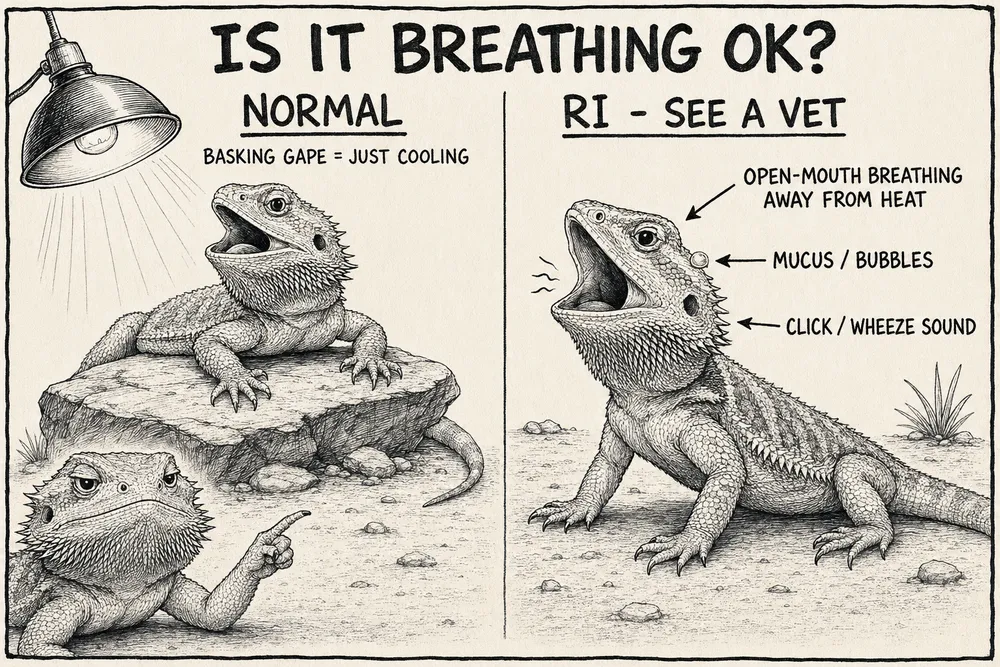
Reptiles are stoic animals that hide illness well — which makes their breathing one of the most valuable things you can learn to read. A respiratory infection is one of the most common illnesses in captive reptiles, it’s usually caused by something in the setup you can fix, and it’s very treatable when caught early. It’s also one that shouldn’t be waited out. Here’s how to tell normal breathing from a red flag, and what to do about it.
🫁 The 30-second answer: watch for open-mouth breathing away from the heat, bubbly or stringy mucus around the nose or mouth, and a clicking, whistling, wheezing, or rattling sound when breathing — often with lost appetite and lethargy. That’s a respiratory infection (RI), and it needs a reptile vet (usually antibiotics). It’s almost always driven by husbandry — too cool, wrong humidity, poor hygiene — so raise the enclosure to correct temperatures and fix humidity/cleanliness and see a vet. Don’t confuse it with a beardie’s normal basking gape or a quick yawn, which are calm and heat-related, not laboured.
Normal breathing vs a red flag
This distinction matters, because some perfectly normal behaviour looks like breathing trouble:
- ✅ A bearded dragon gaping on its basking spot — mouth open, calm, sitting under the heat. That’s thermoregulation (releasing excess heat), not illness.
- ✅ A quick yawn or jaw-stretch, often after a meal — normal.
- ✅ A snake’s occasional audible exhale — a single puff of air is usually nothing.
- 🔴 Open-mouth breathing away from the heat — the animal is holding its mouth open to breathe, not to cool, and it looks laboured.
- 🔴 Any mucus or bubbles around the nose or mouth, or bubbly/stringy saliva.
- 🔴 A sound with each breath — clicking, whistling, wheezing, rattling, or popping.
The theme: normal gaping is calm and heat-related; a respiratory infection is laboured, noisy, or wet.
The signs of a respiratory infection
Put together, an RI usually shows several of these at once:
- 👄 Open-mouth or laboured breathing away from the basking spot.
- 💧 Bubbly or stringy mucus/saliva around the mouth or nostrils.
- 🔊 Clicking, whistling, wheezing, or rattling breath sounds.
- 🍽️ Loss of appetite and lethargy.
- ⬆️ Sometimes holding the head and neck raised to breathe more easily.
If you’re seeing a cluster of these, treat it as an RI until a vet says otherwise.
Why it happens — almost always husbandry
Respiratory infections are usually a husbandry problem wearing a medical costume. As Lauren Jones, VMD — a veterinarian writing for PetMD — states, “The number one risk factor for reptiles acquiring respiratory disease is a lack of suitable husbandry or routine veterinary care.“¹ The common causes:
- 🥶 Too cool. A reptile kept below its correct temperatures can’t power its immune system — the single most common driver.
- 💧 Incorrect humidity. Too damp-and-stale with poor ventilation is a classic cause (and, for some species, chronically too dry contributes too). Match your species — see humidity & shedding.
- 🧽 Poor hygiene. A dirty enclosure breeds the bacteria behind infections.
- 😰 Stress, which suppresses immunity — a new arrival, cohabitation, or an unsuitable setup.
That’s good news: fixing the environment is both treatment support and prevention.
What to do
An RI needs two things, in this order:
- Correct the husbandry immediately. Raise the enclosure to the correct temperatures (at the higher, correct end of your species’ range), fix the humidity, and clean it up. Warmth genuinely helps a reptile fight the infection.
- See a certified reptile vet. This is the part that matters most: respiratory infections generally need veterinary treatment — usually antibiotics — and won’t reliably clear on husbandry alone. Left untreated they can progress to pneumonia, which is dangerous. Find a reptile/exotics vet and make the appointment; don’t wait to see if it passes.
We can’t diagnose or prescribe from afar, and neither can anyone else online — an RI is a genuine medical problem that needs a vet who can examine the animal.
Preventing the next one
Because RIs are so husbandry-driven, prevention is largely about getting the setup right and keeping it that way:
- Keep correct temperatures with a proper warm-to-cool gradient, verified with a thermometer.
- Keep humidity in your species’ range with real ventilation — humid, not stale.
- Keep it clean, and quarantine new arrivals.
- Tick your setup against the fact-checked targets with the setup checker.
Find the detail for your reptile
Temperature and humidity targets differ by species — go deep on yours:
| Your reptile | Care guide |
|---|---|
| 🦎 Bearded dragon | Bearded dragon care |
| 🦎 Leopard gecko | Leopard gecko care |
| 🦎 Crested gecko | Crested gecko care |
| 🐍 Ball python | Ball python care |
| 🐍 Corn snake | Corn snake care |
💚 Learning to read your reptile’s breathing is one of the highest-value skills a keeper can have. Most changes turn out to be normal — a basking gape, a yawn — but the laboured, noisy, or mucusy kind is a genuine red flag. Fix the heat and humidity, and get a reptile vet involved early; caught in time, respiratory infections usually heal well.
Go deeper: Is my reptile sick? · what is my reptile doing? · the setup checker · more real questions in the Baskden Q&A.
Sources & further reading
This guide was written and fact-checked against these authorities. It’s kind, general triage guidance — not a diagnosis or a substitute for a reptile vet:
- ReptiFiles — evidence-based husbandry and the respiratory-infection symptoms, causes, and treatment overview.
- Association of Reptilian & Amphibian Veterinarians (ARAV) — reptile veterinary care and a find-an-exotics-vet directory.
- ¹ PetMD, “Respiratory Infections in Reptiles” — written by Lauren Jones, VMD (University of Pennsylvania School of Veterinary Medicine). The quoted line on husbandry as the number-one risk factor.
- Merck Veterinary Manual — reptiles — respiratory disease and pneumonia in reptiles.
Written and fact-checked by The Baskden Team against veterinarian-authored sources — respiratory infections need veterinary treatment, so if your reptile shows the signs above, see a reptile/exotics vet promptly.
Common questions
What are the signs of a respiratory infection in a reptile?
The classic signs are open-mouth breathing, bubbly or stringy mucus around the mouth or nose, and a clicking, whistling, wheezing, or rattling sound when the animal breathes — often alongside a loss of appetite, lethargy, and sometimes holding the head or neck raised. A respiratory infection (RI) is a common and treatable illness, but it needs a reptile vet; it isn’t something to wait out.
Is open-mouth breathing in a reptile normal?
It depends entirely on the context. A bearded dragon gaping open-mouthed on its basking spot is normal — it’s releasing heat, like a dog panting — and a quick yawn is fine. But a reptile holding its mouth open to *breathe*, away from the heat, especially with mucus or a clicking/whistling sound, is showing a classic sign of a respiratory infection. Normal gaping is calm and heat-related; laboured open-mouth breathing with noise or mucus is a red flag.
What causes respiratory infections in reptiles?
Usually husbandry. The big three are being kept too cool, incorrect humidity (often too damp-and-stale with poor ventilation, though too dry can play a role), and poor hygiene — frequently with stress on top. A reptile kept too cold can’t fight infection well. That’s why correcting temperature, humidity, and cleanliness both supports recovery and prevents the RI coming back.
How do you treat a reptile respiratory infection?
First, get the husbandry right — make sure the enclosure is warm enough (at the correct, higher end of the range), has correct humidity, and is clean, which supports the immune system. Then see a certified reptile vet, who will likely prescribe antibiotics. Respiratory infections generally need veterinary medication; they don’t reliably clear on husbandry alone, and left untreated they can progress to pneumonia.
Can a reptile respiratory infection be serious?
Yes. Untreated, an RI can progress to pneumonia and become life-threatening, so it’s not one to delay on. The reassuring part is that caught early and treated by a reptile vet — alongside corrected temperature, humidity, and hygiene — most reptiles recover well. The key is recognising the signs and acting rather than waiting to see if it passes.