"What sex is my gecko?" comes up constantly. Some reptiles are easy to sex once grown; others
genuinely need an expert. Here's the honest version for each — no false confidence.
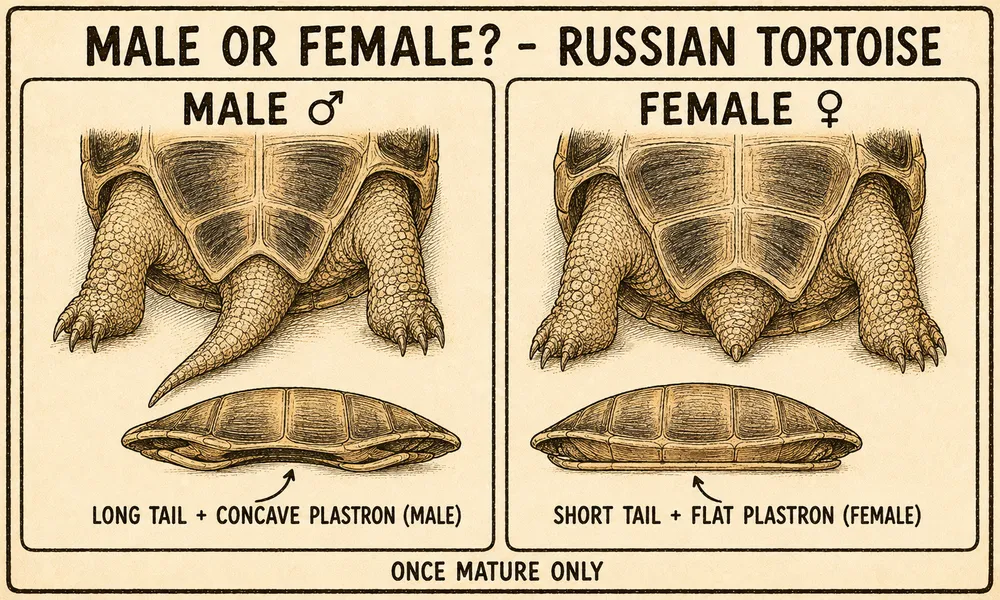
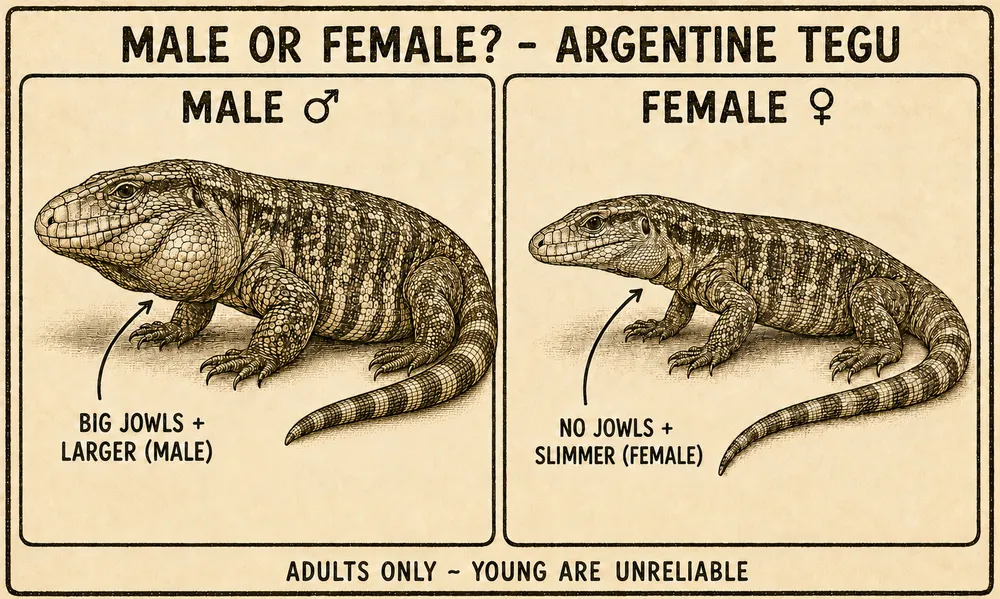
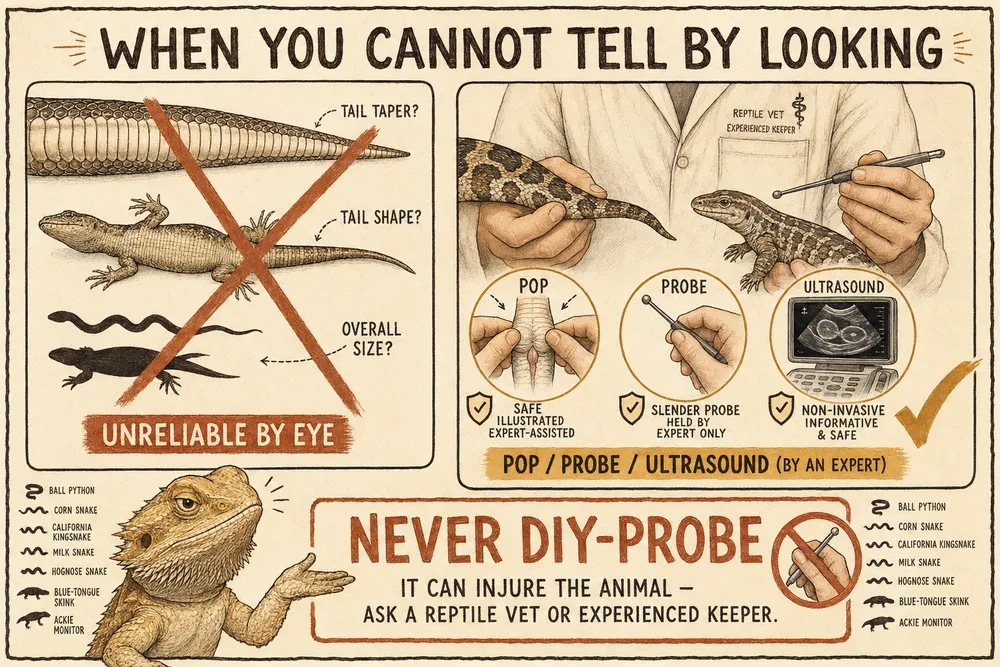
The femoral-pore method — two tail-base bulges + prominent femoral pores = male; a single central bulge + faint pores = female. Wait for subadult size.A bold V of pre-anal pores + two hemipenal bulges = male; faint pores and a smooth tail base = female. Reliable from ~6+ months, not hatchlings.A hemipenal bulge at the tail base = male; a smooth tail base = female. Young ones are genuinely hard — a magnifier helps; give it time.A tarsal spur on the back of each hind foot (present from hatching) = male; no spur = female. One of the easiest reptiles to sex.A longer tail + a concave (dented-in) plastron = male; a short tail + a flat plastron = female. Only once mature.Large cheek jowls + a bigger, heavier body = a mature male; little jowl and a slimmer body = female. Adults only — young tegus are unreliable.These species have no reliable visual tell. Tail-taper and size guesses are unreliable — an expert pops, probes or ultrasounds. Never DIY-probe: it can injure the animal.
Two rules before you start: juveniles usually can't be sexed reliably —
wait for size — and for snakes, please don't try risky DIY "probing"; that's an expert's job.
🦎 Leopard Gecko
Confidence: High, once matureSexable: From ~6+ months / good adult size
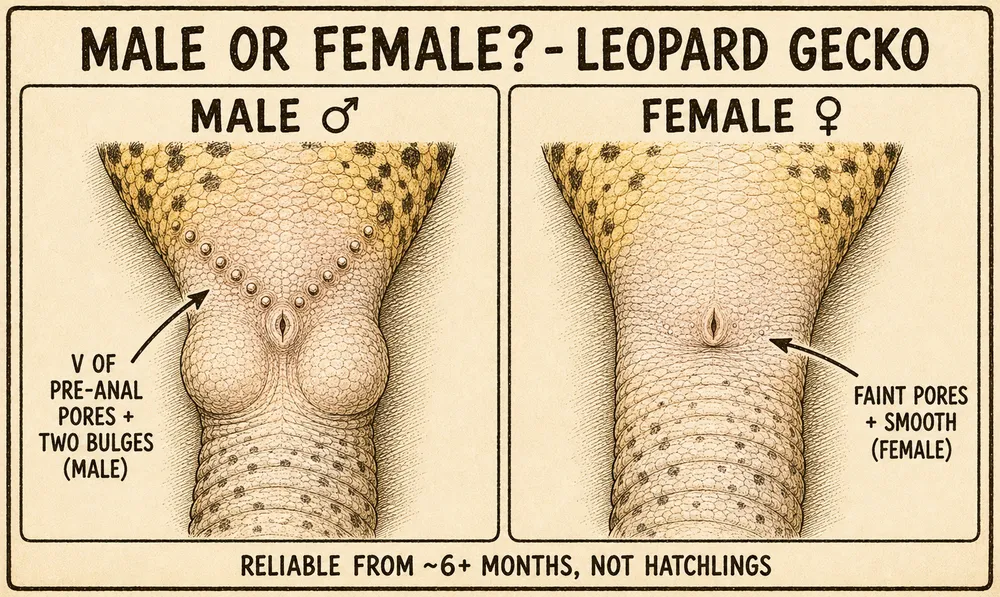
How to look: Look at the underside at the base of the tail, just past the vent (a gentle, brief look — no need to press).
♂ Male
A bold, V-shaped row of enlarged pre-anal pores just above the vent (often waxy-looking)
Two clear hemipenal bulges just behind the vent, at the tail base
♀ Female
Pores faint or absent — no bold V
No hemipenal bulges; a smooth tail base
Honest note: One of the easiest reptiles to sex once mature. Hatchlings are unreliable — wait for size. (Incubation temperature influences sex in leos, so clutch ratios can skew.)
Confidence: High, once matureSexable: From several months / good adult size
How to look: Just like its leopard-gecko cousin: look at the underside at the base of the tail, just past the vent (a gentle, brief look — no need to press).
♂ Male
A bold, V-shaped row of enlarged pre-anal pores just above the vent (often waxy-looking)
Two clear hemipenal bulges just behind the vent, at the tail base
♀ Female
Pores faint or absent — no bold V
No hemipenal bulges; a smooth tail base
Honest note: As easy to sex as a leopard gecko once mature — the pores and bulges are clear on adult males. Hatchlings are unreliable; wait for size.
Confidence: High — even as a hatchlingSexable: From hatching (the spur is present from birth)
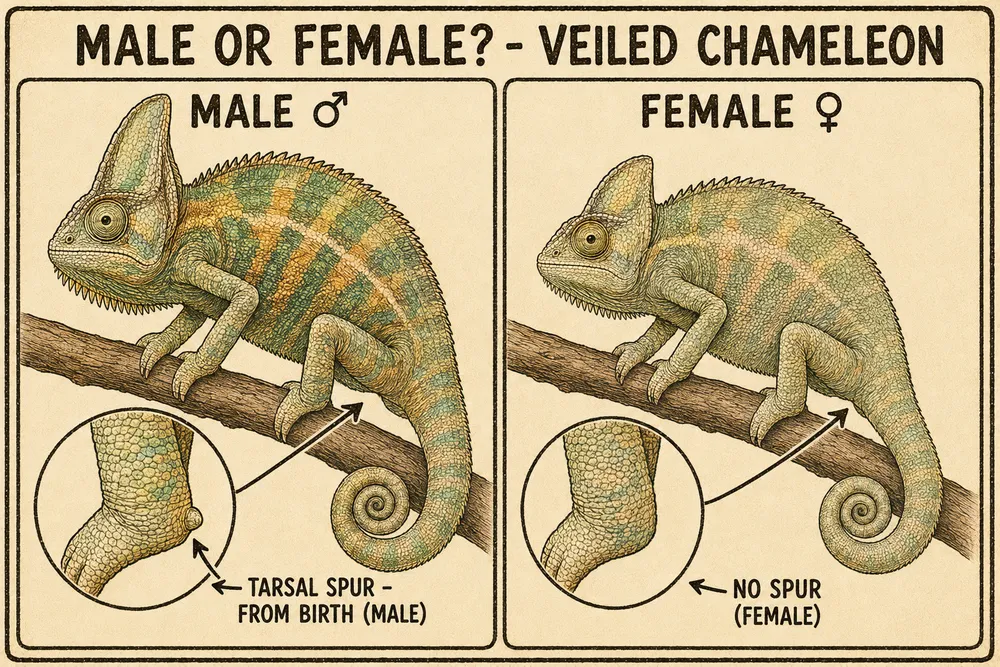
How to look: Look at the back of each hind foot (the heel). Male veiled chameleons have a small bump — a tarsal spur — there from the day they hatch; females don't.
♂ Male
A tarsal spur (small bump) on the back of each hind foot
Usually a taller casque and bolder colours/banding as it grows
Larger overall
♀ Female
No tarsal spur on the hind feet
Shorter casque; often rounder-bodied
Tends toward more pastel, mottled colours
Honest note: One of the easiest reptiles to sex — the tarsal spur is reliable from hatching. (Note: a lone female still develops eggs, so "she" needs a lay bin to avoid egg-binding.)
Confidence: Moderate–high, once grownSexable: From ~15–25 g / several months
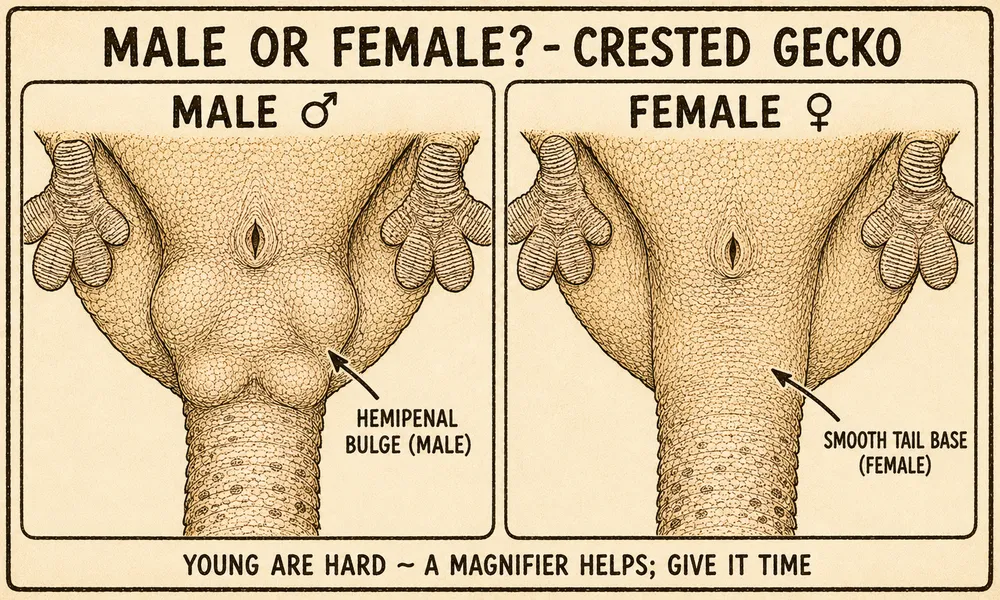
How to look: Like the crested gecko — look at the underside of the tail base for a hemipenal bulge (a magnifier helps on young geckos); mature males also develop pre-anal pores.
♂ Male
A visible hemipenal bulge at the base of the tail
A row of pre-anal pores develops with maturity
♀ Female
Smooth tail base, no bulge
No obvious pores
Honest note: Same as the crested gecko: young gargs are hard to sex — the bulge shows as they grow. Give it time rather than guessing early.
Confidence: Moderate–high, once subadultSexable: From ~5–6 months / subadult size
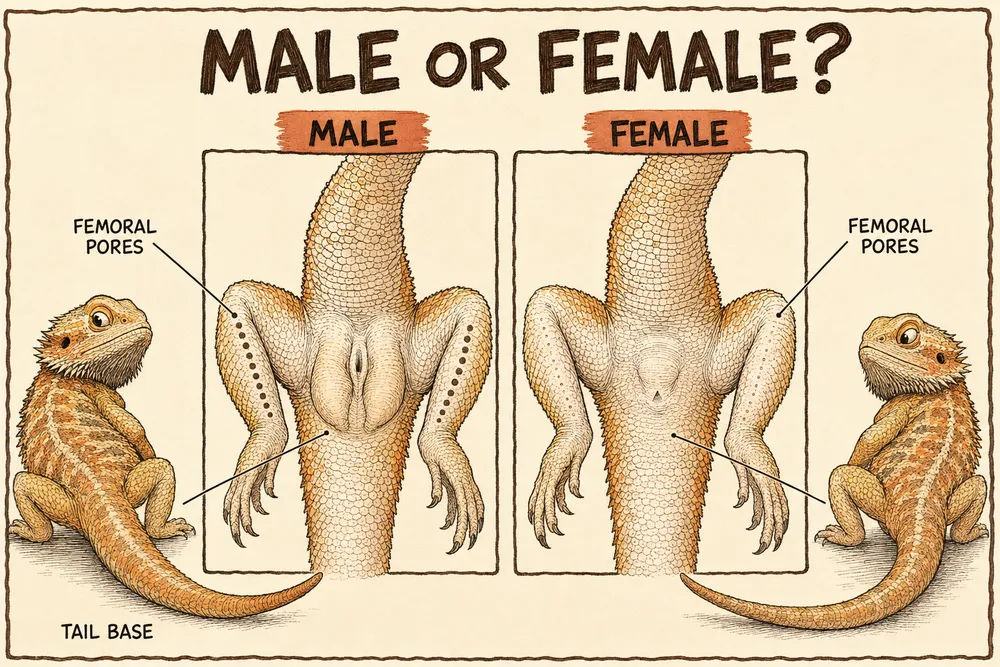
How to look: Gently lift the tail and shine a bright light down through the base of the tail (hold it over a torch), and check the femoral pores on the underside of the thighs.
♂ Male
Two bulges, one either side of the tail base (paired hemipenes)
Larger, more prominent femoral pores (a row of dots along each thigh)
Often a broader head and darker beard; larger overall
♀ Female
A single bulge in the centre, above the vent
Smaller, fainter femoral pores
Often a slimmer head
Honest note: Hatchlings can't be sexed reliably — wait for subadult size. The tail-base bulge (the "torch method") is the most reliable sign.
Confidence: Moderate, once matureSexable: From adult size / maturity
How to look: Look at the colour, the femoral pores on the underside of the thighs, and the tail base once it's grown.
♂ Male
Often brighter, bolder colours
Larger, more prominent femoral pores (a row of dots along each thigh)
A slightly bulkier tail base (hemipenes)
♀ Female
Usually duller, more muted colouring
Smaller, fainter femoral pores
A slimmer tail base
Honest note: Hatchlings can't be sexed reliably — wait for size. Colour and pore differences are the usual signs once mature, but they vary by species; an experienced keeper can confirm.
Confidence: Low — genuinely hard, often needs an expertSexable: By an experienced keeper or vet
How to look: Blue tongue skinks have no reliable external difference between the sexes. The dependable methods are eversion ("popping") or an ultrasound done by a reptile vet or experienced keeper.
♂ Male
Sometimes a broader head and slightly larger size; may evert hemipenes when popped (unreliable by sight)
♀ Female
Sometimes a rounder, wider body (unreliable by sight)
Honest note: Honestly one of the harder pet reptiles to sex — the visual "tells" are unreliable. If you need to know for certain, ask a reptile vet or an experienced skink keeper rather than guessing.
Confidence: Moderate in adults (jowls); hard when youngSexable: From ~2–3 years / adult size
How to look: Mature males develop large, obvious jowls (bulging cheek masses) and grow noticeably bigger. Young tegus are hard to sex and may need an expert.
♂ Male
Large jowls / bulging cheeks at maturity
A noticeably larger, heavier body
A broader head
♀ Female
Little or no jowl development
A smaller, often slimmer body
Honest note: Adult males are fairly easy to spot by their big jowls and size, but young tegus are unreliable — wait for maturity, or ask a vet or experienced keeper.
Confidence: Moderate, once matureSexable: From roughly adult size / sexual maturity
How to look: Compare the tail and the belly (plastron) once it's grown — the sexes differ in tail length and the shape of the underside.
♂ Male
A longer, thicker tail (often tucked to one side)
A slightly concave (dented-inward) plastron
A narrower rear shell notch; sometimes longer claws
♀ Female
A shorter, stubbier tail
A flat plastron
A wider, more U-shaped rear notch; often a rounder, larger body
Honest note: Can't be sexed as a hatchling — wait for size. The tail-length and plastron differences are the reliable signs once mature; an experienced keeper or vet can confirm.
Confidence: Low by eye — often needs an expertSexable: By an experienced keeper or vet
How to look: Ackies have no reliable external difference between the sexes. The dependable methods are eversion ("popping"), a hemipenal-bulge check, or imaging by a reptile vet or experienced monitor keeper.
♂ Male
Sometimes slightly larger with a broader head, and small spiny scales beside the vent; may evert hemipenes when popped (unreliable by sight)
♀ Female
Sometimes a slightly smaller, rounder body (unreliable by sight)
Honest note: Genuinely hard to sex by eye — don't rely on size or head shape. To know for certain, ask a reptile vet or an experienced monitor keeper rather than guessing.
Confidence: Low by eye — needs an expertSexable: Any age, but by a trained handler
How to look: Snakes are sexed by "popping" (everting the hemipenes, usually in young snakes) or "probing" — both done by an experienced keeper or reptile vet. Done wrong, either can injure the snake.
♂ Male
"Pops" or probes deeper (hemipenes present)
Sometimes a longer/thicker tail past the vent and larger spurs — but these hints are unreliable on their own
♀ Female
Probes shallow
Tail often tapers sooner — again, unreliable by sight alone
Honest note: Please don't DIY-probe without training. If you need to know for certain, ask an experienced breeder or a reptile vet — visual guesses are frequently wrong.
Confidence: Low by eye — needs an expertSexable: By a trained handler / vet
How to look: Same as its kingsnake cousin and other snakes — "popping" (juveniles) or "probing" by someone experienced. Tail-shape hints are unreliable on their own.
♂ Male
Probes deeper; tail often thicker past the vent (unreliable alone)
♀ Female
Probes shallow; tail often tapers sooner (unreliable alone)
Honest note: Have an experienced keeper or vet pop/probe it — don't rely on tail-shape guesses, and don't probe it yourself untrained.
Confidence: Low by eye — needs an expertSexable: By a trained handler / vet
How to look: Sexed like other snakes — "popping" (juveniles) or "probing" by someone experienced. Hognoses are size-dimorphic (females much larger) and males have relatively longer tails, but those hints are unreliable on their own.
♂ Male
Probes deeper; a relatively longer, thicker tail past the vent; a noticeably smaller adult (unreliable alone)
♀ Female
Probes shallow; shorter tail; a much larger adult size (unreliable alone)
Honest note: Have an experienced keeper or vet pop/probe it — don't probe it yourself untrained, and don't rely on size or tail guesses.
It depends on the species — some are easy to sex once grown, others genuinely need an expert. Pick your reptile above for its honest method: bearded dragons and leopard geckos by femoral/pre-anal pores and hemipenal bulges, crested geckos by a tail-base bulge, veiled chameleons by a hind-foot tarsal spur (present from hatching), Russian tortoises by tail length and plastron shape, and Argentine tegus by their cheek jowls. Snakes and several others have no reliable visual tell.
When can you sex a young reptile?
Usually not as a hatchling — most reptiles can only be sexed reliably once they reach subadult size. Leopard geckos become readable from around six months, tortoises and tegus only once mature, while a veiled chameleon’s spur is the exception (visible from hatching). Sexing a juvenile too early is how people get a confident wrong answer, so wait for size.
How do you tell the sex of a snake?
Snakes have no reliable external tell you can read at a glance — tail-taper and size guesses are unreliable. Sex is confirmed by an expert popping or probing, which is genuinely a trained keeper’s or vet’s job. Please don’t attempt DIY probing at home: done wrong it can seriously injure the animal.
Why does the sex of my reptile matter?
It matters most for housing and health: many reptiles must not be housed together (males often fight, and unplanned breeding stresses females), and some female-specific issues like egg-binding depend on knowing you have a female. For casual keeping it’s often just curiosity, but before breeding or any cohabitation decision, have an experienced keeper or reptile vet confirm.
Kind, general guidance from The Baskden Team. When it really matters (breeding, cohabitation
disputes), have an experienced keeper or reptile vet confirm.

 Free tool · honest, not guesswork