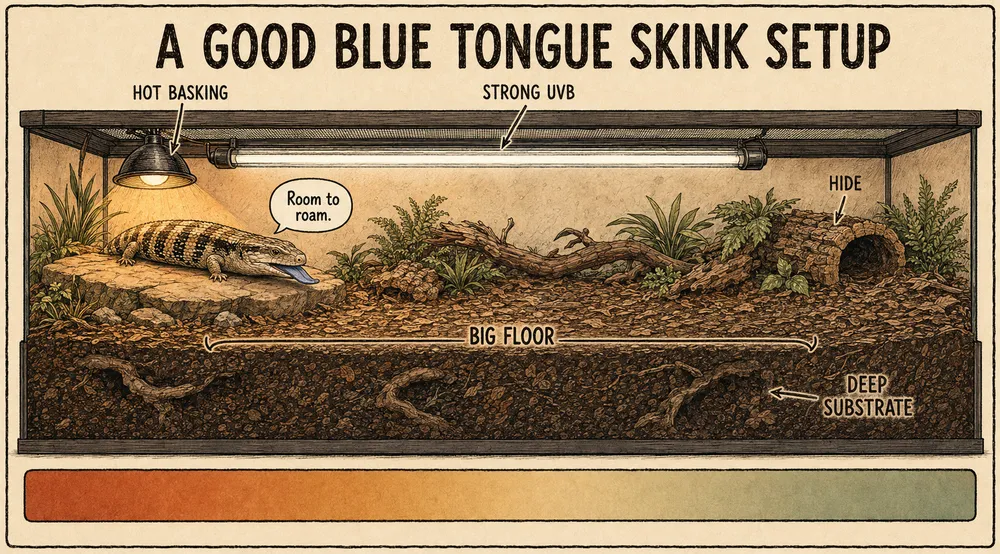
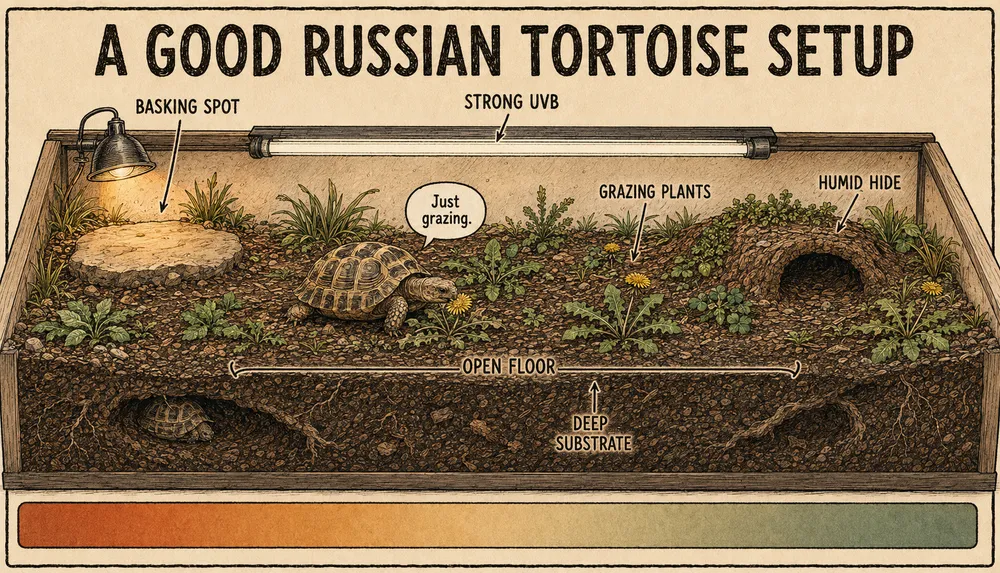
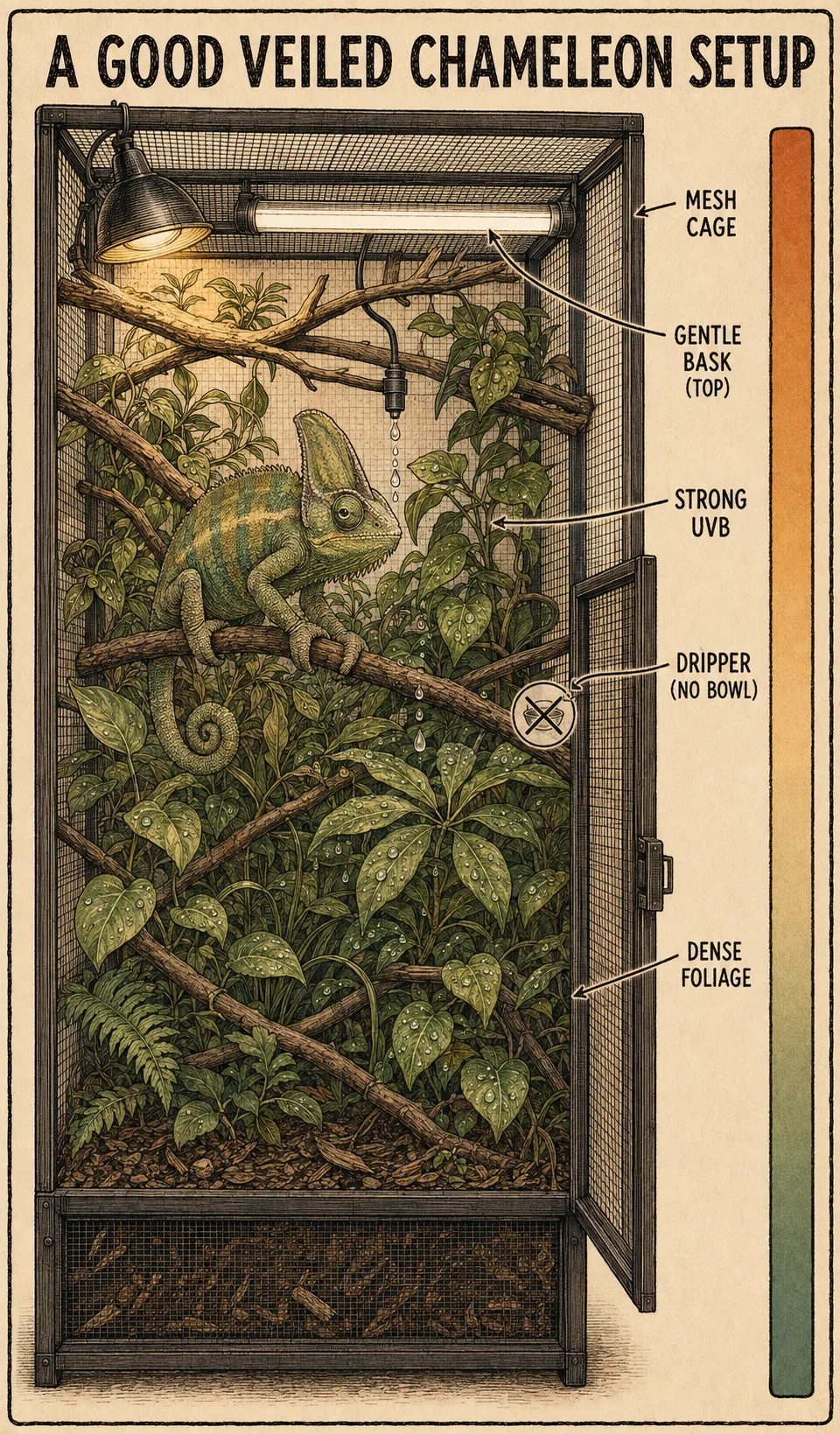
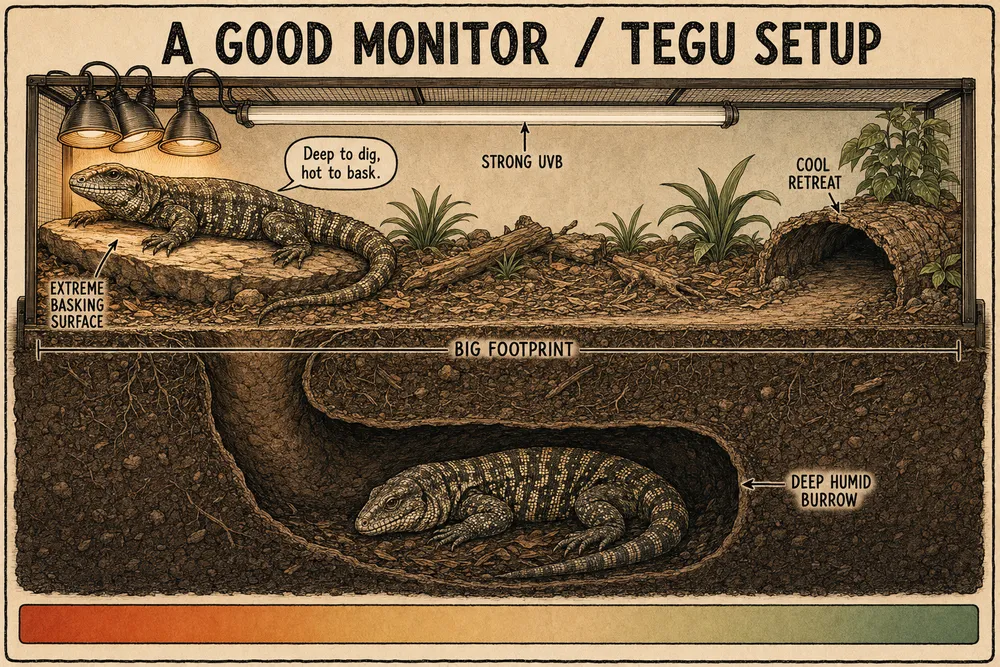
Your reptile: Green Iguana Chinese Water Dragon Green Tree Python Eastern Box Turtle Caiman Lizard Rosy Boa Brazilian Rainbow Boa Carpet Python Children's Python Rat Snake Blood Python Bull Snake Rubber Boa Tokay Gecko Giant Day Gecko Leachianus Gecko Chahoua Gecko Chinese Cave Gecko Greek Tortoise Red-Footed Tortoise Leopard Tortoise Marginated Tortoise Indian Star Tortoise Rankin's Dragon Common Chuckwalla Collared Lizard Fire Skink Schneider's Skink Sandfish Skink Frilled Dragon Pygmy Chameleon Bearded Dragon Leopard Gecko Ball Python Crested Gecko Corn Snake Gargoyle Gecko Western Hognose Blue Tongue Skink California Kingsnake Milk Snake African Fat-Tailed Gecko Russian Tortoise Veiled Chameleon Ackie Monitor Uromastyx Argentine Tegu Savannah Monitor Sulcata Tortoise Hermann's Tortoise Panther Chameleon Jackson's Chameleon Mourning Gecko Kenyan Sand Boa Boa Constrictor Red-Eyed Crocodile Skink Painted Turtle Common Musk Turtle Yellow-Bellied Slider African Sideneck Turtle Northern Map Turtle Reeves' Turtle Eastern Mud Turtle Red-Eared Slider Green Anole Garter Snake
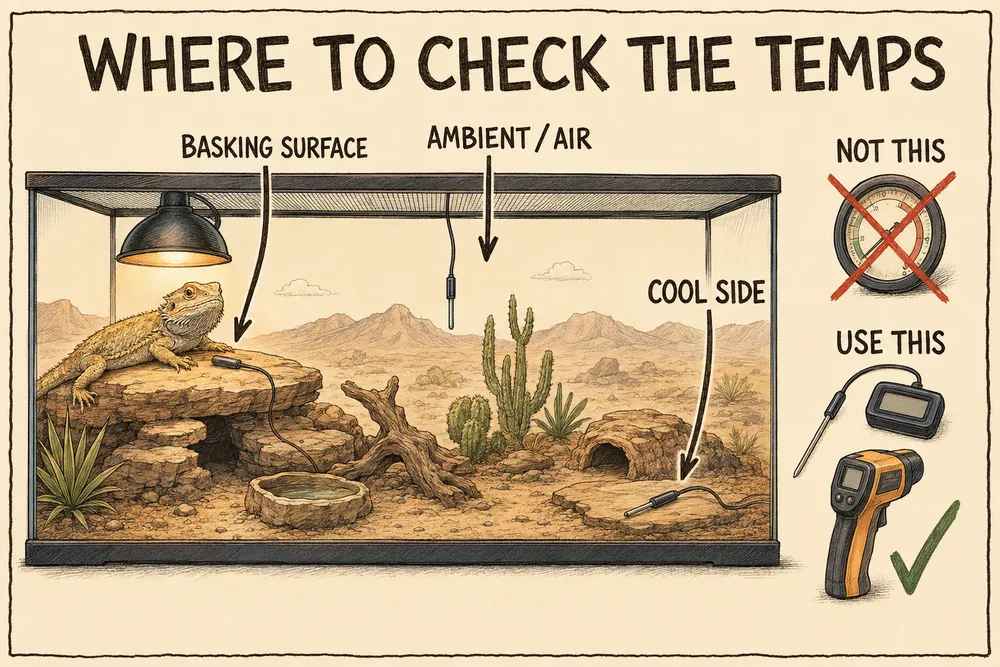
Enclosure. Adults need a custom, room-sized, VERTICAL enclosure, not a fish tank. Plan for a minimum around 10 ft long x 5 ft wide x 6 ft tall (3 x 1.5 x 1.8 m); an ideal build is closer to 12'L x 6'W x 6'H. As a rule of thumb, length should be at least twice the iguana's body length and height at least 6 ft, because these are arboreal climbers who need to get UP. Fill it with sturdy, thick climbing branches and broad basking shelves that can hold a 15-20 lb animal, plus solid smooth walls (no wire mesh they can rub their snouts raw on). Because iguanas soak and even swim, include a large, shallow water/soak area big enough to fit the whole body, at room-to-lukewarm temperature; change it daily and disinfect weekly. Hatchlings can start in a temporary 20-55 gallon setup but will outgrow it within a year, so budget for the adult space before you buy. Basking / warm zone. A hot basking surface of about 120°F (50°C), measured at the branch or shelf with a temperature gun (not a stick-on dial). This gives them a proper spot to thermoregulate and digest. Cool side. Ambient/cool end around 75-85°F (24-29°C), so the animal can move down the gradient to cool off. Night. Should not drop below the low-to-mid 70s F; keep nights roughly 73-84°F (23-28°C). A gentle nighttime dip is fine, but never let it get cold. UVB & lighting. STRONG UVB is non-negotiable for this rainforest baskers. Use a high-output linear T5 HO tube (e.g. Arcadia 12-14% or Zoo Med Reptisun 10.0), spanning much of the enclosure, mounted so the basking zone reads a UV Index (UVI) of about 3.0-4.0. With mesh in the path, that is roughly 13-24 inches from the animal depending on the bulb, so measure with a Solarmeter rather than guessing. Run it 10-13 hours a day and replace tubes on schedule (about every 6-12 months) since UV output fades long before the light dies. Humidity. Fairly humid, reflecting their tropical origins: aim for roughly 60-80% during the day, with a higher spike toward 100% at night (misting or a humid microclimate). Chronically dry air contributes to poor sheds, dehydration, and kidney strain. Provide good airflow too, so damp does not become stagnant. Substrate. Use a safe, absorbent substrate: a 2-4 inch (10-15 cm) layer of large-particle coconut husk or cypress mulch works well for holding humidity, or go simple with pelleted paper bedding or reptile carpet for easy cleaning. Avoid loose sand, fine particles, pine, and cedar (impaction and respiratory irritation risk). Spot-clean daily and refresh regularly. Diet. 100% herbivore (folivore). The whole diet is plants: roughly 60-70% dark leafy greens (collard, dandelion, mustard greens, turnip greens, kale in rotation, escarole, watercress), about 20-30% other vegetables (squash, bell pepper, green beans, snap peas, grated carrot), and only about 10% fruit as a treat (berries, mango, papaya). NEVER feed animal protein, insects, dog or cat food, or "monkey biscuits." This is critical: iguanas are strict vegetarians in the wild, and animal protein is a leading cause of fatal kidney disease and gout in captive iguanas. Offer fresh food daily and remove uneaten produce before it spoils. Full Green Iguana guide → Is this normal? →
Enclosure. Adult minimum roughly 6 ft tall x 3 ft wide x 6 ft long (about 1.8 x 0.9 x 1.8 m); bigger is strongly recommended, and height matters because they climb. Build it as a paludarium: a large, heated pool that occupies about one-third to one-half of the floor space and is at least 6 in (15 cm) deep — deep enough for the dragon to fully submerge and swim, since these lizards dive to escape and can hold their breath underwater for many minutes. Keep the water warm (basking-warm surface, roughly 80s F / high-20s to low-30s C during the day) and, critically, filtered and moving — a canister or submersible filter plus weekly water changes (or sooner if soiled), because they defecate in the water and stagnant water breeds infection. Densely plant the land side and add visual barriers to stop snout-rubbing on the glass (see below). A single pet-store 75-gallon tank is a temporary juvenile home at best, not an adult enclosure. Basking / warm zone. Warm land basking spot around 90-95°F (32-35°C), measured at the surface where the dragon actually sits. Provide sturdy horizontal branches under the basking lamp so it can thermoregulate above the water. Cool side. Cool end around 77-86°F (25-30°C) per ReptiFiles, so the animal has a real thermal gradient to move through. Night. Night around 75-77°F (24-25°C); a modest natural drop is fine, but do not let it fall below about 65°F (18°C). Sustained cold is a leading cause of respiratory infection in this species. Use a non-light heat source (ceramic heat emitter or radiant panel on a thermostat) if the room drops. UVB & lighting. Yes — UVB is essential. Use a high-output T5 HO linear tube: an Arcadia 12% (Desert) or Zoo Med ReptiSun 10.0, spanning roughly half to two-thirds of the enclosure in a reflective fixture, aiming for a basking-zone UV Index of about 3.0-4.0 (Ferguson Zone 3). Mount it about 11-15 in (30-38 cm) above the basking branch if over mesh, or 16-20 in (40-50 cm) if inside the enclosure. Replace the bulb every 6-12 months — UV output fades before the visible light does. Pair it with a bright ~6500K daylight LED, since a UVB tube alone isn't bright enough for their needs. Humidity. High: daytime average around 60-80%. Achieve it with the large water feature plus misting 1-2x daily (or an automatic mister/fogger) and a moisture-holding substrate. Good ventilation still matters — high humidity with stagnant air invites respiratory and skin infections, so aim for humid but airy, not swampy-stale. Substrate. On the land side, a deep (about 4 in / 10 cm) moisture-holding layer such as coconut fiber, sphagnum/peat moss, or a bioactive soil mix — it holds humidity and cushions falls. Avoid loose particulate that could be swallowed with prey. Some vets prefer easy-clean paper towel or vinyl for hospital/quarantine setups; for a permanent enclosure, a naturalistic moist substrate suits the species better. Diet. Insectivore-leaning omnivore. Juveniles are almost entirely insect-eaters; adults take roughly 80-90% insects (crickets, dubia roaches, black soldier fly larvae, silkworms, the occasional worm) with the remainder as leafy greens, vegetables, and small amounts of fruit. Gut-load feeder insects for 24-72 hours before offering. Adults typically eat insects every few days with salad available more often; feed juveniles more frequently. Offer appropriately sized prey (no wider than the space between the eyes). Full Chinese Water Dragon guide → Is this normal? →
Enclosure. Adult minimum is a tall, front-opening enclosure of at least 3 ft L x 2 ft W x 2 ft H (36" x 24" x 24"), per ReptiFiles and Dubia; bigger is better for welfare, and vertical height matters more than floor space because this snake lives in the branches. Prioritize a tall, well-ventilated setup — good airflow is what lets you run high humidity without stagnant, infection-breeding air. This is an arboreal, perch-based species; it will almost never come down to the floor voluntarily. Basking / warm zone. Warm perch / basking zone 80–86°F (27–30°C). This is the temperature of the sturdy horizontal branch at the warm end where the snake will drape and coil to digest — never a hot rock, and never a bare bulb it can press against. Cool side. Cooler perch / cool end 70–80°F (21–26°C), giving the snake a true horizontal branch at each temperature so it can thermoregulate by simply shifting which perch it drapes on. Night. Night drop to about 68–72°F (20–22°C) is fine and natural; Dubia advises not letting it fall below 68°F. UVB & lighting. Low/optional but genuinely beneficial — a modern-best-practice choice, not a strict requirement. GTPs can survive without UVB (they don't rely on it for calcium the way a diurnal basker does), but ReptiFiles strongly recommends providing it for welfare, targeting a UVI of 2.0–3.0 in the basking area (e.g., Arcadia ShadeDweller MAX or Zoo Med Reptisun 5.0 T5 HO), on a 12-hour cycle. Adults are crepuscular, so pair modest UVB with a bright, well-lit day; mount over mesh and measure with a Solarmeter rather than guessing. Humidity. High but breathing: roughly 40–70%, allowed to spike higher right after an evening misting and then dry back toward ~40% before the next one. The goal is a humid rainforest that ventilates — never a permanently soggy box. Track it with a digital probe hygrometer placed mid-enclosure. Substrate. A moisture-holding, forest-floor substrate 2–4 in deep — coconut fiber/husk, ReptiSoil or Eco Earth, plantation soil, or a bioactive mix — to buffer humidity. Since a healthy GTP rarely touches the ground, substrate is mostly a humidity engine; keep it clean and spot-clean promptly, because chronic wet filth is a fast track to skin and respiratory infection. Diet. A whole-prey carnivore and ambush feeder: appropriately sized mice and rats (with quail, chicks, or other rodents adding variety). Feed from long, soft-tipped tongs — this snake strikes at warm, moving prey and you do not want your hand in that arc. Frequency by age: hatchlings ~every 5–7 days, juveniles ~every 1–2 weeks, adults ~every 2–4 weeks. Prey should be no wider than the thickest part of the snake. Full Green Tree Python guide → Is this normal? →
Enclosure. Think land floor space, not a fish tank. Indoor minimum is about 5.5 ft L x 3 ft W x 1.5 ft H (1.6 x 0.8 x 0.4 m), roughly 14 sq ft / 1.3 sq m of floor, and bigger is always better (ReptiFiles). A secure OUTDOOR pen is the gold standard — walls at least 2 ft (0.6 m) tall and sunk ~12 in (30 cm) into the soil to stop digging escapes (ReptiFiles). This is NOT an aquatic turtle: instead of a swim tank it needs a SHALLOW soak/water dish no deeper than the turtle's "knees," with an easy ramp in and out, cleaned daily because they drink and defecate in it (ReptiFiles; VCA). Basking / warm zone. Basking spot 84-88°F / 29-31°C (ReptiFiles). Some sources list a warmer zone, but for this shade-dwelling woodland species keep it moderate — aim for the lower, well-ventilated end, and always pair it with a cooler, shaded, humid retreat it can escape into. Cool side. Cool end about 70–75°F / 21–24°C (ReptiFiles; VCA). Night. Nighttime can safely drop to about 50°F / 10°C for this temperate species (ReptiFiles); a gentle night drop is normal and healthy. VCA notes 65–70°F / 18–24°C is also fine indoors with no supplemental heat needed. UVB & lighting. Yes — UVB is essential (it drives vitamin D3 and calcium absorption; without it you get metabolic bone disease). Use a linear T5 HO tube such as Arcadia 6% or Zoo Med ReptiSun 5.0, mounted over the basking area to hit a UV Index of about 3.0–4.0 (ReptiFiles). Mount distance: ~13–14 in / 33–36 cm below the lamp if there's mesh between bulb and turtle, or ~17–18 in / 43–46 cm with no mesh (ReptiFiles). Never filter UVB through glass or plastic, and replace the bulb per the maker's schedule (roughly every 6–12 months) (VCA). A turtle living outdoors in real sunlight needs no artificial UVB. Humidity. High — target an average of 60–80%, and don't let daytime humidity fall below ~51% (ReptiFiles). Always provide a humid hide on the cool side lined with damp substrate, and mist/soak as needed. Chronic dryness causes shell and eye problems. Substrate. Deep and MOIST so the turtle can burrow. Indoors, use at least 4 in / 10 cm of a water-holding mix — e.g. roughly 40% organic topsoil, 40% coir/Reptisoil, 20% play sand — topped with a leaf-litter layer of at least ~1 in / 2.5 cm (more is better). Outdoors, aim for ~12 in / 30 cm of soil for digging and brumation (ReptiFiles). Avoid bare setups on sand alone, gravel, wood shavings, corn cob, or walnut shell (VCA). Diet. Omnivore, split roughly 50% animal matter / 50% plant matter for adults; juveniles are more carnivorous (~70–80% protein) and shift toward plants as they mature (ReptiFiles; VCA; Merck). Protein: earthworms, crickets, grasshoppers, mealworms, hard-boiled egg, and quality reptile/turtle pellets. Greens: dandelion, collard, mustard and turnip greens, kale, bok choy, watercress, plus squash, carrot, and bell pepper. Fruit is a small treat — under ~10% of the diet (berries, melon, apple, pear, fig). Feed juveniles daily, adults every other day. Skip iceberg lettuce, celery, dog/cat food, and wild-caught insects (VCA). Full Eastern Box Turtle guide → Is this normal? →
Enclosure. Think room-sized, not tank-sized. Modern best-practice minimum for one adult is about 8 ft L x 4 ft W x 6 ft H; some older care sheets list 6 x 3 x 4 ft as the floor, but bigger is genuinely better for a swimming, climbing animal. The single most important feature is a large WATER area: a pool taking up roughly one-third to one-half of the floor, at least 12 in deep for adults (20 in is even better) so the lizard can fully submerge and swim, held at about 78 F (range 75-85 F) with a submersible aquarium heater. Water fouls FAST with this messy shellfish-eater: run a large, high-quality external/aquarium filter AND still do full water changes at least weekly, often 2-3x weekly, scrubbing the basin before refilling. On the LAND side, provide sturdy climbing branches under the basking lamp, since wild caiman lizards perch on limbs over water and dive in to escape. Basking / warm zone. Hot basking spot on the land/branch side. Aim for an air basking zone around 100-105 F; keepers who measure the actual basking SURFACE with an IR temp gun target roughly 120-130 F on the perch under the lamp. Verify with a thermometer/IR gun, never guesswork. Cool side. Cool end / ambient roughly 70-80 F, with the warm side sitting 80-90 F, giving a clear thermal gradient across the enclosure. Night. A mild night drop is fine, but do not let temperatures fall below about 75 F. UVB & lighting. Yes, real UVB is required for calcium metabolism and to prevent metabolic bone disease. Use a high-output linear T5 HO tube such as an Arcadia Desert 12% or Zoo Med ReptiSun T5 HO 10.0 (46 in), mounted over the basking branch and replaced on the manufacturer's schedule. Pair it with bright 6500K daytime lighting and run an 11-13 hour photoperiod (shorter in winter, longer in summer). Humidity. High: target 70-80%, and do not let it sit below 60%. The large heated pool does a lot of the work; supplement with misting or a fogger/humidifier and good ventilation to avoid stagnant, mold-prone air. Substrate. On the land side, a moisture-holding mix such as cypress mulch blended with organic topsoil (and a little sand) works well, kept several inches deep (about 6 in) and fully replaced roughly every 3-4 months. Avoid dusty or dry substrates that fight the humidity you are trying to hold. Diet. A shellfish specialist. In the wild they crush freshwater snails, clams, crayfish and crabs with molar-like rear teeth, plus some fish, amphibians and invertebrates. In captivity feed canned/whole snails (a staple), crayfish/crawfish, shrimp, whole fish, plus superworms, dubia roaches, hornworms and earthworms, with occasional egg or small rodent and small amounts of non-citrus fruit. Prey should be no larger than the lizard's skull. Feed juveniles daily; adults about 2-3x per week. Full Caiman Lizard guide → Is this normal? →
Enclosure. A single adult does well in a 36"L x 18"W x 18"H enclosure (front-opening). ReptiFiles' modern floor-space formula is length x half-length x half-length, so a big ~44" animal wants roughly 48"L x 24"W x 24"H. Older guides that suggest a 10-20 gallon tank are dated minimums, not targets. Basking / warm zone. Warm hotspot of 85-90°F (29-32°C) on the surface where the snake rests. Some vet sources run the warm end up to ~90-92°F; keep it on a thermostat. Cool side. Cool end around 75–80°F (24–27°C), per ReptiFiles/exotics-vet sources; brief dips toward ~70°F are tolerated. A true gradient across the enclosure lets the boa self-regulate. Night. Safe to let the enclosure drop into the low-to-mid 60s°F at night; temperatures can fall to about 60°F (16°C) without harm. No night heat needed at normal room temperatures. UVB & lighting. Low need. As a crepuscular/nocturnal desert boa, a rosy boa can be kept healthy without UVB, and many keepers skip it. Modern best practice still favors providing a low, shade-dweller UVB level for overall wellbeing (e.g. Arcadia ShadeDweller 7%, aiming for a basking UVI around 2.0-3.0). If you do add it, offer plenty of shade and hides so the snake can get out of the light. Humidity. Keep it dry: ambient humidity below about 60% (some vets aim under 50%), measured with a digital probe hygrometer in the middle of the enclosure. Chronic dampness causes scale rot and respiratory infection in this desert species. For shedding, offer a small humid hide with lightly moistened sphagnum moss on the cool side rather than misting the whole tank. Substrate. A dry, burrow-friendly substrate 3-4 in (7.5-10 cm) deep: aspen shavings or a sand/sandy-soil mix (e.g. reptile-safe desert sand) both work well and keep humidity low. Aspen needs spot-cleaning and periodic full changes. NEVER use pine or cedar - their oils are toxic to snakes. Diet. Strictly carnivorous. Feed appropriately sized frozen-thawed rodents - a prey item no wider than about 1.5x the snake's thickest point, or roughly 10% of the snake's body weight. Hatchlings take pinky/fuzzy mice; adults take adult mice or small rats. Variety (mice, rats, gerbils, quail chicks) is fine. Full Rosy Boa guide → Is this normal? →
Enclosure. Adult minimum roughly 6 ft L x 3 ft W x 3 ft H (about 4' x 2' x 2' is a common practical floor). A good rule of thumb is enclosure length = snake's full length and width = half its length. Bigger is better, and a front-opening PVC or glass vivarium holds humidity far better than a screen-top tank. Basking / warm zone. Warm hotspot / basking zone 86–90°F (30–32°C). Do NOT let it climb higher — this species is heat-sensitive. Cool side. Cool end / daytime ambient around 78–84°F (26–29°C), giving the snake a true gradient to choose from. Night. Night drop to about 72–75°F (22–24°C) is fine and even welcome. UVB & lighting. Low-need, not no-benefit. Brazilian rainbows live under dense forest cover and are largely nocturnal, so they can be kept healthily without UVB on a good varied rodent diet. Modern best practice still favors a low-output UVB source for overall wellness: a T5 HO Reptisun 5.0 or Arcadia Forest 6% giving a basking-zone UVI of about 2.0–3.0, on ~12 hours a day, replaced yearly. Never use a bright, hot basking bulb that pushes temps over 90°F. Humidity. Roughly 70% by day, rising to 90–100% at night — the nightly humidity spike is essential, not optional. Neonates and snakes under ~1 year need a consistent 90–100%. Aim for humid air, not a swamp: the substrate should never be wet and stagnant. Substrate. A deep (about 4 in / 10 cm) moisture-holding mix: cypress mulch, coconut coir, sphagnum moss, or a topsoil/coco-fiber blend (roughly 60/40). It should hold humidity while staying loose and breathable; spot-clean constantly and do a full change every few months to prevent mold and scale rot. Diet. Appropriately sized frozen-thawed rodents (mice graduating to rats), roughly the width of the snake's body — target about 10% of body weight per meal. Juveniles every 7–14 days; adults every 10–14 days, stretching toward every 2–4 weeks for large adults. Frozen-thawed is safer than live. Full Brazilian Rainbow Boa guide → Is this normal? →
Enclosure. Adult minimum roughly 6.5 ft L x 3 ft W x 3 ft H (2 x 0.9 x 0.9 m); bigger and taller is always better. These are semi-arboreal — height for sturdy climbing branches matters as much as floor space. Smaller subspecies (Darwin) do fine in a 4 x 2 x 2 ft footprint as adults. Basking / warm zone. Warm hotspot 88–95°F (31–35°C). ReptiFiles targets a warmer basking surface of 95–100°F (35–38°C) under a halogen; PetMD's vet sheet gives a warm end of 85–90°F. Aim for a genuine surface hotspot in the low-to-mid 90s and let the snake choose. Cool side. 75–80°F (24–26°C) at the cool end — a true thermal gradient across the enclosure is the goal, not one uniform temperature. Night. 72–78°F (22–25°C); a natural night drop is fine and healthy. Don't let it fall below 70°F (21°C). A small seasonal winter dip of 5–10°F is normal and can help mature adults. UVB & lighting. Low-need but beneficial, not strictly essential. A T5 HO 5–6% bulb (Zoo Med Reptisun 5.0 / Arcadia Forest 6%) giving a basking-zone UVI of ~2.0–3.0 (Ferguson Zone 1–2) supports natural behavior and D3 synthesis. Provide UVB gradient shade. If you skip UVB, dust prey with D3 more consistently — modern best practice leans toward offering it. Humidity. 40–60% ambient is the everyday target, with a humid hide (moist sphagnum moss) always available. Let it rise toward 60–70% during a shed. Chronically wet, stagnant air causes respiratory infection and scale rot — ventilate. Substrate. 2–4 in of a moisture-holding, absorbent substrate: cypress mulch, coconut fiber, ReptiSoil/topsoil blends, or aspen for drier setups. Newspaper/paper towel works for quarantine or hatchlings. Avoid anything dusty or aromatic (cedar/pine). Diet. Obligate carnivore fed whole frozen-thawed rodents sized to the snake's girth (mice up graduating to appropriately sized rats). Hatchlings/juveniles every 7–10 days; adults every 10–14 days, tapering to every 2–4 weeks for large adults. Feed roughly 10% of body weight per meal — carpets stay lean and active, and overfeeding is a real welfare risk. Full Carpet Python guide → Is this normal? →
Enclosure. Adult minimum 36 x 18 x 18 in (3 x 2 x 2 ft / ~90 x 45 x 45 cm) of floor space; bigger is always better. Being a ground-dwelling snake, prioritize length and width over height, and use a secure front-opening enclosure with a tight lid (pythons are excellent escape artists). Basking / warm zone. 88-90°F (31-32°C) warm-side surface/hotspot, provided by an under-tank heater or overhead heat source on a thermostat. Verify with a probe or temp gun, never a stick-on dial. Cool side. 75-80°F (24-27°C) at the cool end, giving the snake a true thermal gradient to choose from. Night. A natural night drop is fine and healthy; roughly 68-75°F (20-24°C). Don't let the whole enclosure fall below the upper 60s°F. UVB & lighting. Not required. This is a nocturnal, secretive species that does fine without UVB, though a low-output tube (roughly Ferguson Zone 1–2, a basking UVI of about 2.0–3.0) offers modest benefits for vitamin D synthesis and general well-being. If you skip it, provide a proper day/night light cycle instead. UVI need is low. Humidity. Moderate, around 50-60%. They're forgiving of a fairly wide range, but bump humidity up (mist lightly or offer a humid hide) during a shed. Always keep a bowl of fresh water big enough to soak in. Substrate. Aspen shavings, cypress mulch, coconut husk/coir, beech chip, or plain paper towels for quarantine/hatchlings, at about 2-3 in deep so the snake can burrow. Avoid cedar and pine, which give off oils that are toxic to reptiles. Diet. Strict carnivore fed appropriately sized rodents. Prey should be no wider than the thickest part of the snake's body. Adults eat an adult mouse to a small rat roughly every 10-14 days; growing juveniles every 5-7 days. Use frozen-thawed prey rather than live. Full Children's Python guide → Is this normal? →
Enclosure. Minimum for one adult is 6'L x 3'W x 3'H (about 180 x 90 x 90 cm) of floor space — bigger is always better. Because rat snakes are strong climbers, height and branches are used, and a tightly locking, escape-proof lid is non-negotiable. Basking / warm zone. Warm hotspot 85–90°F (29–32°C), created with an overhead heat source on a thermostat. Cool side. 72–77°F (22–25°C) at the cool end, giving the snake a full thermal gradient to choose from. Night. Turn heat off at night and let the enclosure cool to normal room temperature (roughly 70–75°F / 21–24°C is fine); no night heat is needed unless your room drops below the low 60s°F. UVB & lighting. Low-need, not no-need. Rat snakes can survive without UVB, but modern best practice is a low-output UVB tube because it supports better welfare and D3/calcium metabolism. A T5 HO 5–6% bulb (Zoo Med Reptisun 5.0 or Arcadia Forest 6%) aimed at the basking zone for a UVI of about 2.0–3.0, mounted ~12–14 inches above the snake with no mesh blocking it. Humidity. Average 50–70%, measured with a digital probe hygrometer placed in the middle of the enclosure. A brief bump toward the higher end helps during shed. Substrate. A loose, moisture-holding substrate about 4 inches (10 cm) deep for burrowing — soil-based mixes or plantation soil work well. Aspen or cypress mulch are also common. Avoid cedar and pine, which give off harmful oils. Diet. Strict carnivore: appropriately sized frozen-thawed rodents (mice graduating to rats as the snake grows). Feed adults roughly every 7–14 days; juveniles every 5–7 days. Prey should be no wider than about 1–1.5x the thickest part of the snake's body. Full Rat Snake guide → Is this normal? →
Enclosure. Adult minimum roughly 48" L x 24" D (a 4 x 2 ft footprint, about 1,000+ sq in of floor space); a 6 x 2 ft enclosure is better for a big female. Height can be modest (12-24") since they are terrestrial, not climbers. A front-opening, solid-walled terrarium or tub holds humidity and helps a nervous snake feel secure. Basking / warm zone. Warm end / hotspot around 86-88°F (30-31°C). This species is heat-sensitive: keep ambient warm-side temps in the 78-82°F range and treat 85°F as the ceiling for the general warm area. Use a thermostat on all heat sources and verify with a probe thermometer, not the dial. Cool side. Cool end 75-78°F (24-26°C). The gradient between warm and cool is what lets the snake self-regulate. Night. A mild night drop into the low-to-mid 70s°F is fine and natural; do not let it fall to 65°F (18°C) or below. UVB & lighting. Low / optional. Blood pythons are nocturnal-to-crepuscular and there is no proven UVB requirement, so they can be kept successfully without it. Modern best practice is that a low-output UVB bulb (a low Ferguson-zone lamp giving a UVI of roughly 1-2 at basking height) is a reasonable enrichment upgrade rather than a necessity. If you skip UVB, feeding whole rodents covers vitamin D3. Humidity. 60-70% ambient, with many experienced keepers targeting around 60% average as the sweet spot. Too dry causes bad sheds and respiratory trouble; chronically soggy, stale, poorly ventilated air causes scale rot and infection. Aim for a large water bowl, a humid hide, and good airflow rather than constant misting. Substrate. A deep (at least 4", ideally 4-6") layer of a moisture-holding but breathable substrate: cypress mulch is the keeper favorite; sphagnum moss, coconut husk chips, or peat blends also work. Spot-clean constantly and fully replace every few months. Avoid cedar and pine (toxic oils). Diet. Strict carnivore fed appropriately sized frozen-thawed rodents. Hatchlings start on mice/small rats; adults eat large rats (very large females may take small rabbits). Prey should be roughly the girth of the snake, about 10% of its body weight, and no more than ~1.5x its widest point. Full Blood Python guide → Is this normal? →
Enclosure. Adult minimum around 4 x 2 x 2 ft (48\" L x 24\" D x 24\" H) of floor space; bigger is better, and large 6-8 ft animals need substantially more room. A front-opening wooden or PVC vivarium holds heat and low humidity better than a screen-top glass tank. Basking / warm zone. Warm-side hotspot around 88-90°F (31-32°C); a basking surface up to ~90-92°F (32-33°C) is fine. Always verify with a probe thermometer at snake level, not a stick-on dial. Cool side. Cool end around 70-78°F (21-26°C), giving the snake a proper thermal gradient to choose from across the enclosure. Night. A modest night drop is natural and healthy; letting the cool end fall to the low 70s°F (around 68-72°F / 20-22°C) is fine. No overnight bright light is needed. UVB & lighting. Optional but recommended. Bull snakes can thrive on whole prey without UVB, but modern best practice provides low-level UVB for overall health: a T5 HO 5-6% tube (e.g., Arcadia Forest 6% or Zoo Med ReptiSun 5.0) spanning about half the enclosure on the warm side, mounted so the basking zone sits in a low UVI band. Replace UVB tubes about every 12 months. Humidity. Low and dry: roughly 30-50% ambient humidity. Chronically damp, high humidity paired with cool temps invites scale rot and respiratory infection. Always offer a humid hide (damp sphagnum moss) and raise humidity briefly around shed to help a clean, one-piece slough. Substrate. A deep, dry, burrow-friendly layer of aspen shavings, cypress mulch, or a naturalistic soil-based (bioactive) mix. Provide several inches for burrowing. Avoid cedar and pine shavings, which release oils harmful to reptiles. Diet. Strictly carnivorous: appropriately sized frozen-thawed rodents (mice graduating to rats), each roughly as wide as the snake's thickest point. Hatchlings/juveniles about every 5-7 days; adults about every 7-14 days. Provide a large, sturdy water bowl at all times. Full Bull Snake guide → Is this normal? →
Enclosure. Minimum for one adult is a tall 24 × 24 × 48 in (60 × 60 × 120 cm) per modern authority guidance (ReptiFiles, The Bio Dude); bigger is better. These are arboreal, so height and vertical climbing space matter more than floor space. One tokay per enclosure, always. Basking / warm zone. A warm basking spot of 90-100°F (32-38°C) measured with a digital probe on the basking surface. (Some sources cite up to 105°F; keep the true basking surface in the low-to-mid range and always offer a gradient.) Cool side. 80-85°F (26-29°C) on the cool end, giving the gecko a real thermal gradient to move through. Night. A natural nighttime drop to about 75-80°F (24-26°C) is fine; do not let it fall below ~75°F (24°C). Use a non-light heat source (like a ceramic heat emitter) if the room gets cold, so you don't disrupt the day/night cycle. UVB & lighting. Yes, provide low-level UVB. Tokays are nocturnal so they can technically survive on dietary D3 alone, but modern keepers get healthier animals with UVB. Aim for a Ferguson Zone 1 basking UVI of about 1.0-2.0 using a T5 or T8 tube such as a Zoo Med ReptiSun 5.0 or an Arcadia ShadeDweller, mounted so the basking branch sits roughly 6-10 in below the lamp (measure with a Solarmeter to be sure). Replace UVB bulbs every 12 months. Humidity. High: aim for roughly 60-80% average, measured with a digital probe hygrometer, allowing it to cycle down between mistings rather than sitting soggy. Mist 1-2x daily. Ventilation matters just as much as moisture; a stagnant, waterlogged tank causes skin and respiratory infections. Substrate. A moisture-holding tropical substrate at least 2 in (5 cm) deep: coconut fiber (Zoo Med Eco Earth), a soil mix like ReptiSoil or Exo Terra Plantation Soil, or a bioactive soil blend. Loose substrate holds humidity and supports live plants; a planted/bioactive setup with cleanup crew is ideal. If using loose soil non-bioactively, spot-clean constantly and replace it every few months. Diet. Insectivore. Feed a rotation of appropriately sized feeders: crickets, dubia and discoid roaches, red runner roaches, locusts/grasshoppers, hornworms, and silkworms. Prey should be no larger than the space between the gecko's eyes (roughly its head). Juveniles daily, adults every other day, offering what the gecko eats in about 5 minutes. An occasional pinky mouse or crested-gecko diet can be given roughly 2x/month as a treat, not a staple. Full Tokay Gecko guide → Is this normal? →
Enclosure. Minimum 24 x 24 x 48 inches (60 x 60 x 120 cm) tall for a single adult, and bigger is better. Height and vertical climbing surfaces matter far more than floor space for this arboreal species. Use a front-opening or well-ventilated planted vivarium; screen tops help airflow but you'll need to manage humidity. Basking / warm zone. Basking surface 85-90°F (29-32°C), created with an overhead heat source on one end. (Note: some guides list a hotter spot up to ~95°F; the 85-90°F range is the more widely recommended target.) Cool side. 77-82°F (25-28°C) on the cool end, giving the gecko a clear gradient to move through. Night. A natural night drop to about 73-77°F (23-25°C) is fine and healthy. No nighttime heat is usually needed at normal room temperatures. UVB & lighting. Yes, they need it. Day geckos are diurnal and bask, so UVB is important for healthy calcium metabolism and their best color. Target a UVI of about 3.0-4.0 in the basking zone using a quality T5 HO bulb such as an Arcadia Forest 6% or Zoo Med Reptisun 5.0 (or an Arcadia ShadeDweller for shorter mounting distances), placed at the manufacturer's recommended distance. Replace UVB bulbs every 12 months even if they still glow. Humidity. Aim for an average of roughly 40-75%, cycling higher after misting and drying out between mistings. Mist once or twice daily; good airflow prevents stagnant, moldy conditions. They rarely drink from a bowl, so they hydrate by lapping water droplets off leaves and glass. Substrate. A moisture-retentive bioactive-friendly mix works well: organic topsoil blended with coconut fiber (for example ~60/40), or a ready-made option like Zoo Med ReptiSoil / Eco Earth or Exo Terra Plantation Soil. Top with leaf litter and add live plants (pothos, bromeliads, sansevieria) plus cork bark, bamboo, and sturdy branches for climbing. Diet. Omnivorous leaning toward insects plus fruit/nectar. Feed a powdered complete gecko diet (CGD, e.g. Pangea or Repashy) plus gut-loaded feeder insects (crickets, dubia/discoid roaches, hornworms, silkworms, occasional grasshoppers). A common adult routine is insects 2-3x per week and CGD roughly 1x per week; juveniles eat more often. Offer insects slightly smaller than the gecko's head. Full Giant Day Gecko guide → Is this normal? →
Enclosure. Vertical space is the priority. For an adult Grande Terre leachie, a minimum of 48"L x 24"W x 48"H (120 x 60 x 120 cm); for the smaller Henkel's form, a minimum of 36"L x 18"W x 36"H (90 x 45 x 90 cm). Bigger is always better for these arboreal climbers, and taller matters more than long. Basking / warm zone. A LOW, gentle basking/warm spot around 82–88°F (28–31°C). This is not a desert hotspot, just a modest warm zone at the top of the enclosure. (ReptiFiles cites 86–88°F/30–31°C; some sources use a cooler 82–85°F/28–29°C target.) Cool side. Ambient/cool end around 72–78°F (22–26°C) through most of the enclosure. Leachies are comfortable at moderate room temperatures and can overheat easily, so a cool retreat is essential. Night. A natural drop to about 66–72°F (19–22°C) at night is fine and even beneficial. No supplemental night heat is usually needed if the room stays in this range. UVB & lighting. Low but genuinely beneficial. Leachies are nocturnal/crepuscular and only take small amounts of natural UV, so use a LOW-output tube: Arcadia ShadeDweller (2.4%) for smaller/shorter enclosures, or an Arcadia Forest 6% / Zoo Med T5 HO ReptiSun 5.0 for tall enclosures, aiming for a UVI of about 2.0–3.0 at the top basking branch (verify placement with a Solarmeter). Run ~11–13 hours/day. They can survive without UVB if D3 is supplemented in the diet, but low-level UVB is the more natural, robust option. Humidity. High: aim for an average of 60–80% (measured with a digital probe hygrometer in the middle of the enclosure). It's healthy for humidity to swing lower in the day (~50%) and spike near 100% overnight after misting. Mist 1–2x daily; always allow good airflow so it dries between mistings. Substrate. A moisture-holding bioactive-style mix: organic topsoil + coconut fiber (roughly 60/40), or ready-made options like Zoo Med ReptiSoil, Eco Earth, or Exo Terra Plantation Soil, at least ~2–3 in / 5–8 cm deep, topped with leaf litter. Add cork bark, dense branches, and live or sturdy fake plants for climbing and cover. A bioactive setup with a cleanup crew works very well. Diet. Omnivorous. The staple is a complete powdered crested-gecko-style diet (Pangea, Repashy, Black Panther Zoological, Zoo Med, Lugarti), offered in a dish and simply mixed with water. Supplement with appropriately sized live insects (dubia/discoid roaches, crickets, locusts, hornworms). Rough schedule: juveniles get CGD daily plus insects a few times a week; adults get CGD every other day (roughly 2x/week) plus insects about 1–2x/week. Very occasional larger prey (a pinky) can be offered to big adults but is not necessary. Full Leachianus Gecko guide → Is this normal? →
Enclosure. Minimum 24"L x 24"W x 36"H (60 x 60 x 90 cm) for a single adult, and bigger/taller is better — this is an arboreal climber that uses height, not floor space. A bioactive, heavily planted setup with lots of branches and cork suits them beautifully. Basking / warm zone. Low warm spot of 82-85°F (28-29°C), measured with a digital probe thermometer at the basking branch — no intense heat lamp needed Cool side. 72-75°F (22-24°C) on the cool end; brief highs into the upper 80s are stressful, so keep the enclosure below the mid-80s overall Night. A natural night drop is fine and welcome — 65-72°F (18-22°C), and as low as 65°F is acceptable UVB & lighting. Low-UVB species. They can survive without UVB if given dietary D3, but modern best practice is to provide low-level UVB so they thrive: a Zoo Med T8 ReptiSun 5.0 or an Arcadia ShadeDweller Arboreal kit, aimed to give a UVI of about 1.0-2.0 at the highest basking branch. Keep the branch no closer than about 6" below a low-output lamp and provide shaded hides so the gecko can self-regulate. This is a nocturnal/crepuscular gecko, so keep UVB gentle — not the high output a diurnal day gecko wants. Humidity. 60-80% average on a digital probe hygrometer, with brief dips to ~50% and spikes to 100% after misting being fine. Aim for daily wet/dry cycles rather than a constant swamp — good airflow prevents mold and respiratory trouble. Substrate. A moisture-retentive, bioactive-friendly substrate: Zoo Med ReptiSoil, Eco Earth (coconut fiber), or Exo Terra Plantation Soil; a common DIY blend is about 60% organic topsoil to 40% coconut fiber. A drainage layer and live plants/leaf litter help hold humidity in a taller enclosure. Diet. Omnivore. Base the diet on a complete powdered gecko/crested-gecko diet (CGD) — brands like Pangea, Repashy, Black Panther Zoological, Zoo Med, or Lugarti — mixed with water, PLUS regular live insects. Chahoua want and eat noticeably more insect prey than crested or gargoyle geckos. Feeders: appropriately sized crickets, dubia/discoid/red-head roaches, and gut-loaded locusts. Rough schedule: juveniles (0-12 mo) get CGD daily with insects every other day (1-2x/week); adults (>12 mo) get CGD every 2-3 days with insects about 1-2x/week. Full Chahoua Gecko guide → Is this normal? →
Enclosure. Minimum 24 x 18 x 18 in (60 x 45 x 45 cm) of floor-and-height space for a single adult (ReptiFiles); PetMD lists a comparable ~30 x 12 x 12 in minimum. Bigger is always better, and a planted, cave-like build with height suits them since they'll use vertical cork and backgrounds. A pair or small female group needs a 40-gallon-breeder footprint or larger. Basking / warm zone. No hot basking spot. The warm end / warm hide should top out at 80-82°F (27-28°C) and never higher, this is a warm hide, not a heat lamp target. Cool side. 70-77°F (21-25°C). A true cool retreat is essential; ambient room temperature is often close to ideal. Night. 68-72°F (20-22°C); safely down to about 65°F (18°C). A natural night drop is welcomed and normal. UVB & lighting. Low but beneficial. Use a low-output UVB such as an Arcadia ShadeDweller T5 targeting a UVI of just 1.0-2.0 at basking height (about 8-12 in / 20-31 cm away), or an equivalent low (5.0 / 2-5%) tube. As nocturnal shade-dwellers they need far less than a diurnal lizard, so provide plenty of shade and never overexpose them. Humidity. 60-80% is a good working target, cycling lower by day and higher (up to ~90% in humid hides/microclimates) at night. Mist morning and evening and keep a moist hide; track it with a digital hygrometer probe placed mid-enclosure. Substrate. A moisture-holding mix, coconut fiber (coco coir) blended with organic topsoil and/or sphagnum moss, or orchid bark, at least 2-4 in (5-10 cm) deep so it burrows and holds humidity. Spot-clean daily; replace sections that get waterlogged or soiled. Diet. Insectivore. Feed a rotating variety of appropriately sized live insects: crickets, dubia roaches, mealworms, superworms, and occasional treats like waxworms, hornworms, or calci-worms. Juveniles daily; adults every other day (about 3-4 times a week). Gut-load feeders and offer a shallow water dish at all times. Full Chinese Cave Gecko guide → Is this normal? →
Enclosure. Adults need a minimum of ~12 sq ft (about 6 x 3 ft / 1.8 x 0.9 m) of usable FLOOR space indoors, and bigger is always better. Ideally they live outdoors in a secure, predator-proof, escape-proof planted pen for the warm months — tortoises are diggers and surprising climbers, so bury the walls and check the top. Basking / warm zone. Basking spot 95-105°F (35-40°C) directly under the heat lamp. Cool side. Ambient / cool end 75-85°F (24-29°C), giving a proper warm-to-cool gradient across the enclosure. Night. Heat can be turned off at night; a natural drop is healthy. Don't let it fall below ~50°F (10°C) indoors — if a night shelter dips lower, give supplementary heat to hold ~55-60°F (13-16°C). UVB & lighting. High UVB requirement (Ferguson Zone 3 — open sun-basker, basking-zone UVI ~2.9-7.4). Use a strong linear T5 HO tube such as Arcadia T5 HO 12% or Zoo Med Reptisun 10.0, sized to cover much of the enclosure and mounted per the maker's chart (roughly 6-8 in for the Zoo Med / 17-18 in for the Arcadia above the shell). Replace UVB tubes every ~12 months even if they still glow. Natural unfiltered sunlight outdoors is ideal. Humidity. An arid/semi-arid species: low ambient humidity is fine, but always provide a humid microclimate — a humid hide or damp substrate area kept around 65-70% so they can hydrate and burrow. Hatchlings are far more prone to dehydration and do best kept at 65-70% ambient with regular soaks. Substrate. A deep, diggable, moderately water-holding mix — a ~50/50 blend of topsoil and play sand (or topsoil/coir with some sand) works well. At least 4 in (10 cm) deep so they can dig and thermoregulate; deeper is better. Avoid cedar and pine shavings (respiratory irritants). Spot-clean often and fully replace every few months. Diet. Strict herbivore and grazer. Base the diet on low-calorie, high-fiber leafy weeds and greens: dandelion, clover, plantain, hawksbit, cat's ear, sow thistle, plus collard/turnip/mustard greens, kale, hibiscus leaves and flowers, and grazing grasses. Offer variety daily. Fruit is NOT appropriate for Mediterranean tortoises — their gut isn't built for sugary food, and it causes digestive upset. Avoid high-protein/animal foods and iceberg-type filler greens. Full Greek Tortoise guide → Is this normal? →
Enclosure. Bigger is always better. Aim for a minimum of about 8 ft × 4 ft (roughly 32 sq ft / 3 sq m) of floor space for one adult, using an open-topped tortoise table or large custom pen rather than a glass tank. Outdoors is ideal in warm weather: a predator-proof, dig-proof pen with walls at least 2 ft tall and a barrier sunk ~12 in into the soil, plus a shaded hide and a shallow water/wallow area. Basking / warm zone. A warm basking spot of about 90–95°F (32–35°C) under the heat/UVB lamp. Cool side. Cool end around 75–80°F (24–27°C); daytime ambient across the enclosure should stay warm (roughly 74–85°F / 23–29°C). This is a tropical species — don't let it get cold. Night. Night can safely drop to about 68–75°F (20–23°C). If your room falls below that, use a thermostat-controlled ceramic heat emitter (no light at night). UVB & lighting. Yes — daily UVB is essential to prevent metabolic bone disease. Use a linear T5 HO tube (e.g. Arcadia 6% or Zoo Med ReptiSun 5.0 over a screen; a 12%/10.0 if mounted higher/behind mesh), roughly half the enclosure length, mounted over the basking zone to give a UVI of about 2.0–3.0 where the tortoise basks. Run lights ~11–13 hrs/day (shorter in winter) and replace UVB tubes every 6–12 months even if they still glow. Humidity. High — target roughly 60–80% (vet clinics often cite 50–70% ambient with a moist "humid hide"/dig box near 80%). Provide a large soaking dish, a damp mossy or dig-box area, and daily misting. Critically, pair humidity with good airflow — stagnant humid air causes respiratory and shell problems. Substrate. Deep, richly organic, moisture-retentive substrate (topsoil/coir/cypress-mulch blends) at least 4 in deep indoors, deeper outdoors, topped with ~1 in of leaf litter for foraging and humidity. Spot-clean daily; keep it damp enough to hold humidity but never waterlogged or mouldy. Diet. Broad-leaf grazer and opportunistic omnivore — the key difference from Mediterranean tortoises. Base the diet on dark leafy greens, weeds and flowers (dandelion, plantain, clover, hibiscus, mulberry leaf, spring greens, leaf lettuces, opuntia/prickly-pear pads). Red-foots genuinely eat fruit in the wild — offer modest amounts of soft fruit (papaya, melon, guava, berries; go easy on banana) as a real part of the diet, not a rare treat. They also naturally eat mushrooms and a little animal protein. Avoid large amounts of goitrogenic/oxalate-heavy foods (kale, broccoli, spinach) and never feed dog/cat food as a staple. Full Red-Footed Tortoise guide → Is this normal? →
Enclosure. Bigger than most people expect. Adults are best kept in a large outdoor pen where climate allows: a pair fits in roughly a 10 ft x 10 ft pen, and about 60-80 sq ft is a reasonable floor for a single adult, with a solid, opaque wall at least 18 in tall (buried 12-24 in) to stop pacing and digging out. Indoors, use the largest tortoise table you can build (a small terrarium is not adequate for an adult); hatchlings can start in a smaller table for the first year or two. Basking / warm zone. Basking spot about 95°F (35°C), with warm-side ambient around 82-85°F (28-29°C). Some vet sources cite a basking range up to ~95-104°F; aim for a clear hot spot near 95°F under the light with room to move away. Cool side. Cool end around 72-75°F (22-24°C). The whole point is a gradient so the tortoise can choose its temperature across the enclosure. Night. Nighttime can safely drop into the high 60s to low 70s°F (around 68-72°F / 20-22°C). If ambient falls below about 60°F, move the tortoise indoors or into a heated house kept around 60-70°F. Leopard tortoises are NOT a hibernating/brumating species. UVB & lighting. High UVB need. Indoors, use a strong linear T5 HO tube such as an Arcadia T5 HO 12% or Zoo Med T5 HO Reptisun 10.0 running the length of the basking zone, mounted roughly 17-18 in above the shell to deliver a basking UV Index (UVI) of about 3.0-5.0 (verify with a Solarmeter). Run about 12-14 hours in summer and ~10 hours in winter. Natural unfiltered sunlight outdoors is even better (glass and most plastics block UVB). Humidity. Adults do well in moderately dry conditions, about 40-50%. Hatchlings and juveniles need noticeably more, roughly 60-80%, plus a humid hide/microclimate; this is a major factor in preventing shell pyramiding. Provide humid retreats even for adults so they can self-regulate. Wild leopards shelter in burrows and dense grass where humidity is much higher than the open savanna air. Substrate. A deep, slightly-damp organic substrate: plain topsoil, or topsoil mixed with coco coir (some keepers use a ~60/40 topsoil-to-play-sand blend), at least 3 in deep so they can dig in and hold humidity at ground level. Outdoors, natural soil planted with grasses works best. Avoid pure sand and dry, dusty beddings; spot-clean often and refresh indoor substrate every few months. Diet. A grazer. Feed roughly 90% grasses and weeds and about 10% leafy "salad" greens. Great staples: Bermuda grass, orchard grass, timothy/grass hay, dandelion (leaves, stems, flowers), plantain (Plantago), sow thistle, clover, hibiscus leaves and flowers, mallow, grape leaves, and cactus pads (Opuntia), plus greens like endive, escarole, romaine, collard/mustard/turnip greens. High-fibre, low-protein, low-sugar. Fruit is not part of the natural diet: skip it, or offer only tiny amounts (well under 5% of the diet, or none) as a rare treat. Never feed dog/cat food or other animal protein. Full Leopard Tortoise guide → Is this normal? →
Enclosure. Think floor space, not tank. A single adult wants an outdoor pen of at least ~8 x 4 ft (many keepers target ~100 sq ft / a large secure garden run); indoors, a big open-topped tortoise table, not a glass vivarium. Juveniles start around 3 x 2 ft and scale up. Bury walls ~6 in and make them ~18 in tall — these are strong, determined diggers and climbers. Basking / warm zone. A hot basking spot of about 95-100°F (35-38°C) directly under the lamp, so the tortoise can properly heat up each morning. Cool side. Ambient daytime of ~75-85°F (24-29°C) across the rest of the enclosure, with a genuine cool, shaded retreat — never a uniformly hot box. Night. A natural night drop to about 65-72°F (18-22°C) is fine and healthy; don't let it fall below ~59°F (15°C) for animals that aren't being deliberately brumated. UVB & lighting. UVB is non-negotiable for shell and bone health. This is a Ferguson Zone 3 open basker: aim for a basking-zone UV Index of about 2.9-7.4, fading to shade. Use a quality linear T5 HO tube (e.g. ReptiSun 10.0 or Arcadia 12%) mounted at the manufacturer's stated distance (roughly 17-18 in over the shell for these tubes) — measure with a Solarmeter if you can. Run ~12-14 hrs in summer, ~10 hrs in winter. Real unfiltered sunlight outdoors is best of all. Skip cheap coil bulbs. Humidity. Moderate and dry-leaning for adults: around 40-60% ambient. Provide one damp microclimate (a humid hide with moist sphagnum) rather than a wet enclosure. Hatchlings are far more prone to dehydration and want higher local humidity (~60%+) plus regular soaks; cool AND damp together is what causes trouble. Substrate. A deep, diggable, well-draining mix — topsoil/coir blended ~50/50 with play sand works well — at least ~4 in deep (deeper for adults) so they can burrow and it holds a little moisture without going soggy. Outdoors, natural well-drained soil with grass and edible weeds is ideal. Diet. A high-fibre, low-protein grazer. Base the diet on weeds, grasses and leafy greens: dandelion (leaves and flowers), plantain (broad- and narrow-leaf), clover in moderation, sow thistle, mallow, hibiscus leaves/flowers, and prickly-pear cactus pads. Offer chopped greens daily. Keep it varied and coarse — the gut is built for fibre, not soft supermarket veg. Full Marginated Tortoise guide → Is this normal? →
Enclosure. Bigger is always better; adults do best with a large open tortoise table or, ideally, a secure outdoor pen in warm weather. As a practical indoor minimum for one adult, aim for at least ~16 sq ft of floor (e.g. a 4 x 4 ft pen) with 8 in solid walls; a 4 x 2 ft table is the bare floor of what one adult can tolerate. Outdoors, a 4 x 4 ft pen is a starting minimum and much larger is preferred. Double the space for any additional tortoise, and never house with other species. Basking / warm zone. A hot basking spot of about 95-105°F (35-40°C) under a halogen/incandescent flood; some sources give 90-100°F (32-38°C). Position the heat lamp so the shell top sits roughly 8+ in below it and the tortoise can move away. Cool side. A warm ambient of about 75-80°F (24-27°C) at the cool end, so there's a clear gradient across the floor. The cool side should not sit cold-and-damp; chilled, wet conditions are dangerous for this species. Night. A modest night drop is fine and even helpful: down to about 60-70°F (15-21°C) is widely used indoors, and outdoor adults tolerate short dips to around 50°F (10°C). Avoid heating that never lets the temperature fall; a cool-but-not-cold night is normal. UVB & lighting. Strong UVB is non-negotiable for shell and bone health. Use a high-output linear tube such as a Zoo Med Reptisun 10.0 T5 HO or Arcadia 12% T5 HO running most of the enclosure length, 10-12 hours a day. Mount per the maker's guidance for the fixture (roughly 6-8 in above the shell for an unmeshed Zoo Med hood, ~17-18 in for an Arcadia ProT5 reflector) and replace the tube about every 12 months even if it still glows. Best of all is real unfiltered sunlight outdoors, which needs no artificial UVB. Humidity. This is the part people get wrong in both directions. Star tortoises are NOT true desert animals; their homeland has a humid monsoon season, so they need more moisture than a Mediterranean tortoise but not a swamp. Aim for roughly 40-75% ambient humidity for adults, with the higher end and a humid hide especially important for hatchlings and juveniles (often 70-80% in their microclimate) to prevent shell pyramiding. Pair humid hides and misting with a well-ventilated, not soggy, main floor. Substrate. A deep, moisture-holding but breathable substrate: topsoil, coir/coconut fibre, or a topsoil-play-sand mix (around 60/40), often topped with grass hay. Provide depth at least as deep as the tortoise's legs are long (aim for 6+ in / 15+ cm) so it can dig and burrow to self-regulate moisture. Spot-clean daily and change fully on a regular schedule. Avoid dusty, resinous or dyed beddings. Diet. A high-fibre grazing herbivore: think roughly 90% grasses and weeds, ~10% leafy greens. Good staples include lawn grass and hay, dandelion, clover, plantain (Plantago), chickweed, honeysuckle, sow thistle, mulberry and grape leaves, watercress, rocket, kale, spring greens and other dark leafy greens, plus opuntia (cactus) pads. Use The Tortoise Table to check any plant. Skip regular fruit and high-protein or high-sugar foods; feed low-and-slow. Provide constant fresh water in a shallow dish and soak young tortoises regularly. Full Indian Star Tortoise guide → Is this normal? →
Enclosure. Minimum 36 x 18 x 18 in (roughly a 40-gallon "breeder"-footprint) for a single adult — bigger is better. A 48 x 24 x 24 in front-opening enclosure gives far more room to thermoregulate and forage, and is required footprint if you ever consider a pair. Basking / warm zone. Basking surface 105–113°F (40–45°C) directly under the lamp. Rankin's are a full-time basking species — this is a real, measured hotspot from an overhead halogen/incandescent flood, not a stick-on gauge guess. Cool side. Cool end 77–85°F (25–29°C), giving a true warm-to-cool gradient across the enclosure Night. Night drop is healthy — down to 65–72°F (18–22°C) is ideal, and brief dips to ~55°F (13°C) are tolerated with no supplemental heat. All lights off at night; no colored "night bulbs." UVB & lighting. High UVB — same requirement as a bearded dragon (Ferguson Zone 3–4, target UVI ~3.0–4.5 at the basking spot on a Solarmeter 6.5). Use a linear T5 HO tube (Arcadia Desert 12% / Dragon 14% or Zoo Med ReptiSun T5 HO 10.0) running about 1/2–2/3 the enclosure length, in a reflector. Mount over the basking end: roughly 11–12 in above the basking surface if over mesh, or 16–18 in if inside with no screen. Replace T5 tubes every 12 months. Humidity. Low/arid — 30–40% average is the sweet spot (fluctuations up to ~50% are fine). This is a dry-country species; chronic damp invites respiratory infection. Substrate. Loose, diggable, arid substrate at least 2 in deep — a washed play sand + topsoil mix (~60/40), or a commercial desert-soil blend. Skip pure calci-sand and loose walnut shell. Bare tile or paper towel works for quarantine/hatchlings but a naturalistic dig substrate lets adults burrow and thermoregulate. Diet. Omnivore that shifts with age. Juveniles (roughly 3–12 months) lean insect-heavy — about 60–70% gut-loaded feeder bugs, 30–40% greens, bugs offered 1–2x daily. Adults flip to plant-forward — about 20–30% insects (2–3x/week) and 70–80% leafy greens and veg daily. Staple insects: dubia roaches, crickets, black soldier fly larvae. Staple greens: collard, turnip, mustard greens, dandelion, endive. Always offer fresh water. Full Rankin's Dragon guide → Is this normal? →
Enclosure. For one adult, a minimum of 4' L x 2' W x 2' H (48 x 24 x 24 in / 120 gallons), giving at least about 8 sq ft of floor space; bigger is genuinely better for these active baskers. Add roughly a foot to each dimension per additional chuckwalla. Use a front-opening, well-ventilated enclosure. Basking / warm zone. A hot basking surface of 110-125°F (43-52°C). Provide it with a cluster of overhead halogen flood bulbs over a flat rock or basking platform so the whole animal can warm up, and always measure the surface temperature with a probe or infrared thermometer. Cool side. Cool end around 75-88°F (24-31°C) during the day, giving a clear thermal gradient across the enclosure so the lizard can self-regulate. Night. Safe to drop to room temperature at night; anything above about 65°F (18°C) is fine, and a natural nighttime cool-down is healthy. No night heat is needed in a normal home. UVB & lighting. High UVB requirement (Ferguson Zone 4, sun-basker). Wild chuckwallas bask at a UVI of roughly 2.6-3.5, and captive care guides target a basking UVI in the mid-single digits using a high-output desert bulb such as a 22" Arcadia T5 HO Dragon 14% or Zoo Med ReptiSun T5 HO 10.0 running the length of the basking zone. Mount so the basking surface sits about 9-12 in below the lamp if it is over mesh, or 14-16 in if inside the enclosure, and replace T5 bulbs every 12 months. Humidity. Low and arid: aim for an average ambient humidity of about 15-30%, and it should generally stay under ~50%. Despite the dry air, provide a single humid hide/burrow they can retreat to, which mimics the cooler, more humid rock crevices they use in the wild. Substrate. A naturalistic, diggable desert mix such as washed play sand blended with organic topsoil (or sandy soil), packed at least 3-4 in deep so it holds a burrow. Some keepers use sand/pea-gravel mixes or slate slabs; avoid loose calcium-carbonate "calci-sand," which risks impaction. Include stacked, secured rocks for climbing and wedging. Diet. Herbivore. Offer a varied daily salad of dark leafy greens, edible flowers, and desert-appropriate weeds/plants making up the large majority of the diet (roughly 85% greens/plants/flowers), with a small portion of other vegetables and occasional fruit as a treat. Chuckwallas naturally eat creosote flowers, forbs, and grasses; live insects are not needed and, if offered at all, only very rarely. Full Common Chuckwalla guide → Is this normal? →
Enclosure. 36 x 18 x 18 in (90 x 45 x 45 cm) is the realistic minimum for one adult, but 48 x 24 x 24 in (120 x 60 x 60 cm) is a much better home and is what these fast, active runners deserve. Floor space matters more than height. Front-opening with a mesh/ventilated top. Basking / warm zone. Hot. A basking SURFACE temperature of 104-118°F / 40-48°C, measured on the rock or platform with a probe or infrared temp gun (not an ambient dial thermometer). Build a rock/platform stack up toward the lamp to hit it. Cool side. 77-90°F / 25-32°C on the cool end during the day, so the lizard can pick its own temperature across a real gradient. Night. A natural nighttime drop to 68-79°F / 20-26°C is fine and healthy. No night heat is needed unless your room falls below the low 60s°F. UVB & lighting. High. This is a Ferguson Zone 3-4 open-sun basker: provide strong UVB with a target UVI of 4.0-6.0 in the basking spot. A high-output T5 tube running roughly half the enclosure length works well - e.g. Arcadia Desert 12% T5 HO or Zoo Med Reptisun 10.0 T5 HO. Mount it over the warm side and set basking-spot distance by bulb (about 8-12 in below if over mesh; farther for a bare bulb). A Solarmeter 6.5 is the honest way to confirm your UVI. Run 10-12 hours a day. Humidity. Low and arid. Aim for around 30-40% for the western/desert form; the eastern form tolerates a bit more (up to ~50%). Good ventilation, a mostly dry setup, and just a humid burrow/hide are enough - this is not a misting species. Substrate. A naturalistic, diggable desert mix: washed play sand, or a roughly 60/40 blend of clean topsoil and fine sand, packed at least 4 in / 10 cm deep so they can burrow. Add flat rocks and stone piles for climbing, basking, and hiding. Skip loose calci-sand and dusty "desert sand" products. Diet. Insectivore. The bulk of the diet is live insects - crickets, dubia and other roaches, black soldier fly larvae, the occasional hornworm - offered daily to a healthy adult, as much as they'll eagerly eat in a few minutes. In the wild they also grab spiders and even small lizards, but you don't need to feed vertebrate prey. A little leafy greens/flowers can be offered but is a minor extra, not a staple. Full Collared Lizard guide → Is this normal? →
Enclosure. Minimum for one adult is 36 x 18 x 18 in / 90 x 45 x 45 cm (roughly a 40-gallon), and bigger is strongly recommended. Floor space and substrate depth matter more than height for these burrowers. A secure, tight-fitting lid is a must — they are fast and can climb. Basking / warm zone. 92–96°F (33–35.5°C) at the basking surface. This is the warm end of the gradient, not the whole tank. Cool side. 75–85°F (24–29°C) on the cool end, so the skink can thermoregulate by moving between zones. Night. A natural night drop to about 70–75°F (21–24°C) is fine and healthy; brief dips a little lower are tolerated. No colored "night" bulbs — turn overhead heat off after dark and use a thermostat-controlled source if the room gets cold. UVB & lighting. Low but beneficial — this is a forest-floor animal, not a desert baskers. A linear T5 HO 6% ("Forest") UVB tube giving a basking-zone UVI of about 3.0–4.0 is the modern best practice; mount it roughly 8–10 in / 20–25 cm above the skink's back (further if over mesh). A fire skink can survive on dietary D3 alone, but UVB plus provided shade and cover is safer and more natural. Replace the tube every ~12 months. Humidity. Average 60–70%, verified with a digital probe hygrometer. Achieve it with deep moisture-holding substrate and a daily misting (morning and evening), keeping the lower substrate layers damp while the surface and air still dry out between mistings to avoid stagnant, mold-prone conditions. Substrate. A deep, moisture-retentive, burrowable mix — 4–6 in / 10–15 cm minimum. A blend like organic topsoil with coconut fiber and/or peat, plus a little play sand, works well; commercial options include ReptiSoil or plantation soil. Top with leaf litter and cork for hiding. These skinks spend real time underground, so depth is non-negotiable. Diet. Insectivore. Offer a varied rotation of appropriately sized live insects — crickets, dubia/discoid roaches, black soldier fly larvae, isopods, the occasional mealworm/superworm — no larger than the space between the skink's eyes. Juveniles eat daily to every other day; adults eat roughly every 2–4 days, offering what they'll clean up in about 5 minutes. Full Fire Skink guide → Is this normal? →
Enclosure. Aim for a horizontal, floor-space-first enclosure. 36"L x 18"W x 18"H (a "3x2") is the practical minimum for a small adult under about 14 inches; a full-grown adult does much better in 48"L x 24"W x 24"H (a "4x2x2," ~120 gallon). Bigger is always better — these are active, ground-cruising diggers. Floor area matters far more than height. Basking / warm zone. Modern best practice is a basking surface of 105–115°F (41–46°C), measured with an infrared temp gun on the actual basking rock or sand under the lamp — not a stick-on dial. (Older care sheets list 95–100°F; the higher modern range better matches this hot, sun-loving desert species. Provide the gradient and let the skink choose.) Cool side. 75–85°F (24–29°C) on the cool end, giving a true thermal gradient across the enclosure so the skink can self-regulate. Night. A natural night drop is fine and healthy; temperatures should not fall below about 65°F (18°C). No nighttime light is needed — use a non-light heat source (like a thermostat-controlled ceramic emitter) only if your room gets colder than that. UVB & lighting. Yes — provide UVB. Despite old claims that skinks "don't need it," this is a diurnal, sun-basking desert species and does best with UVB plus dietary D3. Use a linear T5 HO tube run along part of the enclosure: for a 16–18" tall enclosure, an Arcadia Forest 6% or Zoo Med ReptiSun 5.0 mounted about 7–9" above the basking surface; for a taller ~24" enclosure, an Arcadia Desert 12% or Zoo Med ReptiSun 10.0 about 13–15" above the basking spot (further if there's no mesh in between). Target a basking-zone UVI around 3–4. Replace T5 tubes about every 12 months. Humidity. Low — keep the ambient average under about 50%, measured with a digital probe hygrometer; many keepers run it lower (30–40%). This is a dry-country species and chronic damp invites skin and respiratory problems. Offer a humid hide or lightly moisten the deeper substrate layer to help with shedding rather than misting the whole enclosure. Substrate. A deep, diggable, sandy substrate at least 4 inches (10 cm) deep so the skink can burrow and tunnel — this is essential natural behavior, not optional decoration. A washed play-sand / topsoil blend or a reptile desert sand (e.g., ZooMed ReptiSand, Exo Terra Desert Sand) works well; deeper is better. Avoid loose calci-sand and keep the bed on the dry side. Spot-clean regularly and refresh fully every few months. Diet. Omnivore that leans insectivore — think roughly an 80/20 insect-to-plant split. Staple feeders: dubia/discoid roaches, crickets, black soldier fly larvae, plus occasional mealworms, superworms, hornworms, and silkworms. Add a modest share of leafy greens (collard, mustard, turnip, dandelion) and small amounts of fruit/veg. Juveniles eat daily; adults eat 2–3 times a week, offering what they'll finish in about 5–10 minutes. Gut-load feeders well. Full Schneider's Skink guide → Is this normal? →
Enclosure. Minimum 30 x 12 x 12 in (75 x 30 x 30 cm) — a 20-gallon "long" — for one adult. Better: 36 x 18 x 18 in (90 x 45 x 45 cm / ~40 gallon). Floor space and sand depth matter far more than height. Add at least ~1 sq ft (10 gal) per extra skink if grouping. Basking / warm zone. Basking surface 130–140°F (54–60°C). Yes, that's hot — it's a surface temp on the sand under the lamp, not air temp. Use an overhead halogen flood on a thermostat/dimmer and confirm with an infrared temp gun. Cool side. Cool end 80–90°F (26–32°C). The whole enclosure should offer a real gradient so the skink can dive down and cool off — the sand a couple inches below the surface runs noticeably cooler than the basking spot. Night. Night drop to about 70–80°F (21–26°C). Turn heat and UVB off at night; a normal cool room usually handles this with no extra night heat. UVB & lighting. Yes — they're diurnal desert lizards and benefit from UVB. Ferguson Zone 1: aim for a UV Index of about 1.0–2.0 at the basking surface, leaning to the higher end. A T5 HO tube such as Arcadia Forest 6% or Zoo Med ReptiSun 5.0 at ~14–20 in, or an Arcadia ShadeDweller 7% at ~8–12 in, works well. Replace UVB bulbs every 12 months. Photoperiod ~12 hours/day (some keepers cycle ~13h summer / ~11h winter). Humidity. Low — desert dry, generally under ~50% ambient. Don't spray the whole tank. Instead keep a small shallow water bowl and dampen a lower pocket of sand (e.g. via a buried tube) so the skink can find moisture underground if it wants it. Substrate. Deep, clean, fine desert sand — this is the whole point of the species. At least 4–6 in (10–15 cm) so they can burrow and "swim"; deeper is better. Use washed play sand or a low-dust reptile sand (Jurassic Sands, Zoo Med ReptiSand, Exo Terra Desert Sand). Avoid calcium/vitamin "sands," sandblasting sand (free silica), and anything that isn't sand — carpet, coco fiber, and aspen all defeat the purpose. Diet. Insectivore. Staples: crickets, dubia/discoid/red-runner roaches, black soldier fly larvae, small locusts, mealworms, small superworms, darkling beetles. Occasional treats: small hornworms, silkworms, waxworms, butterworms. Keep prey no wider than the skink's head; offer what it eats in ~5 minutes. Full Sandfish Skink guide → Is this normal? →
Enclosure. Tall and arboreal. Treat 4 x 2 x 4 ft (L x D x H, ~120 x 60 x 120 cm) as a realistic adult minimum, and go taller/bigger where you can - many keepers aim for ~4 x 2.5 x 5-6 ft. Vertical space and climbing branches matter more than floor area for this species. Babies do better started in smaller enclosures so they can find prey and warmth. Basking / warm zone. A genuinely hot basking surface of about 105–115°F (40–46°C) directly under the lamp. Aim for the middle of that band and verify with a probe/temp gun at the branch, not a guess. Cool side. Warm-side ambient in the mid-to-high 80s°F (~29-32°C), grading down to a cool end around 75-80°F (24-27°C) so the animal can thermoregulate. Night. A natural nighttime drop to about 70-78°F (21-26°C) is fine and healthy; try not to let it fall below ~68-70°F (20-21°C). UVB & lighting. High UVB need. Use a high-output T5 HO tube (Arcadia 12% / Zoo Med 10.0 or similar) spanning roughly the warm two-thirds of the enclosure, positioned to give a basking-zone UV Index of about 3–5 (Ferguson Zone 2, the standard classification for this species). Distance depends on the fixture and whether there's mesh in between — measure with a Solarmeter if you can. Replace the tube on schedule (about every 12 months for quality T5 HO), not when it stops glowing. Humidity. Moderate: aim for roughly 50-70% average, allowed to swing (drier by day, higher overnight/after misting). Provide good ventilation and let it dry out between mistings - chronically damp, stagnant air above ~75% is linked to respiratory infection. Substrate. A moisture-holding, naturalistic mix works well for adults - cypress mulch, coconut fiber, or a soil/organic-topsoil blend - deep enough to hold humidity (and for females, a deeper lay-box area). Skip loose sand-only setups, cedar, and pine. Very young animals are often kept on paper towel to reduce impaction risk and make prey easy to find. Diet. Primarily insectivorous. Base the diet on gut-loaded, varied feeder insects: crickets, dubia and other roaches, black soldier fly larvae (calciworms), locusts, plus occasional hornworms, silkworms and (sparingly) waxworms/superworms as treats. Many adults also nibble some greens/soft fruit, and occasional vertebrate prey (e.g. a pinky) is a rare extra, not a staple. Feed hatchlings/juveniles daily; adults roughly every 2-3 days / several times a week. Full Frilled Dragon guide → Is this normal? →
Enclosure. Minimum ~18" x 18" x 18" (a front-opening, well-ventilated glass or PVC terrarium — NOT a tall full-screen chameleon cage). Because they're floor-dwellers they value floor space and dense low planting over height. Add ~5 gallons of space per extra animal if group-housing. Basking / warm zone. No traditional hot basking spot. If used at all, a low-wattage plant/heat lamp should keep the warmest point around 77–80°F (25–27°C) — never higher. In a normal room these often need no heat lamp at all. Cool side. Ambient/shaded areas ~68–75°F (20–24°C). They live in cool tropical understory, so a big hot-to-cold gradient isn't the goal — even, moderate temps are. Night. A natural night drop to ~58–65°F (14–18°C) is fine and welcome; room-temperature nights are ideal. UVB & lighting. Low-intensity UVB is recommended for long-term health. Use a low-output linear tube such as an Arcadia ShadeDweller or Zoo Med T8 Reptisun 5.0, positioned so the animal can't get closer than ~6 inches to the bulb; heavy planting lets them self-regulate. Run ~12 hours a day and provide plenty of shade — these are shade-dwelling forest-floor animals, not sun-baskers. Humidity. High and steady: roughly 60–80% by day, rising to 80–100% at night. Achieve it with several light mistings a day and live plants — always paired with good ventilation so it never goes stagnant. Substrate. A deep, moisture-holding, well-draining substrate — at least ~3 inches of organic soil (e.g. coir/ReptiSoil/plantation soil) topped with clean, chemical-free leaf litter. This holds humidity, supports live plants, and mimics the forest floor they hunt on. Bioactive with a springtail/isopod cleanup crew works well. Diet. Strict insectivore. Small feeders sized smaller than the head — 1/8"–1/4" crickets, flightless/fruit flies, small roaches (dubia/discoid), plus baby silkworms and hornworms. Gut-load and hydrate feeders well. Adults: about 4–6 small crickets every other day; babies and juveniles eat more, more often. Full Pygmy Chameleon guide → Is this normal? →
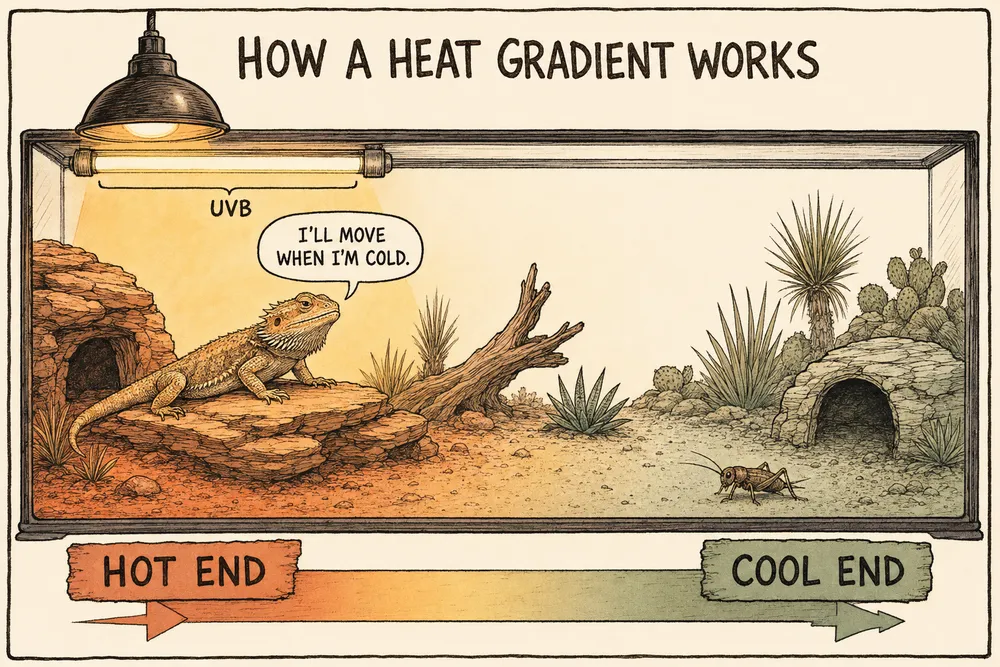
Enclosure. Adult minimum 4×2×2 ft (a 120-gallon footprint); 6×2×2 ft / 24 cu ft is the modern best-practice standard, and bigger is always better. Front-opening and well-ventilated. The 10–40-gallon “starter kit” tanks are far too small. Basking / warm zone. Basking-surface temperature 108–113°F (42–45°C), from an overhead halogen/heat cluster of at least two flood bulbs on a thermostat/dimmer — measured with a temp gun at the basking rock, not a stick-on dial. Cool side. Cool-side surface 77–85°F (25–29°C); overall air gradient ~72–99°F (22–37°C). Night. Night 55–75°F (12–24°C) — a drop to ~50°F is fine and even healthy. Lights fully off at night; no coloured “night” bulbs. UVB & lighting. Strong UVB is non-negotiable for a beardie. Use a linear T5 HO bulb (e.g. Arcadia 12% Desert or 14% Dragon) spanning roughly ½–⅔ of the enclosure, giving a UVI of 4.0–4.5 at the basking spot (and no more than 3.0 for pale/translucent or scaleless “silkback” morphs). Replace the bulb every 12 months. Humidity. Ambient humidity 30–60%, measured on the cool end. The “keep it bone-dry” rule is a myth — central Australia isn’t bone dry, and too-low humidity causes its own problems. Substrate. A naturalistic, burrowable soil/sand mix packed 4–6″ deep is ideal — and, done right, it does NOT cause impaction. Impaction usually traces to husbandry (too-cool temps → poor digestion), not to loose substrate itself. Avoid dusty artificial “calci-sand”, and skip loose substrate for unwell dragons. Diet. Omnivore whose ratio flips with age: babies eat mostly insects (as much as they’ll take, daily) plus greens; adults flip to mostly greens daily with head-sized insects only ~2×/week. Insects no larger than the space between the eyes. Fruit is a rare treat, not a staple. Full Bearded Dragon guide → Is this normal? →
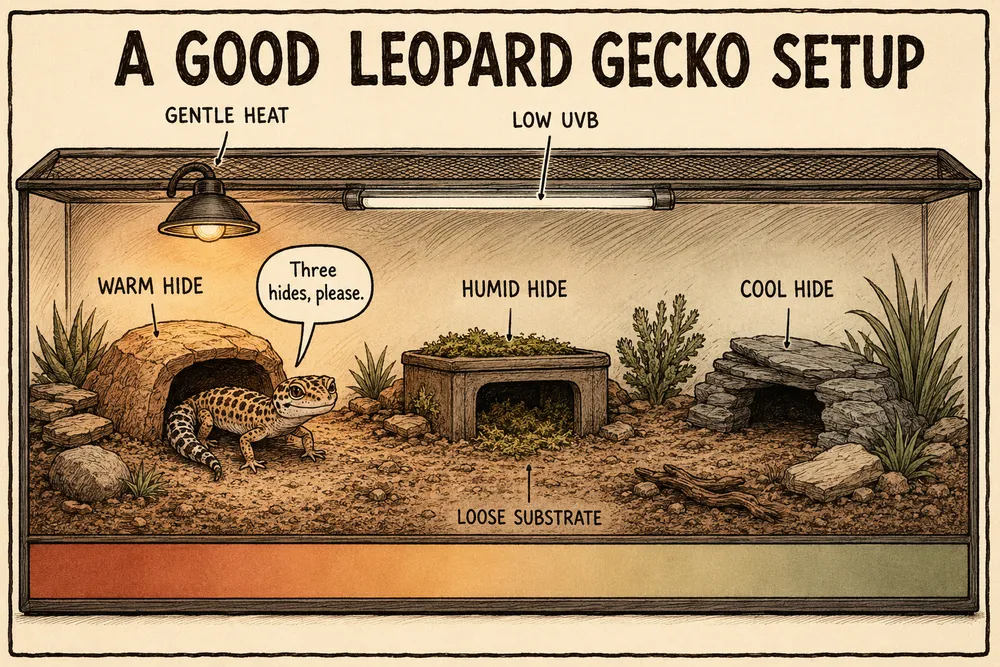
Enclosure. Adult minimum 36×18×18 in (≥4.5 sq ft of floor); bigger is better. A front-opening enclosure with three hides (warm, cool, and a humid hide) suits them well. Basking / warm zone. A warm basking surface of 94–97°F (34–36°C), with a warm hide around 90–92°F so the gut gets the heat it needs to digest — provided by overhead heat, not a dangerous belly heat-rock. Cool side. Cool side 70–77°F (21–25°C). Night. Night can fall to room temperature; no coloured night bulbs (a light-on-at-night disrupts them). UVB & lighting. Low-level UVB is now recommended (the old "leos don't need UVB" line is outdated): UVI ~0.5–1.5 at the basking spot for normal morphs, and a gentler 0.5–0.7 for pale/albino/less-pigmented morphs, which are light-sensitive. Ferguson Zone 1. Humidity. Ambient 30–40%, plus a dedicated humid hide at 70–80% so they can shed cleanly. Substrate. A naturalistic loose mix (e.g. ~60% organic topsoil / 30% play sand / 10% excavator clay), packed ≥4″ deep, actually suits their digging — and, done right, is not the impaction bogeyman. Paper towel or tile works for quarantine. Avoid dusty calci-sand. Diet. Strict insectivore — no fruit, veg, or meat. Juveniles daily; young adults every other day; adults whose tail is fatter than their neck every ~5 days. Feeder insects no larger than the space between the eyes. Don't leave loose feeders in overnight — crickets nibble sleeping geckos. Full Leopard Gecko guide → Is this normal? →
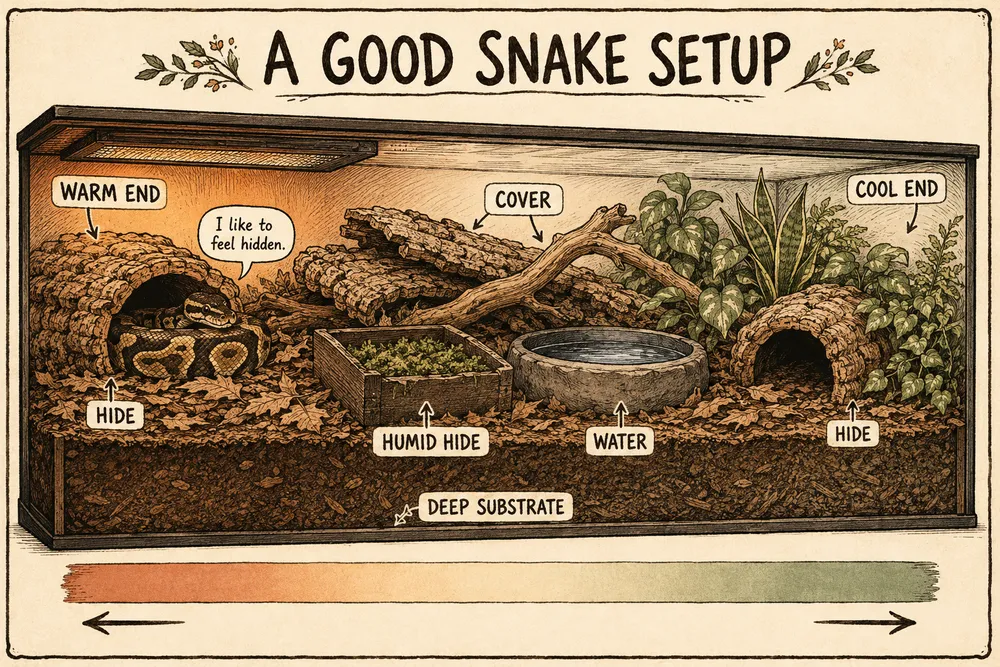
Enclosure. Adult minimum 4×2×2 ft (48×24×24 in, a 120-gallon footprint), ≥2 ft tall. A tight-fitting, locking lid is essential — corn snakes are legendary escape artists. Basking / warm zone. Basking/warm surface 90°F (32°C) from an overhead heat source, on a thermostat. Cool side. Cool side ~75–82°F (24–28°C), giving a full thermal gradient with hides on both ends. Night. Night at room temperature (~75°F/24°C is fine); no coloured night bulbs. UVB & lighting. UVB is recommended: a T5 HO bulb giving UVI 2.0–3.0 at the basking spot (Ferguson Zone). Replace yearly. Humidity. Ambient 65–75% — more than the old bone-dry caresheets suggested; helps with clean shedding. Substrate. Aspen, cypress mulch, coconut fibre, or a topsoil/coco mix hold up well. Avoid pine and cedar. Keep moist enough to support the humidity range. Diet. Carnivore — appropriately-sized frozen/thawed mice (about the width of the snake at its thickest). Frequency by size: hatchlings every 5–7 days, juveniles every 7–10, subadults every 10–12, adults every 14–21 (older adults ~10–14). Full Corn Snake guide → Is this normal? →
Enclosure. Big — they’re thick-bodied, active ground-dwellers. Provide at least 12 sq ft of floor space (a 4×3 ft footprint or larger) and 18–24 in of height (24 in if lights are mounted inside). The old “4×2×2 ft” standard is now considered too small; bigger is better. Basking / warm zone. A proper hot basking surface of 100–105°F (38–41°C) from overhead heat on a thermostat — they are diurnal baskers like a bearded dragon. The Northern, Eastern and Tanimbar types (Tiliqua scincoides) like it hotter: 105–115°F (41–46°C). Cool side. Cool end / ambient ~75–85°F (24–29°C) for Indonesian types; Australian types run a touch cooler. Night. Night ~65–75°F (18–24°C) — a natural drop is fine. UVB & lighting. Strong UVB is needed (a diurnal basker): a linear T5 HO bulb giving a UVI of 3.0–4.0 at the basking area, spanning much of the enclosure (Arcadia Forest 6% for Indonesian types, Desert 12% for Australian). Replace every 12 months. Humidity. SUBSPECIES-DEPENDENT, and the spec people get most wrong. Indonesian types (Merauke, “Classic”, Halmahera, Kei, Tanimbar) want 60–80%; Northern 40–60%; Australian (Centralian, Western, Blotched) 20–50%. Identify your subspecies and match it. Substrate. A deep, burrowable substrate (they dig): a soil/coco mix that holds humidity for Indonesian types, drier for Australian types. Diet. OMNIVORE — the defining feature, and the key to success. Feed as much variety as possible: protein (insects, snails, eggs, lean cooked meats), vegetables/greens, and a little fruit. A rough serving is ~1–2 tablespoons (about head-sized); juveniles eat more protein and more often, adults shift toward vegetables. Variety is everything. Full Blue Tongue Skink guide → Is this normal? →
Enclosure. Adult minimum 4×2×2 ft (48×24×24 in, a 120-gallon footprint); larger is better for these active snakes. A tight, locking lid is essential — kingsnakes are strong, determined escape artists. House ONE per enclosure: they eat other snakes and will cannibalise a cagemate. Basking / warm zone. Warm/basking surface 85–90°F (29–32°C) from an overhead heat source on a thermostat. Cool side. Cool side 70–80°F (21–27°C), giving a full warm-to-cool gradient with hides on both ends. Night. Night at room temperature (~70–75°F/21–24°C is fine); no coloured night bulbs. UVB & lighting. UVB is recommended (not strictly required — they are diurnal and benefit from it): a T5 HO bulb (e.g. Arcadia Forest 6% or Zoo Med ReptiSun 5.0) spanning about ½ the enclosure, giving UVI ~2.0–3.0 at the basking spot (Ferguson Zone 2). Replace every 12 months. Humidity. Semi-arid: ambient around 40–60%. Even so, provide a humid hide (moist sphagnum or substrate) on the cool side at all times so they stay hydrated and shed cleanly. Substrate. A naturalistic, burrowable soil/coco mix (or aspen) around 4″ deep suits them and holds a little humidity. Never cedar or pine (toxic oils). Diet. Obligate carnivore — appropriately-sized frozen/thawed rodents (about 10–15% of the snake’s body weight), thawed to 75–100°F and offered with tongs INSIDE the enclosure (feeding inside does not make snakes aggressive — that is a myth). Frequency by age: hatchlings every 5–7 days, juveniles every 7–10, adults every 10–14. Famous for eating other snakes, so keep hands smelling clean. Full California Kingsnake guide → Is this normal? →
Enclosure. Adult minimum 36×18×18 in (a 3×1.5 ft floor); bigger is better. They’re terrestrial, so floor space beats height. Provide three hides — a warm hide, a cool hide, and a humid hide. Basking / warm zone. A warm basking surface of 90–94°F (32–34°C) in the warm season, from overhead heat (with a warm hide under it) so the gut gets the heat it needs to digest — not a dangerous belly heat-rock. Cool side. Cool side 72–77°F (22–25°C). Night. Night can fall to ~72–77°F in the warm season. Keepers who run an optional cooler “dry season” drop the basking area to ~79°F and nights to ~63–64°F — but keep any gecko under 6 months in warm-season conditions. UVB & lighting. Low-level UVB is recommended (they’re nocturnal — Ferguson Zone 1): UVI ~1.0–2.0 at the basking spot. They can survive on a high-D3 calcium supplement without UVB, but they do best with it. Humidity. Higher than a leopard gecko, and ideally cycled: a rainy/warm season around 70–80% by day, and a drier season around 50% by day. Whatever the season, give a humid hide (moist substrate, kept ~70%+) on the cool end at all times so they shed cleanly — retained shed on the toes and tail tip is the classic fat-tail problem. Substrate. A naturalistic, well-drained semi-arid mix packed ≥4″ deep for burrowing — e.g. ~40% topsoil / 40% play sand / 20% excavator clay. Use paper towel for quarantine and for geckos under ~6 months. Avoid dusty calci-sand. Diet. Strict insectivore — no fruit, veg, or meat. A varied, gut-loaded insect menu (crickets, dubia roaches, etc.): juveniles daily; adults every other day, or every few days for one whose tail is nicely plump. Feeders no larger than the space between the eyes; don’t leave loose insects in overnight. Full African Fat-Tailed Gecko guide → Is this normal? →
Enclosure. Floor space matters far more than height. Indoor minimum for one is 7×3.5×2 ft (about 24.5 sq ft of floor) — a small terrarium or “tortoise table” alone is not enough. An outdoor, predator-proof grazing pen is ideal whenever the weather allows. Add ~10 sq ft per extra tortoise; they’re fine kept singly. Basking / warm zone. Basking area 95°F (35°C) from an overhead halogen flood on a thermostat (avoid dimmers — they cut the beneficial infrared). Cool side. Cool zone 75–85°F (24–29°C), giving a full gradient. Night. Night 70–75°F (21–23°C); a natural drop is fine. UVB & lighting. Strong UVB is essential for a diurnal grazer: a T5 HO bulb giving UVI 3.0–4.0 in the basking area (Ferguson Zone 3–4), plus a bright ~6500K LED for daylight. Run 14 hours in summer, 10 in winter to mirror the seasons. Replace the UVB bulb every 12 months. Humidity. Ambient 40–75% — lower by day, higher at night — with a humid hide/burrow. Too-dry keeping is a main cause of a bumpy, “pyramided” shell, so don’t keep them bone-dry. Substrate. A deep, burrowable substrate they can dig into (a topsoil/coco/sand mix) that holds a little moisture. They are avid diggers and burrowers. Diet. A grazing HERBIVORE that needs a high-fibre, LOW-protein, LOW-sugar diet: mostly leafy greens, grasses, and edible “weeds” (dandelion, plantain, clover) plus flowers as treats. NOT the vegetables and fruit from the produce aisle — those are too high in protein and sugar. Fruit and the odd insect are rare treats at most. Full Russian Tortoise guide → Is this normal? →
Enclosure. A front-opening 24×24×48 in mesh cage minimum, larger preferred — they’re arboreal, so height and dense planting matter. Full-mesh suits humid climates; in a very dry home a partly solid (glass/PVC) enclosure holds humidity better. House ONE per cage — chameleons are solitary and stressed by company. Basking / warm zone. A gentle basking spot of 85°F (29°C) — the heat lamp only needs to be on for about 3 hours in the morning. They do NOT want a hot all-day basking zone. Cool side. General temperature 72–78°F (22–25°C), with a vertical gradient (warmer at the top, cooler below) so it can thermoregulate by climbing. Night. Night 55–65°F (13–18°C) — a genuine night-time drop is healthy. UVB & lighting. UVB is essential (diurnal, arboreal): a T5 HO bulb (Arcadia Forest 6% or Zoo Med ReptiSun 5.0) giving UVI ~3.0 at basking height (Ferguson Zone 3), plus a bright 6500K daylight LED for wellbeing. 12-hour photoperiod; replace the UVB bulb yearly. Humidity. Low by day, high at night: 40–50% during the day and 80–100% at night. Crucially, they drink DROPLETS, not standing water — provide water by misting morning and evening, a dripper in the afternoon, and ideally a fogger before “sunrise”. A water bowl will be ignored. Substrate. Because so much water passes through daily, most keepers run a bare floor with a drainage system rather than loose substrate (which saturates and poses an impaction risk). Live potted plants add cover and humidity. Diet. Insectivore — a varied, gut-loaded insect menu (crickets, dubia, hornworms, silkworms, black soldier fly larvae): juveniles daily, adults every 1–2 days. Veiled chameleons also nibble non-toxic live plants (pothos, hibiscus), which is normal. Full Veiled Chameleon guide → Is this normal? →
Enclosure. Minimum 5×2.5×4 ft (about 12.5 sq ft of floor) for one — larger is always better, and the deep substrate below is non-negotiable. House ONE: males fight (sometimes fatally) and females often clash too. Basking / warm zone. A very hot basking SURFACE of 158–172°F (70–78°C) — the monitor hallmark, made with a tight cluster of halogen floods and measured with a temp gun at the basking rock. Warm ambient air 84–100°F (29–38°C). Cool side. Cool side 75–82°F (24–28°C). A real cool retreat is vital — an ackie that can’t escape the heat can die of heat stroke even with a correct basking temperature. Night. Night at room temperature (a drop is fine); no coloured night bulbs. UVB & lighting. Strong UVB for a diurnal high-basker: a T5 HO bulb (Arcadia Desert 12%) giving UVI ~3.0–4.0 at basking height (Ferguson Zone 3–4), plus a bright 6500K daylight LED. Replace the UVB bulb yearly. Humidity. Dry AIR (ambient 20–50%) but a humid BURROW: the deep substrate is kept moist near the bottom so it holds 80%+ humidity down where the ackie digs. This dry-air / humid-burrow split is the key to ackie hydration. Substrate. DEEP and burrowable — at least 12″ for males and 18″ for females — of a soil/sand mix that packs and holds a tunnel, kept moist at the bottom. Burrowing is essential for hydration, thermoregulation, and security. Diet. Carnivore, primarily insectivorous: a large volume of varied gut-loaded insects (dubia, crickets, roaches), plus occasional whole prey (a pinky/fuzzy, egg) and lean meats. They’re voracious and food-motivated, so obesity from overfeeding is common — feed to body condition, not to appetite. Full Ackie Monitor guide → Is this normal? →
Enclosure. Adult minimum around 6×3×3 ft (per the Federation of British Herpetologists’ 2022 code) — realistically a custom, room-scale build, and bigger is better. House one per enclosure. Basking / warm zone. A hot basking SURFACE of 125–135°F (52–57°C) from an overhead halogen flood (they take heat from above). Warm side 90–95°F (32–35°C). Cool side. Cool side 75–85°F (24–29°C), giving a full gradient across a large enclosure. Night. Night 68–74°F (20–23°C) — turn all heat and light off at night for a healthy drop. UVB & lighting. Strong UVB (a diurnal basker): a T5 HO bulb giving UVI 3.0–4.0 at the basking surface (Ferguson Zone 3–4), spanning about half the enclosure, on for 12–14 hours. Replace every 12 months. Humidity. High: ambient 70–80%, with a humid hide/burrow at 90–100% (damp sphagnum, refreshed to prevent mould). Deep moist substrate is how tegus stay hydrated and shed cleanly. Substrate. A deep, moist, burrowable substrate — 12–24″ of a soil/coco mix (at least on one side) that holds a tunnel. Tegus are strong burrowers, and it’s where they brumate. Diet. An OMNIVORE whose ratio shifts with age. In the first year they need a high-protein diet (~90% protein — insects, whole prey, lean meats, egg — and ~10% vegetables) to fuel fast growth; adults move toward a more balanced mix with more vegetables and some fruit. Feed variety, and feed adults to body condition (obesity is common). Full Argentine Tegu guide → Is this normal? →
Enclosure. Big: an absolute minimum of 8×4×4 ft (about 32 sq ft of floor) for one adult, and bigger is genuinely better — this is a roaming, active animal. A glass tank is not enough; most keepers build a custom enclosure. House ONE per enclosure. Basking / warm zone. A large, intensely hot basking SURFACE of roughly 130–150°F (55–66°C) — the monitor hallmark — from a tight cluster of halogen floods, measured with a temp gun at the basking surface (not air temperature). It needs a broad hot zone big enough to warm its whole body. Cool side. Cool side 75–85°F (24–29°C). A real cool retreat is essential — a monitor that can’t escape the heat can suffer heat stroke. Night. Night no lower than about 72°F (22°C); a mild drop is fine, but add gentle background heat if the room is cold. UVB & lighting. Strong UVB for a diurnal open-habitat basker: a T5 HO bulb (Arcadia Desert 12% or Zoo Med ReptiSun 10.0) giving UVI ~3.0–4.0 at basking height (Ferguson Zone 3), plus bright daylight LED. Replace the UVB bulb yearly. Humidity. Moderate ambient humidity (40–60%) but — as with the ackie — the real key is a deep, MOIST burrow. The bottom of the substrate is kept damp so it holds high humidity down where the monitor digs and sleeps. Dry air over a humid burrow is how a savannah stays hydrated; kept bone-dry with no burrow, it dehydrates. Substrate. DEEP and burrowable — at least 12 in for a juvenile and 18–24 in for an adult — of a soil/sand mix that packs and holds a tunnel, kept moist near the bottom. In the wild they dig long, complex burrows; a monitor that can’t burrow is a stressed, dehydrated monitor. Diet. An insect-based CARNIVORE — not a rodent pet. Field studies of wild savannahs show a diet dominated by insects and other invertebrates, so base captive feeding on a large, varied supply of gut-loaded insects (dubia and other roaches, crickets, locusts, snails), with whole prey (the occasional egg, or a fuzzy) only as an occasional extra. OBESITY is the number-one killer: never free-feed rodents, dog food, or cat food. Growing animals eat a lot; adults eat far less — feed to a lean body condition, not to appetite. Full Savannah Monitor guide → Is this normal? →
Enclosure. Floor space is everything, and an adult outgrows any practical indoor setup. A juvenile under 10 in needs a minimum 7×3.5×2.5 ft (about 24.5 sq ft of floor) with a 6–12 in opaque front barrier to stop pacing. An adult needs a large, predator-proof OUTDOOR pen — the tortoise-length formula (8× shell long, 4× wide) works out to roughly 20×10 ft (~300 sq ft) for a 30 in adult. Walls must be strong (cinder block, not wood) and sunk ≥12 in to stop it digging out. Basking / warm zone. Basking area 100–105°F (38–41°C) for a juvenile, from an overhead halogen on a thermostat. Older sulcatas tolerate a broader range. Cool side. Ambient / cool zone 80–90°F (27–32°C), giving a full gradient. Night. Night 70–75°F (21–23°C). Outdoors, if nights drop below 50°F (10°C) it needs a heated shelter (ceramic heat emitter or radiant panel) set to 70–75°F. UVB & lighting. Strong UVB for a full-sun grazer: a T5 HO bulb (Arcadia Desert 12% or Zoo Med ReptiSun 10.0) giving a UVI of 4.0–6.0 at the basking spot (Ferguson Zone 4). Mount it warm-side, roughly half the enclosure length, and replace every 12 months. Add a bright ~6500K LED for daylight. Run ~13 h in summer, 11 h in winter. Outdoors, natural sunshine does the job for free. Humidity. Higher than "desert" suggests. Juveniles need humidity above 80% (higher at night) with a humid hide always available — chronic dryness is a leading cause of a bumpy, permanently "pyramided" shell and can be life-threatening to a baby. Adults are more resilient, but still give a humid hideout. Hatchlings are soaked in shallow 85–95°F water for 20–30 minutes daily to stay hydrated. Substrate. A deep, diggable mix — 60% organic topsoil / 40% play sand (or coco fibre / cypress mulch) — that holds a little moisture. Layer it ≥6 in deep for juveniles and up to ~24 in for adults. Sulcatas are powerful, committed diggers and burrowers. Diet. A grazing HERBIVORE built for high-fibre, LOW-protein, LOW-sugar forage: grasses and grass hay, leafy greens, and edible weeds (dandelion, clover, hibiscus, mulberry and grape leaves, opuntia cactus). Variety is the key to good nutrition. Young sulcatas eat as much as they can daily; adults get a roughly shell-sized portion daily to prevent obesity. Offer food on a tray to avoid substrate ingestion. NEVER feed fruit, and never a high-protein diet. Full Sulcata Tortoise guide → Is this normal? →
Enclosure. Floor space matters far more than height. Indoor minimum is about 22 sq ft of floor for one — an open-topped table or large enclosure, never a small terrarium. A predator-proof OUTDOOR grazing pen is ideal whenever the weather allows, with walls ~24 in above ground and sunk ≥12 in below to stop climbing and digging escapes. They’re happiest kept singly; add floor space per extra tortoise. Basking / warm zone. Basking area 95–100°F (35–38°C) from an overhead halogen flood on a thermostat (some vets suggest a slightly lower 90–95°F). Cool side. Cool/shaded zone 75–85°F (24–29°C), giving a full gradient. Night. Night below ~72°F (22°C); a natural drop is fine and healthy. UVB & lighting. Strong UVB is essential for a diurnal grazer: a T5 HO 12% bulb (Arcadia Desert 12% or Zoo Med ReptiSun 10.0) giving UVI 3.0–4.0 in the basking area (Ferguson Zone 3), mounted at the maker’s recommended height (~17–18 in above the shell), plus a bright ~6500K LED for daylight. Run ~14 hours in summer, 10 in winter. Replace the UVB bulb every 12 months. Humidity. Adults 40–60%; hatchlings higher at 60–80%, with daily misting or a shallow soak — too-dry keeping is a main cause of a bumpy, “pyramided” shell, so don’t keep a young one bone-dry. A humid hide helps. Substrate. A deep, burrowable roughly 50/50 topsoil-and-play-sand mix, no less than 6 in deep, that holds a little moisture and lets them dig. They are avid diggers and burrowers. Spot-clean daily; refresh every few months. Diet. A grazing HERBIVORE that needs a high-fibre, LOW-protein, LOW-sugar diet: mostly leafy greens, grasses, and edible “weeds” (dandelion, plantain, clover) plus flowers as treats. NOT the vegetables and fruit from the produce aisle — those are too rich. Fruit and any animal protein are, at most, rare mistakes to avoid. Full Hermann's Tortoise guide → Is this normal? →
Enclosure. A tall, front-opening 24×24×48 in mesh cage minimum, larger strongly preferred — they’re arboreal, so height and dense planting at every level matter. Full-mesh suits humid homes; in a dry climate cover two sides (or use a partly solid PVC cage) to hold humidity and add security. House ONE per cage — they’re solitary and stressed by company. Basking / warm zone. A gentle basking spot of 85–90°F (29–32°C) — usually just a couple of low-wattage bulbs, with the chameleon’s back about 6 in below the lamp. They do NOT want a hot all-day basking zone. Cool side. General temperature 72–77°F (22–25°C), with a vertical gradient (warmer at the top, cooler below) so it thermoregulates by climbing. Night. Night 60–70°F (15–21°C) — a genuine night-time drop is healthy. UVB & lighting. UVB is essential (diurnal, arboreal): a T5 HO bulb (Arcadia Forest 6%) giving UVI ~3.0 at basking height (Ferguson Zone 3), mounted ON TOP of the mesh, plus a bright 6500K daylight LED for wellbeing. 12-hour photoperiod; replace the UVB bulb yearly. Humidity. Lower by day, high at night: 50–60% during the day and 75–100% at night. Crucially, they drink DROPLETS, not standing water — mist morning and evening, run a dripper in the afternoon, and ideally a fogger before “sunrise”. Use distilled water to protect equipment and plants. A water bowl will be ignored. Substrate. Because so much water passes through daily, most keepers run a bare floor with a drainage system rather than loose substrate (which saturates and poses an impaction risk). Live potted plants add cover and humidity. Diet. Insectivore — a varied, gut-loaded insect menu (crickets, dubia and red-runner roaches, black soldier fly larvae, hornworms, silkworms): juveniles eat as much as they can daily; adults take about 5 insects every other day. Variety is the key to good nutrition. Gut-load feeders 24–48 hours before offering. Full Panther Chameleon guide → Is this normal? →
Enclosure. A tall, front-opening mesh cage — 24×24×48 in works well for an adult, larger preferred. Mesh is ideal because it lets the enclosure DRY OUT between mistings; in a very dry home a partly solid (glass/PVC) cage holds humidity better. House ONE per cage — they’re solitary and stressed by a rival in view. Basking / warm zone. A LOW basking spot of about 80–83°F (27–28°C) — Jackson’s are montane and must NOT overheat. A small heat bulb is plenty; the cooler-running subspecies want a basking spot nearer 79°F. Cool side. Shade/general temperature 68–72°F (20–23°C), with a vertical gradient so it thermoregulates by climbing. Night. A genuine cool night drop to 50–59°F (10–15°C) is important — this is a mountain species, and the cool night matters to its health. UVB & lighting. UVB is essential (diurnal): a T5 HO bulb (Arcadia Forest 6% or ShadeDweller 7%) giving UVI 3.0–4.0 at basking height (Ferguson Zone 3), plus bright 6500K daylight lamps for wellbeing. 12-hour photoperiod; replace the UVB bulb yearly. Humidity. NOT constant high humidity — that myth kills Jackson’s chameleons. In the wild humidity is up to ~100% at night but falls to around 30% during the day, so the enclosure must DRY OUT by day. Mist heavily morning and afternoon (or run an automatic misting system) and let it dry between; they drink the droplets, not from a bowl. A fogger can add cool night humidity. Substrate. Because so much water passes through daily, most keepers run a bare floor with a drainage system rather than loose substrate (which saturates and poses an impaction risk). Live potted plants add cover and humidity. Diet. Insectivore — a varied, gut-loaded insect menu (crickets, black soldier fly larvae, silkworms, flying insects): juveniles daily, adults about 6–8 medium/large insects every other day. Avoid fireflies, wild-caught insects, and adult roaches (high uric acid → gout). Variety matters — a single-food staple is outdated. Full Jackson's Chameleon guide → Is this normal? →
Enclosure. Small and VERTICAL: 2–3 adults do well in a 12×12×18 in (30×30×45 cm) planted arboreal tank — roughly a 10-gallon on its end — adding about 5 gallons of space per extra 2 geckos. They are arboreal, so height and dense planting matter more than floor space. Seal every gap: they are minute escape artists that climb glass and hang upside-down from the mesh. Basking / warm zone. A gentle warm spot of 80–85°F (26–29°C) at the top of the tank from a low-wattage bulb — NOT the "no heat, room temperature is fine" myth. Consistently above 85°F risks heat stroke. Cool side. Cooler lower zone 70–75°F (21–24°C), giving a vertical gradient. Consistently at or below 72°F causes lethargy and poor appetite. Night. Night 65–72°F (18–22°C) — a natural drop is fine. UVB & lighting. UVB is beneficial even though they’re often kept without it — it noticeably helps healthy growth, especially in hatchlings. A low-output T5 HO bulb (Arcadia ShadeDweller 2.4%) giving UVI 1.0–3.0. Because they bask upside-down right against the top mesh, pick a bulb rated safe at that short distance. Replace yearly. Humidity. Ambient 60–70%, spiking to 80–90% after misting, then allowed to dry back to 50–60% before you mist again (constant wetness grows mould). Mist 1–2× daily depending on ventilation. Live plants help hold humidity and give the colony cover. Substrate. A moisture-holding bioactive-style mix (topsoil / coconut fibre) topped with leaf litter, planted with pothos and other sturdy climbers. For an arboreal micro-gecko the vertical cover matters more than the floor. Diet. Easy: a complete powdered crested-gecko diet (CGD) as the base — keep a few flavours/brands on hand — plus small live insects (fruit flies, pinhead crickets, small roaches) a couple of times a week for enrichment and protein. They lap CGD from a ledge dish and hunt the insects at dusk. Full Mourning Gecko guide → Is this normal? →
Enclosure. Minimum 24×12×12 in (60×30×30 cm) for an average sand boa — floor space matters far more than height, since they burrow rather than climb. A secure lid still matters. House ONE per enclosure. Basking / warm zone. Warm/basking surface 93–95°F (34–35°C) from an overhead halogen (two low-wattage bulbs heat a coiled body more evenly). Put the warm hide directly under the basking spot so it can thermoregulate while staying buried. Cool side. Cool zone 78–83°F (26–28°C), giving a full warm-to-cool gradient. Night. Heating off at night; a natural room-temperature drop is fine. No coloured night bulbs. UVB & lighting. UVB isn’t strictly required but is beneficial (they’re crepuscular): a low-output T5 HO bulb (about half the enclosure length, warm side) giving UVI 2.0–3.0 at the basking spot. Replace every 12 months. Humidity. An ARID species — keep it mostly dry, and humidity is generally not something to fuss over. Provide ONE humid hide (a box of lightly moist substrate or sphagnum on the cool side) for shedding, and mist occasionally, but otherwise let the enclosure stay dry. Chronic damp causes scale and respiratory problems. Substrate. The heart of the setup: at least 3–4 in (deeper is better) of loose, burrowable sand or sandy soil (a 60% topsoil / 40% play-sand mix works well). They submerge and travel through it, so it must be deep and loose enough to disappear into. Spot-clean daily; full refresh every few months. Diet. Carnivore fed whole prey — an ambush hunter that strikes from under the sand. Feed appropriately-sized prey (roughly the width of the snake’s thickest point): juveniles every 1–2 weeks, adults every 2–4 weeks. Mice are the staple, but variety (young rats, quail, chicks) makes for a healthier, less picky snake. Offer frozen/thawed, warmed to ~90°F. Full Kenyan Sand Boa guide → Is this normal? →
Enclosure. Sized to the snake (rule of thumb: length × ½ length × ½ length). An adult of 6–8 ft needs a minimum 6×3×3 ft; a large adult over 8 ft needs 8×4×4 ft. They are SEMI-ARBOREAL, so give real height and sturdy branches as well as floor space. Large enclosures are hard to buy — many keepers build their own. House ONE. Basking / warm zone. Warm/basking surface 86–90°F (30–32°C) from an overhead heat source — a ≥2-bulb halogen cluster over a proper-size enclosure heats a big coiled body far better than a single bulb or a heat mat. Cool side. Cool end 75–80°F (24–26°C), for an overall 75–90°F thermal gradient the snake can move through. Night. Night can fall to about 68°F (20°C). Boas benefit from a seasonal cool-down even if you never breed — a cooler, shorter-day winter (down to ~75–78°F) is natural for them. UVB & lighting. UVB is beneficial (increasingly recommended, though not strictly required): a T5 HO bulb (Arcadia 6%) giving UVI 2.0–3.0 at the basking spot, at the correct Ferguson-zone distance. Replace every 12 months. Humidity. Ambient 55–75%, rising to 75–85% during a shed for a clean, one-piece slough. Mix water into a deep substrate (don’t just pour) or use a cool-mist fogger; avoid a chronically wet, stale enclosure. Substrate. A moisture-holding mix at least 2–3 in deep (deeper is better) — a topsoil / coconut-fibre / play-sand blend holds humidity and lets them burrow, which they occasionally do. Never cedar or pine (toxic oils). Diet. Carnivore fed whole prey — appropriately-sized frozen/thawed rodents (and, for variety, the occasional chick or quail). Boas are NOT stretchy like pythons: a correct meal leaves only a subtle lump, and oversized prey causes dangerous regurgitation. Feed on an infrequent, varied schedule and adjust to body condition — slow feeding is linked to boa longevity, and power-feeding causes obesity. Full Boa Constrictor guide → Is this normal? →
Enclosure. Minimum 24×18×18 in (60×45×45 cm) for one, densely planted with lots of cover and leaf litter, PLUS a larger-than-usual water area it can climb into and soak. They are shy and semi-fossorial, so hides and clutter matter enormously. Best kept singly or as a single male–female pair — males will fight. Basking / warm zone. A gentle warm hide / basking area of 80–82°F (27–28°C) from a low-wattage bulb — this is a cool-running forest species, not a hot basker, so it must not overheat. Cool side. Cool zone 75–78°F (24–26°C). Night. Night 72–75°F (22–24°C) — a mild drop is fine. UVB & lighting. UVB isn’t strictly required (they’re nocturnal) but is beneficial: a low-output T5 bulb (Arcadia ShadeDweller) giving UVI 1.0–2.0 at the top of the enclosure. If you skip UVB you MUST supplement vitamin D3 — UVB is the better route. Replace the bulb yearly. Humidity. HIGH and moisture-dependent — 70–80% by day, rising to 80–100% at night. Mist morning and evening (and often midday), run a fogger at night, and keep a deep moist substrate. This is the single biggest difference from an arid skink: kept dry, a crocodile skink dehydrates and does poorly. Substrate. A moisture-retentive, burrowable mix (a bioactive-style soil/coco blend) at least 2–4 in deep, topped with leaf litter and cork for cover. It holds the humidity and gives them somewhere to hide and dig, which lowers stress. Diet. Insectivore — a varied menu of appropriately-sized insects (crickets, dubia/discoid roaches, black soldier fly larvae, silkworms, earthworms, the occasional canned snail), each feeder roughly half the width of the skink’s head. Juveniles daily; adults every other day, offering as much as they’ll eat in about 5 minutes. Full Red-Eyed Crocodile Skink guide → Is this normal? →
Tank. Think water volume, not "a tank." The modern rule is at least 10 gallons of water per inch of shell length, so a full-grown 8-10 in turtle needs a 75-100+ gallon system, and 150-200 gallons is better. As a footprint, aim for at least 36-48 in wide and 12+ in deep. A stock tank, tortoise/Waterland tub, or 100-gallon+ aquarium beats a cramped starter kit every time. One turtle per enclosure is easiest. Water temperature. Adults/subadults: about 70-76°F (21-24°C). Juveniles: warmer, about 78-80°F (25-27°C). Hold it with a guarded submersible heater sized to the volume and verify with a separate thermometer. Water depth. Deeper than people expect: at least 1.5 times the turtle's shell length so they can swim, dive, and right themselves if flipped. Painted turtles are strong swimmers and use the whole water column, so more depth (with easy access to the dock) is better. Filtration. Turtles are messy, so over-filter: run a canister or filter rated for at least 2-3x the actual water volume in the tank (e.g. a large canister like a Fluval FX-series on a 100+ gallon system). Back it up with a partial water change of ~30% every 1-2 weeks. Basking dock. A dry, sturdy dock (rock, log, or floating platform) big enough for the turtle to haul completely out and dry off. Basking-surface temperature about 85–95°F (29–35°C) via a focused halogen/basking flood — ReptiFiles cites up to ~104°F, so give a warm dock with a clear cool side; measure it with an infrared thermometer, don't guess. Night. Turn the lamps off at night. As long as the room stays around 70-75°F (21-24°C), no night heat is needed; the water heater holds the water steady. Avoid prolonged drops much below that outside a deliberate, vet-informed brumation. UVB & lighting. A linear T5 HO UVB tube is the standard, e.g. Arcadia T5 HO 6% or Zoo Med ReptiSun 5.0 T5 HO, mounted roughly 13-14 in above the dry dock to land a UV Index of about 3.0-4.0 on the basking surface (Ferguson Zone 3). Never filter it through glass or plastic. Replace the bulb every ~6-12 months per the maker even if it still glows, since UVB output fades. Tank bottom. Bare-bottom is easiest, cleanest, and has the lowest impaction risk, ideal for beginners. If you want a natural look, use large smooth river rocks each bigger than the turtle's head so they can't be swallowed. Avoid fine gravel and loose sand, which can be ingested and cause impaction. Diet. Omnivores whose ratio shifts with age. Juveniles (under ~1 yr): roughly 50% animal protein / 50% plants, fed daily. Adults: shift toward ~25% protein / 75% plants, offering protein or a quality aquatic-turtle pellet only 2-3x/week with leafy greens/aquatic plants daily. Protein sources include pellets, feeder fish/worms, and insects; skip fatty meats and iceberg lettuce. Full Painted Turtle guide → Is this normal? →
Tank. A 20-gallon long tank is the realistic minimum for one adult, with 30+ gallons better; many keepers and bioactive guides recommend stepping up to a 40–75-gallon footprint for water quality and floor space. Footprint (length × width) matters more than height for a bottom-walking turtle — go long and wide, not tall. One turtle per tank is safest; musk turtles can be scrappy with each other. Water temperature. Filtered water at 72–78°F (22–26°C) for adults; keep hatchlings and juveniles a touch warmer, around 78–80°F (26–27°C). Use a guarded aquarium heater and a thermometer — don't guess. Water depth. Deeper than pet-store lore claims. Musk turtles are poor swimmers and prefer to walk the bottom, so provide about 8–12 in (20–30 cm) of water for an adult, with plenty of submerged rocks, wood, and plants they can climb to reach the surface for air. Hatchlings start shallower with easy footholds; increase depth as they grow. Filtration. Strong, over-rated filtration is the heart of turtle keeping. Use a canister (or robust submersible) filter rated for roughly 2–3× the tank's water volume — turtles are messy carnivores. Pair it with weekly ~25–30% water changes and a test kit; a mild current is fine and often welcome. Basking dock. A DRY, easily-climbed dock (flat stone, cork, or a commercial platform) that lets the turtle fully leave the water and dry off. Surface temperature under the basking lamp should read about 85–95°F (29–35°C) — aim for ~90°F. They bask less than sliders but absolutely still do it, so the dock is not optional. Night. Turn heat and lights off at night and let the room provide a natural drop. A cooler night in the mid-to-upper 60s°F (roughly 18–21°C) is fine and healthy; you only need supplemental night heat if your home gets genuinely cold. Water rarely swings much overnight, so no separate night heater is usually required. UVB & lighting. A linear T5 HO UVB tube (e.g., Zoo Med ReptiSun 5.0 or Arcadia 6%) in a reflective fixture, spanning part of the enclosure over the basking dock. Mount it so the basking surface reads a UV Index (UVI) of about 3.0–4.0 (roughly 13–14 in / 33–36 cm above the dock, farther if there's mesh between). Run it 10–12 hours a day and replace the tube about every 12 months, as UVB output fades before the light does. Tank bottom. Optional. Bare-bottom is the easiest to keep spotless. If you want a naturalistic look, use fine sand or smooth river rock too large to swallow — avoid small/medium gravel, which musk turtles can ingest while foraging. A bioactive soil base under stone works for experienced keepers. Diet. Predominantly carnivorous. Base the diet on a quality aquatic-turtle pellet (Mazuri Aquatic Turtle Diet, ReptoMin) plus varied protein: earthworms, snails, crickets, ghost/frozen shrimp, and small pieces of fish. Feed juveniles daily; feed adults every other day (or 3–4×/week) to prevent obesity. Adults will also nibble aquatic plants. Skip wild-caught snails/insects (parasite and pesticide risk). Full Common Musk Turtle guide → Is this normal? →
Tank. Minimum 100 US gallons (about 379 L) of water for a single adult, using the standard 10 gallons of water per inch of shell length rule. A 120-gallon tank (roughly 48" x 24" x 25") is a more realistic, widely available target and is what most keepers should aim for. Bigger is always better; stock tanks and large Waterland-style tubs are excellent alternatives to glass aquariums. Water temperature. Adults: 70–88°F (21–31°C). Juveniles run a bit warmer (around 74–76°F) and hatchlings warmer still (about 78–82°F / 24–29°C). Use an aquarium heater rated for your full water volume, guarded so the turtle can't crack or burn against it. Water depth. At least as deep as the turtle's shell is long, and preferably deeper. These are strong, active swimmers that dive and forage, so give them a genuine water column, not a puddle, as long as they can always reach the basking dock and the surface easily. Filtration. Turtles are messy, so oversize your filter: a canister filter rated for at least 2–3x your actual water volume is the working standard (many keepers go 3–4x). For a ~100–120 gallon tank that means a canister rated in the 300–400+ gallon range. Even with strong filtration, do a partial water change of roughly 30% every 1–2 weeks and clean the filter monthly. Basking dock. A large, sturdy DRY dock or platform (big enough for the whole turtle to climb fully out and dry off) positioned under the heat lamp, with a basking surface temperature of about 104°F (40°C). Air temperature just above the basking spot should sit around 85–90°F (30–32°C). An easy climb-out ramp is essential. Night. Lights and heat lamp off at night is fine, and the basking area can cool to room temperature. Many keepers turn the water heater off overnight and back on in the morning for adults; keep hatchlings on consistent warmth instead. Don't let the room get cold-drafty. UVB & lighting. A linear T5 HO UVB tube is the standard, such as a Zoo Med Reptisun 5.0 (T5 HO) or Arcadia Forest 6% (T5 HO). Yellow-bellied/pond sliders fall in Ferguson Zone 3; aim for a UV Index of 3.0–4.0 on the basking surface. Mount a 5.0/6% bulb about 11–13" (28–33 cm) above the basking spot (further for stronger 10.0/12% bulbs), never closer than 10". The bulb should span 50–75% of the tank length. Replace T5 HO tubes about every 12 months, and run lights 11–13 hours/day (shorter in winter, longer in summer). Tank bottom. Bare-bottom is the easiest and cleanest option for an adult tank and makes water changes simple. If you want a naturalistic look, large smooth river stones (too big to swallow) or a play-sand shoreline area work; avoid small gravel, which turtles can ingest. Diet. Omnivore with a lifelong shift: hatchlings and juveniles are mostly carnivorous (insects, worms, small fish, crustaceans), while adults become predominantly plant-eating. Base the captive diet on a quality aquatic-turtle pellet plus lots of leafy greens and aquatic plants, with protein (feeder insects, earthworms, occasional fish) a smaller share for adults. Feed juveniles daily; adults a portion every 2–3 days. Full Yellow-Bellied Slider guide → Is this normal? →
Tank. Minimum 90–110 gallons of water for one adult. A single juvenile can start smaller, but budget for the full-size tank — a 4-foot-plus footprint that holds 90+ gallons — because they grow into it fast and never stop needing the swim room. One turtle per enclosure is safest. Water temperature. 75–80°F (24–27°C) for adults; keep it no cooler than 70°F and under 85°F. Hatchlings and juveniles do best a touch warmer, around 80–85°F. Water depth. Deep enough to swim freely — a good rule is no deeper than about 1.5× the turtle's shell length, so an adult wants roughly a foot or more of water. They're strong swimmers, so more depth (with easy access to the surface and the dock) is better than a shallow puddle. Filtration. A powerful external/canister filter rated for at least 2–3× the tank's actual water volume — turtles are messy, high-waste animals and undersized filtration is the #1 reason tanks go foul. Pair it with a partial water change of about 30% every 1–2 weeks. Basking dock. A dry, stable dock (haul-out platform or floating basking area at least as big as the turtle) kept warm by an overhead basking bulb, with the basking surface at around 95°F (35°C). It must be genuinely dry so the shell can fully dry out between swims. Night. Lights and basking heat off at night is fine as long as the room (and therefore the water) doesn't drop below the low 70s°F. Keep water no cooler than about 70°F (21°C) at any time. UVB & lighting. A linear UVB tube over the basking dock — Zoo Med ReptiSun T5 HO 5.0 or Arcadia Forest 6% — in a reflector, mounted roughly 13–14 inches above the basking platform. Run ~12 hours a day and replace the bulb every 12 months (UVB output fades long before the light looks dim). Tank bottom. Bare-bottom is easiest to keep clean and safest (no impaction risk). If you want a planted, natural look, use large river rocks too big to swallow or a fine sand bed; avoid gravel small enough to be eaten. Diet. Omnivore, and in the wild an opportunistic one — aquatic insects, crustaceans, snails, small fish, plus some plant matter. In captivity, feed a quality aquatic-turtle pellet as the base plus protein (earthworms, insects, occasional whole small fish) and leafy greens/aquatic plants. Young turtles (under ~1 year) run about 50% protein / 50% plants; adults shift to roughly 25% protein / 75% plants, with the protein offered only 1–2 times a week. Full African Sideneck Turtle guide → Is this normal? →
Tank. Think in swimming volume, not floor space. A single male needs a 75-gallon tank minimum; a single female needs a 125-gallon tank minimum (Austin's Turtle Page). A common rule of thumb is at least 10 US gallons of water per inch of adult shell length. Bigger is always better for these active swimmers — hatchlings can start in a 20-gallon long, but plan for the adult tank from day one. Water temperature. 72-76°F (22-24°C) for adults and sub-adults; hatchlings and small juveniles do better a bit warmer at 78-80°F (26-27°C). A submersible aquarium heater (guarded so the turtle can't crack or burn on it) holds it steady. Water depth. As deep as you can give them — map turtles are powerful, confident swimmers who thrive in deep, open water. Hatchlings start shallower at about 4-6 in with plenty of easy resting spots and structure to climb, then go progressively deeper as they grow. Always provide submerged rest ledges so they can pause without a hard swim to the surface. Filtration. Heavy filtration is essential — these are clean-water river turtles and they're messy eaters. Use a canister filter rated for at least 2x the tank's actual water volume (turtle keepers routinely over-filter). Strong flow also oxygenates the water, which map turtles appreciate. Do partial water changes weekly regardless of filter size. Basking dock. A completely dry basking dock (floating platform, cork slab, or above-water ledge) they can climb fully out onto and drip-dry. Map turtles are "aggressive baskers", so make it easy to reach and stable. Basking-surface temperature ~95–100°F (35–38°C), up to ~110°F at the hottest point for large adults (per Austin's Turtle Page), always with a cool side to move to. Night. Lights and basking heat off at night is fine. Room temperature down to the mid-60s°F (around 18°C) is acceptable as long as the water stays in range; if the room gets cold, the water heater keeps the tank stable overnight. UVB & lighting. Real UVB is non-negotiable. Use a linear T5 HO tube — Zoo Med ReptiSun T5 HO 5.0 or Arcadia Forest 6% — running the length of the basking end (about 50-75% of the tank length). Like the closely related slider (Ferguson Zone 3), aim for a UV Index of about 3.0-4.0 on the dry basking surface. Mount a 5.0/6% tube roughly 11-13 in (28-33 cm) above the platform (a 10.0/12% tube goes higher, 17-21 in), never closer than 10 in, and never behind glass or fine mesh — glass blocks ~95% of UVB and mesh ~30%. Replace the tube every 12 months even if it still glows. Tank bottom. Bare bottom is easiest to keep clean and is perfectly fine. If you want a planted, natural look, use sand or river rock/gravel that's either too large to swallow or fine enough to pass — avoid the small-to-medium gravel a turtle could gulp and impact on. Diet. Predominantly carnivorous, and mollusc-loving in particular. In the wild females crush snails, clams, and crayfish with their broad jaws while males take aquatic insects and smaller snails. In captivity, base the diet on a quality aquatic-turtle pellet (Mazuri, ReptoMin) plus whole prey — snails, earthworms, crayfish, krill, and the occasional feeder — with some leafy aquatic greens and plants offered too. Feed hatchlings daily; taper adults to protein 2-3x per week with more plant matter, to avoid overfeeding and shell/growth problems. Full Northern Map Turtle guide → Is this normal? →
Tank. Go by water volume, not "gallons of tank." The modern rule of thumb is at least 10 US gallons of WATER per inch of the turtle's adult shell length — so a 6-inch adult wants roughly 60+ gallons of water, plus extra length above the waterline for the basking dock. A single adult is happiest in a long tank at least ~90 cm (3 ft) wide. Bigger is always better; long footprint beats tall. Water temperature. 70–80°F (about 21–27°C) for a healthy active adult, held with a guarded aquarium heater. Hatchlings and sick turtles are kept at the warmer end. Water depth. Give real but not extreme depth. Minimum roughly 1.5× shell length; adults do well around 8–12 in (20–30 cm) once they're confident swimmers (Reeves are only moderately good swimmers). Hatchlings start shallow (~2 in) with easy exits until they swim strongly — too-deep water is a drowning risk for tiny turtles. Filtration. Turtles are messy; filtration is non-negotiable. Use a canister (or turtle-rated) filter rated for at least 2–3× the tank's actual water volume. Even with a strong filter, change ~30% of the water every 1–2 weeks to keep ammonia and nitrate down. Basking dock. A DRY basking dock (cork, floating platform, or stacked slate) the turtle can climb fully out onto and dry off completely. Basking-surface temperature ~85–95°F (30–35°C). It must be genuinely dry — a permanently damp shell leads to shell rot. Night. Lights and basking heat off at night is fine; this is a temperate species that tolerates a natural night drop. Let air fall to normal room temperature (roughly high 60s–low 70s°F / ~20–22°C). Keep the WATER within its daytime range with the heater; avoid letting it drop below the low 70s°F for an active (non-brumating) turtle. UVB & lighting. A linear T5 HO UVB tube running roughly half the tank length in a reflective fixture — e.g. Zoo Med Reptisun T5 HO 5.0 or Arcadia Forest 6% (higher-output ~10–12% tubes are also used over the basking area). Mount ~8–11 in above the dock if firing through mesh, ~13–15 in if unobstructed. Replace the bulb every 12 months even if it still glows (UVB output fades before the visible light does). Tank bottom. Bare-bottom is easiest to keep clean, or a thin layer of large river stones / sand too big to swallow. For any land/soil area, a semi-moist sandy soil mix (roughly 80% clean topsoil, 20% play sand) works. Avoid small gravel that can be eaten and cause impaction. Diet. Omnivore that shifts toward more plants with age. Base the diet on a quality aquatic-turtle pellet, rotated with protein (earthworms, crickets, mealworms, occasional cooked fish/shrimp) and leafy greens/aquatic plants (kale, dandelion, duckweed, water lettuce). Hatchlings: protein daily. 6–12 months: protein every other day. Adults: protein only ~2–3×/week, with greens/plants offered daily. Full Reeves' Turtle guide → Is this normal? →
Tank. A glass aquarium is the tank — this is a fully aquatic setup, not a dry vivarium. Modern best practice for one adult is about 75 gallons, roughly 48"L × 18"W × 21"H, which gives a weak swimmer real room to forage. A 40-gallon breeder is the practical floor for a single small adult, but bigger is always better and easier to keep clean. House only one; never keep two males together. Water temperature. 75–78°F (24–26°C) for adults, held steady with a guarded aquarium heater; keep it below ~85°F. Hatchlings a touch warmer (low 80s °F). Always use a thermometer — never guess. Water depth. Moderate depth. Eastern Mud Turtles are only modest swimmers, so keep water roughly twice the turtle's shell length — about 8–10 in for a small adult — with gentle slopes or plants so it can always reach the surface and haul out easily. Filtration. A canister or large hang-on-back filter rated for at least 2–3× the tank's actual water volume — turtles are messy and produce a lot of waste. Even with strong filtration, change about 25–30% of the water every 1–2 weeks and keep the flow gentle, since this species prefers calm water over strong current. Basking dock. A dry basking dock — a floating platform, cork bark, or a stacked rock/log ramp that lets the turtle climb fully out and dry off completely. Aim for a surface temperature of about 85–90°F (29–32°C) directly under the heat lamp, measured with a probe or IR thermometer on the dock itself. Even though Eastern Mud Turtles bask less than sliders, the dry, warm dock is non-negotiable for shell health. Night. Lights and basking heat off at night. Room temperature down into the high 60s to low 70s °F is fine as long as the heated water stays in its normal range; no separate night heat source is needed indoors at normal household temperatures. UVB & lighting. A linear T5 HO UVB tube such as a Zoo Med ReptiSun T5 HO 5.0 or Arcadia Forest 6%, run over the basking dock for 10–12 hours a day. Mount it in a reflective fixture at the manufacturer's distance for the basking zone (roughly 6–9 in with a mesh screen, farther without). Replace the bulb every 6–12 months — UV output fades long before the light stops glowing. Tank bottom. Bare-bottom is easiest to keep clean and perfectly acceptable. If you prefer a planted, natural look, use a layer of smooth, large river gravel too big to swallow, or fine sand for a species that likes to nose along the bottom. Avoid small gravel that can be gulped and cause impaction. Diet. Omnivore, leaning carnivorous, and a bottom-forager by nature. Base the diet on a quality aquatic-turtle pellet, rotated with protein like earthworms, snails, small feeder invertebrates, and occasional bits of fish or thawed shrimp, plus leafy greens (dandelion, collard, mustard greens) offered in the water. Feed juveniles daily; feed adults a protein meal every other day with greens available in between. Only offer what's eaten in about 15–20 minutes. Full Eastern Mud Turtle guide → Is this normal? →
Tank. The rule is 10 gallons of water per inch of shell length (a 4 in turtle → 40 gal; a 12 in adult → 120 gal). Because they reach dinner-plate size, buy the adult-size setup from the start: a 100 US gallon (379 L) minimum, ideally 120–125 gal, or an indoor/outdoor pond. Water is extremely heavy — a 100 gal glass tank of water weighs ~830 lb (377 kg), so set it up on a ground floor or basement that can take the load. Water temperature. Water 78–82°F (24–29°C), warmer for hatchlings and unwell turtles. Use a guarded aquarium heater on larger setups. Water depth. At least as deep as the turtle is long (deeper is better) so it can swim freely and right itself if it flips — never keep a slider in shallow "dish" water. Filtration. A powerful canister filter rated for at least 2–3× the water volume — ordinary aquarium filters are sized for tidy fish, and turtles are far messier. Back it up with regular partial water changes; dirty water is a direct cause of shell and eye infections. Basking dock. A dry haul-out dock big enough to fit the whole turtle out of the water, with a stone surface (flagstone is ideal — it warms evenly), heat and UVB mounted directly above. Basking-surface temperature 104°F (40°C), from an overhead halogen. The turtle must be able to climb fully out and dry off completely. Night. Turn the basking lamp and UVB off at night. The large water volume holds heat well, so a natural night-time drop is fine and no night heat is needed in a normally-heated room. UVB & lighting. Strong UVB is essential for a diurnal basker: a T5 HO bulb giving a UVI of 3.0–4.0 at the basking surface (Ferguson Zone 3), running 50–75% of the enclosure length and mounted ≥10 in above the dock alongside the heat lamp. Replace every 12 months. Real sunshine in an outdoor pond is ideal (never filtered through glass). Tank bottom. Bare-bottom is easiest and safest to keep clean. If you want a planted look, use large smooth river stones too big for the turtle to swallow — avoid small gravel, which turtles eat and can become impacted on. Diet. An OMNIVORE whose ratio flips with age. Under 1 year: roughly 50% animal protein / 50% vegetables — protein and greens daily, turtle pellets every other day. Over 1 year: roughly 25% protein / 75% vegetables — protein only 1–2×/week, leafy greens daily, pellets 2–3×/week. Pellets should be no more than ~25% of the diet. Variety is the key to good nutrition, and they eat in the water. Full Red-Eared Slider guide → Is this normal? →
Enclosure. A TALL, planted, front-opening enclosure — minimum 24×24×24 in (60×60×60 cm) for one, larger preferred — because they’re semi-arboreal climbers that live up in the foliage. Pack it with branches, vines, and live or artificial plants to climb and hide in. House ONE (or a single male with females); males fight. Basking / warm zone. A basking spot of 90°F (32°C) from an overhead heat bulb, placed over a branch up in the canopy where the anole will bask. Cool side. Cool side 70–77°F (21–25°C), with a vertical gradient it can climb through. Night. Night 65–75°F (18–24°C) — a natural drop is fine. UVB & lighting. UVB is essential (diurnal, sun-loving): a T5 HO bulb (Arcadia Forest 6%) giving UVI ~3.0–4.0 at the basking branch (Ferguson Zone 3), plus a bright daylight LED. 14-hour summer / 10-hour winter photoperiod; replace the UVB bulb yearly. Humidity. Average 60–70%, achieved by misting the enclosure morning and evening — anoles drink the droplets off leaves and will largely ignore a standing bowl, so misting is their main water source. A night fogger helps in dry homes. Live plants hold humidity and give cover. Substrate. A moisture-holding, bioactive-style mix (topsoil/coconut fibre) with leaf litter and live plants — it holds humidity and supports the planting that makes an anole feel secure. Vertical cover matters more than floor space. Diet. Insectivore — a varied menu of small feeders (crickets, dubia/discoid/red-runner nymphs, flightless fruit flies, black soldier fly larvae): juveniles eat as much as they’ll take daily; adults take 2–3 feeders, each slightly smaller than the anole’s head, every other day. Gut-load feeders 24–48 hours first. Full Green Anole guide → Is this normal? →
Enclosure. Roomy for an active diurnal forager: about 48×24×24 in (120×60×60 cm) for an adult, at least 18 in tall for safe lighting and climbing terrain. Unusually for a snake, garters CAN be group-housed (it can even lower stress in juveniles) — but each extra snake needs significantly more space. Basking / warm zone. Basking area 85–90°F (29–32°C) from an overhead halogen over a flat basking rock or plank. Two bulbs make an even basking zone. Cool-side air above 91°F (33°C) is dangerous — garters overheat and can die of heat stroke. Cool side. Cool side 75–80°F (23–27°C), giving a full gradient. Night. Night 64–75°F (18–24°C); heat off at night. A winter cool-down to ~60–68°F by day is natural for them. UVB & lighting. UVB is beneficial for a diurnal, day-active snake: a T5 HO bulb (Arcadia Forest 6%) giving UVI 2.0–3.0 at the basking spot. Replace every 12 months. Humidity. Average 35–60% — higher on the cool end and at night, lower on the warm end. Consistently too damp or too dry causes problems, but the big water basin (below) does most of the humidity work. Substrate. A moisture-retentive, burrowable mix (aspen is too dry-only; a topsoil/coco blend or a bioactive mix suits them) that holds a little humidity. Add cover, plants, and climbing terrain for a busy, exploring snake. Diet. NOT a rodent snake — a fish-and-worm eater, and VARIETY is the rule. Feed a varied menu of earthworms / nightcrawlers and whole feeder fish, plus the occasional pinky mouse. Juveniles every 3–5 days, adults every 4–7 days (worm-eaters need feeding more often than fish- or mouse-eaters). Prey no more than ~1.5× the snake’s width; offer worms and fish several at a time. Full Garter Snake guide → Is this normal? →
Measure where it matters — the basking surface, the cool side, and the air — with a digital probe or temp gun, not a stick-on dial. Quick answers How do I know if my reptile enclosure is set up correctly? Check it against your species’ targets one requirement at a time — enclosure size, basking heat, UVB, humidity, substrate and diet. Pick your reptile above and tick everything your setup already does; anything you can’t tick is simply your next upgrade. The targets come straight from our fact-checked care sheets, so you’re measuring against the current standard, not folklore.
What temperature and UVB does my reptile need? It depends entirely on the species — a desert basker like a bearded dragon wants a hot 108–113°F basking spot and strong UVB, while a crested gecko must stay under ~82°F with no basking lamp at all. Select your reptile above and the checker shows its exact basking temperature, cool-side range, night drop and UVB (UVI) target from its care sheet.
Where should I measure the temperature in my vivarium? Measure where it matters — the basking surface, the cool side, and the air — using a digital probe or an infrared temp gun, not a round stick-on dial (those are inaccurate and read only one spot). Checking all three tells you the whole gradient your reptile actually moves through, which is what keeps it healthy.
My reptile looks unwell — could it be the setup? Very often, yes. Most reptile “illness” is really a husbandry gap — too little heat, missing or expired UVB, or the wrong humidity — which is why fixing the enclosure resolves so many problems. Run through this checker first; if the setup is right and your reptile is still off (weight loss, lethargy, not eating), see a reptile vet.
How big should a bearded dragon enclosure be? Adult minimum 4×2×2 ft (a 120-gallon footprint); 6×2×2 ft / 24 cu ft is the modern best-practice standard, and bigger is always better. Front-opening and well-ventilated. The 10–40-gallon “starter kit” tanks are far too small.
What humidity does a ball python need? Ambient 60–80%, rising higher at night — this is the spec people most often get wrong. Use a thick (≥4″) moisture-retentive substrate and a humid hide; poor humidity causes stuck, patchy sheds.
Does a leopard gecko need UVB? Low-level UVB is now recommended (the old "leos don't need UVB" line is outdated): UVI ~0.5–1.5 at the basking spot for normal morphs, and a gentler 0.5–0.7 for pale/albino/less-pigmented morphs, which are light-sensitive. Ferguson Zone 1.
How big should a leopard gecko tank be? Adult minimum 36×18×18 in (≥4.5 sq ft of floor); bigger is better. A front-opening enclosure with three hides (warm, cool, and a humid hide) suits them well.
Targets fact-checked by The Baskden Team against current husbandry sources. Ticks are just for
you — nothing is saved or sent anywhere.

 Free tool · the current standard